On This Page
- What is WordPress Food Menu?
- Why Should You Integrate a Food Menu Feature?
- How to Create Restaurant Food Menu in WordPress – An Easy Guide
- Step 1: Choose the Best Food Menu WordPress Plugin
- Step 2: Install and Activate Food Menu by RadiusTheme Plugin
- Step 3: Tweak Some Plugin Settings
- Step 4: Add a Category to the Food Menu
- Step 5: Add Ingredients, Nutrition, Tags, and Unit
- Step 6: Create a Food Menu
- Step 7: Display Food Menu
- Bonus: Enable the Online Ordering System
- Wrapping Up
You’ll enjoy many benefits just by creating a responsive food menu on your WordPress food-related business site. For example, your targeted customers can quickly learn about the food items you sell and easily order them online.
The benefits are immense. But do you know how to create food menu in WordPress? It’s easy – just install and activate the best food menu plugin and follow a few simple steps.
That said, this article teaches you about the best food menu plugin and practical steps for creating a food menu in WordPress in minutes.
What is WordPress Food Menu?
A WordPress food menu is an option for restaurant owners to display all available food items on their WordPress websites.
It’s a significant feature of every restaurant website. It allows restaurant admins to draw customer attention by offering the best food items and helps restaurant businesses maximize their conversion rate.
Why Should You Integrate a Food Menu Feature?
Imagine this: you crave food and don’t want to eat at home or want to taste diverse food items from restaurants. In this case, you search online for food you want to eat and land on a restaurant website.
On that website, you’ll first check the food menu. Once you find your desired food, you’ll order that. This is the ideal scenario. But what if you don’t find your preferred food or the menu fails to keep your attention?
Also, you see that even if you like a food item, you can’t order it since the website lacks online ordering functionality. As a result, you leave that website and look for alternatives.
That’s where a food menu with an online ordering system becomes crucial for a food business-related website. For inspiration, check out some unique restaurant menu ideas to make your menu stand out. If you have a food business website that lacks this feature, you’ll lose many potential customers.
How to Create Restaurant Food Menu in WordPress – An Easy Guide
Here’s a step-by-step guide to help you easily create a restaurant food menu. Follow these steps correctly and take action accordingly.
Step 1: Choose the Best Food Menu WordPress Plugin
First, you need to choose the best food menu WordPress plugin. You can select a free version or a pro version. Whatever plugin and version you choose, make sure it allows you to accomplish the job easily.
Here’s what you can consider while choosing the best food menu plugin WordPress free.
- It should generate a visually appealing food menu to attract customers
- Needs to have a user-friendly interface
- Ensure the plugin can help you create menus that adapt well to diverse screen sizes
- Make sure the plugin lets you personalize the menu with colors, fonts, and layouts
- Check if the plugin allows for clear organization of menu items into categories
- Ensure the plugin has an online ordering system
- Make sure the plugin developer actively updates this plugin
- Check if the plugin is compatible with your theme and other essential plugins
- Ensure the plugin comes with reliable customer support
- Finally, compare the pricing tiers of different plugins
After going through these factors, choose a food menu plugin. Try the Food Menu by RadiusTheme if you need recommendations.
This plugin meets all the above mentioned criteria and comes in free and paid versions. Let’s use it to build a professional food menu that attracts customers and allows them to order from your restaurant website.
Step 2: Install and Activate Food Menu by RadiusTheme Plugin
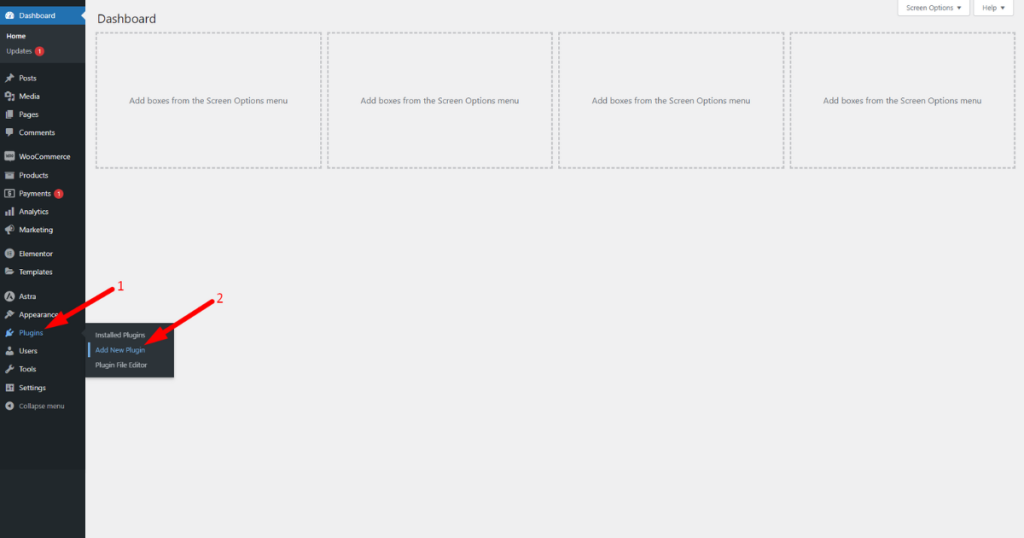
Installing and activating this plugin is super simple. First, log into your WordPress Admin Dashboard. Then, go to Plugins > Add New Plugin.
Afterward, search with the keyphrase “Food Menu” in the search field on the right side of the plugin repository.
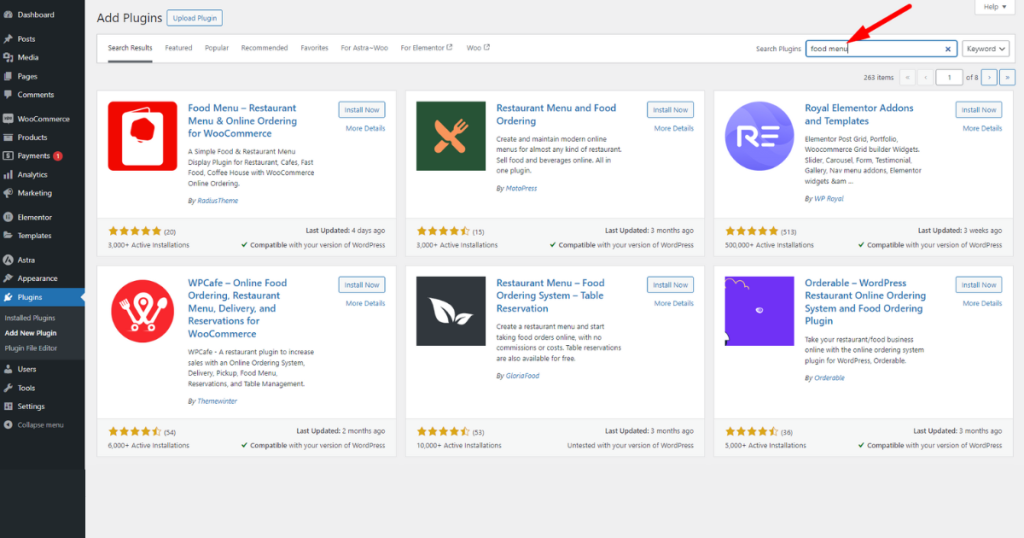
Now, navigate to the Food Menu free plugin by RadiusTheme and install and activate it.
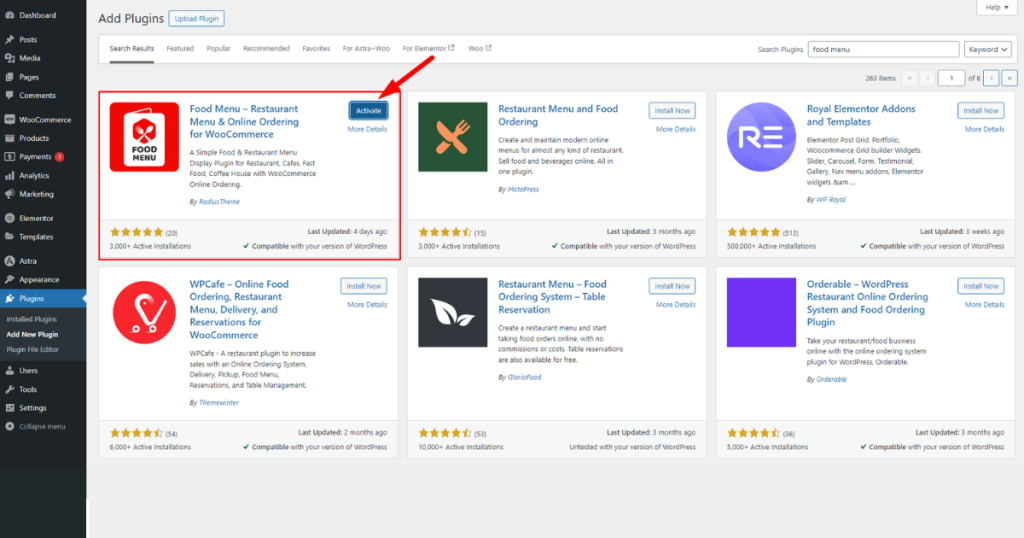
N:B: To have this plugin work smoothly on your restaurant website, you need to install and activate the WooCommerce plugin.
Step 3: Tweak Some Plugin Settings
After installing and activating the Food Menu plugin, you need to change some settings. For example, you need to set the currency to display with your food item and also want to control the visibility of food options displayed on the food details page.
Hence, head to the WordPress Admin Panel > Food Menu > Settings to accomplish these jobs.
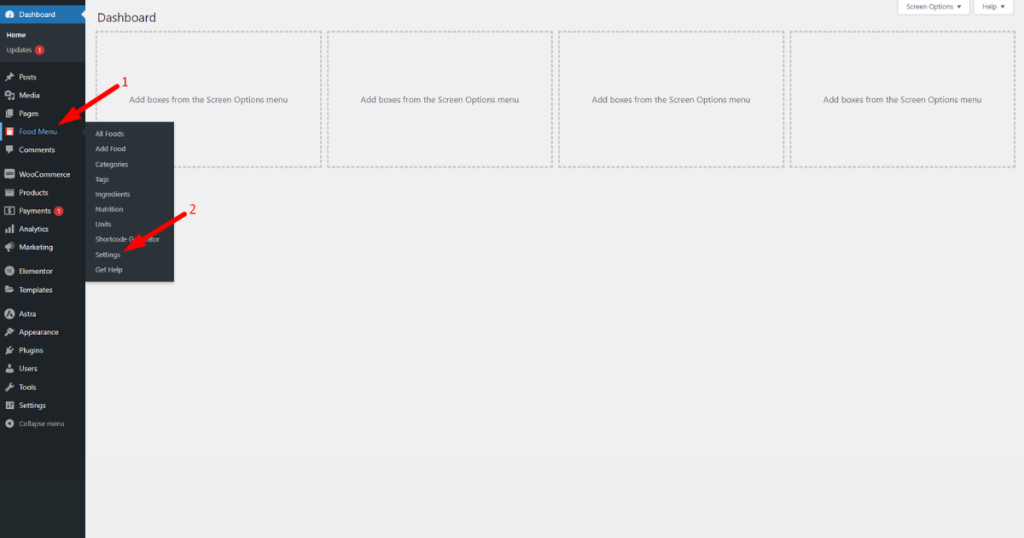
Then, ensure you are under the ‘General’ tab. Now, change the ‘Currency,’ ‘Currency Position,’ and other fields to fit your needs.
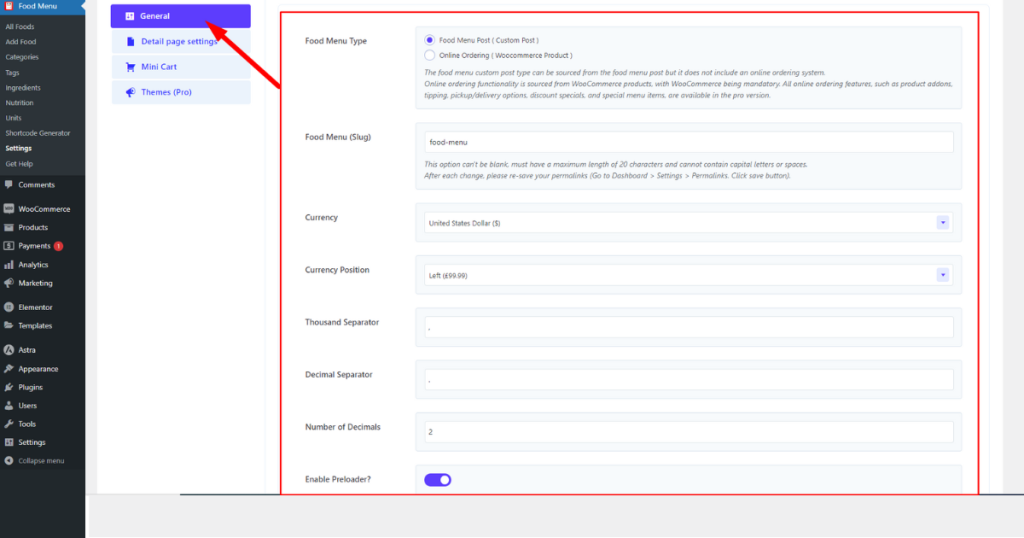
Afterward, click the “Save Changes” button.
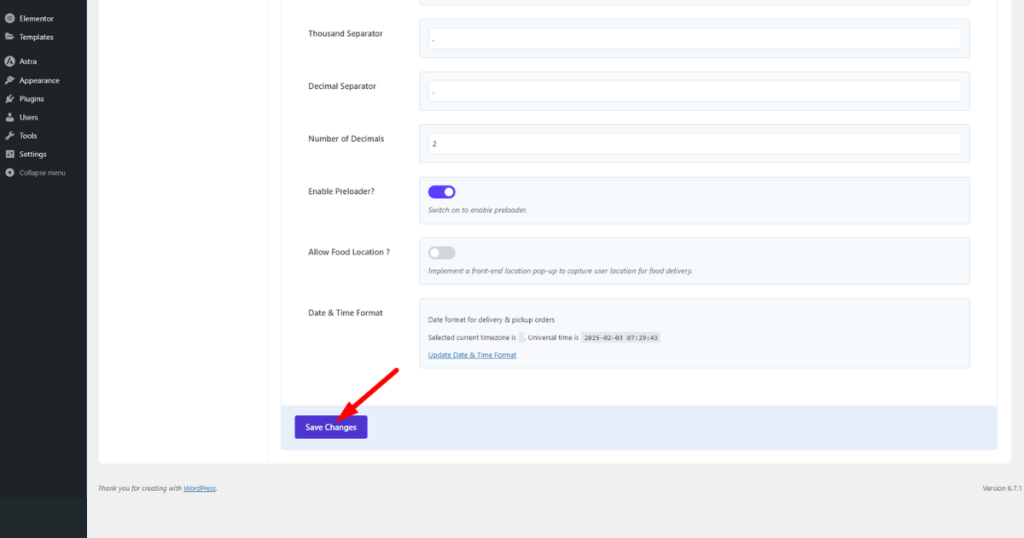
Head to the “Detail page settings” tab and check mark the food menu options you want to hide on the food details page.
Also, explore other options and hit the “Save Changes” button when you are okay with the settings.
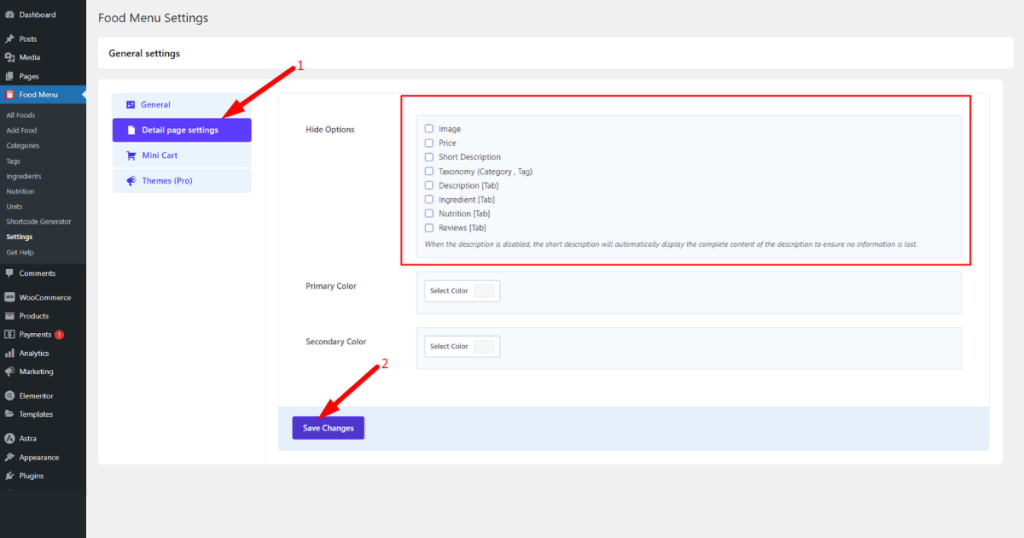
We encourage you to check other tabs of the Food Menu’s Settings and make necessary tweaks according to your requirements. If you need help along the way, read the documentation.
Step 4: Add a Category to the Food Menu
Before you create a food menu, it’ll be wise to build a food category first. To do so, navigate to the WordPress Admin Dashboard > Food Menu > Categories.
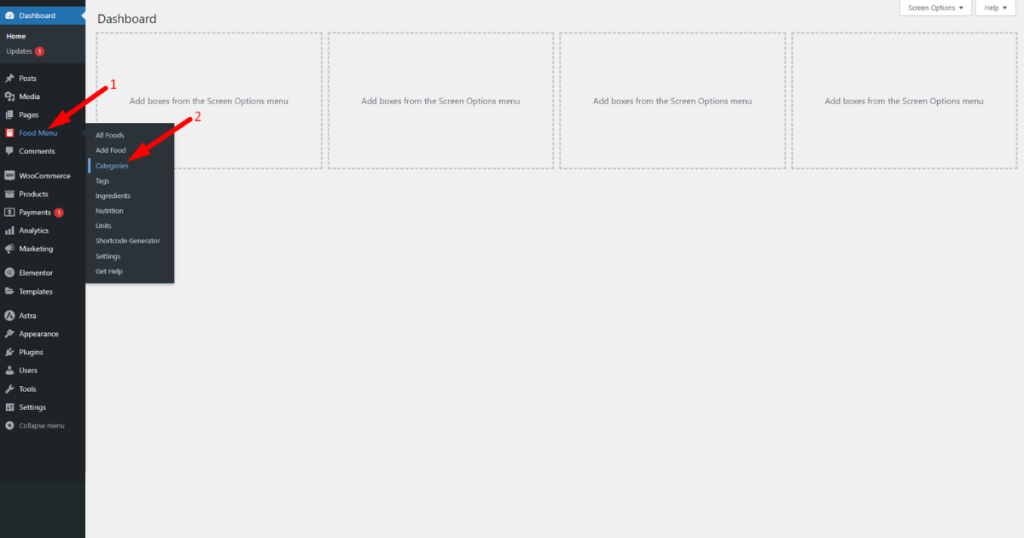
Then, give a name to the category, add a slug name, and click the “Add New Category” button.
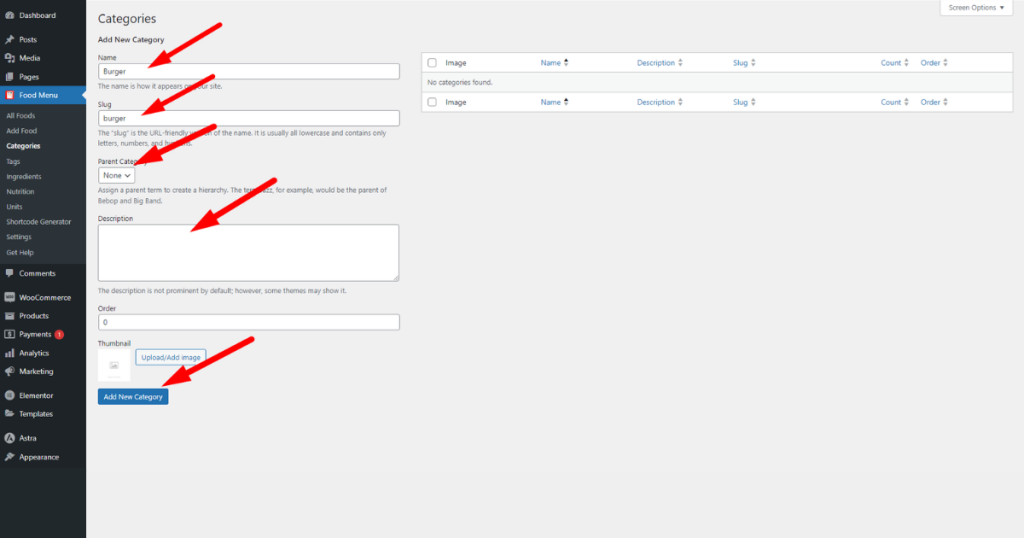
That’s it. We will now add other options related to the food menu.
Step 5: Add Ingredients, Nutrition, Tags, and Unit
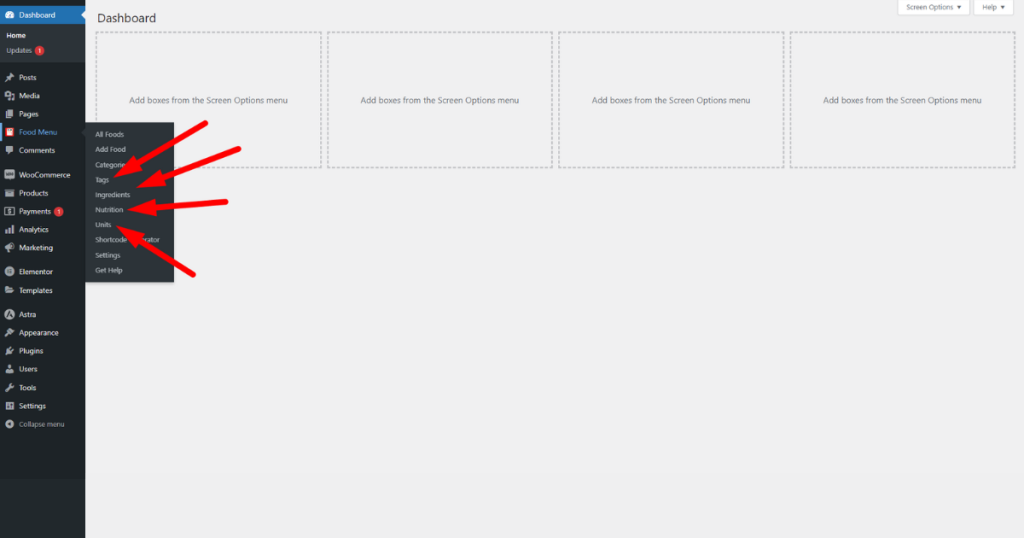
At this point, add food ingredients, nutritional information, tags, and units. You can add them by following the same steps you followed to add a new food category a moment ago.
Just head to each option from the Food Menu, fill in the necessary information that each menu will contain, and click the “Add New {Tag, Ingredient, Nutrition, Unit (the button name will appear with the corresponding menu name you are working on)}” button.
Step 6: Create a Food Menu
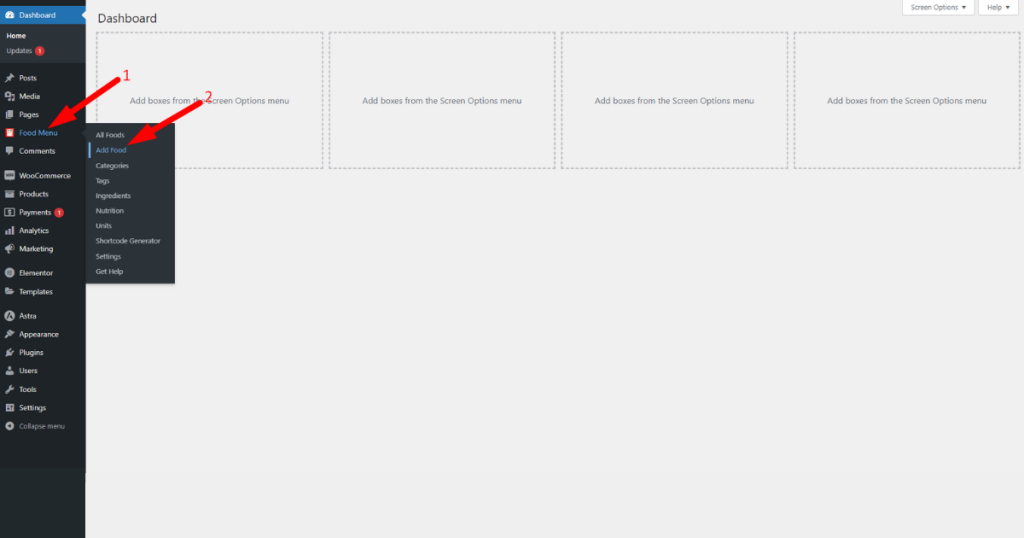
First, head to the WordPress Admin Panel > Food Menu > Add Food.
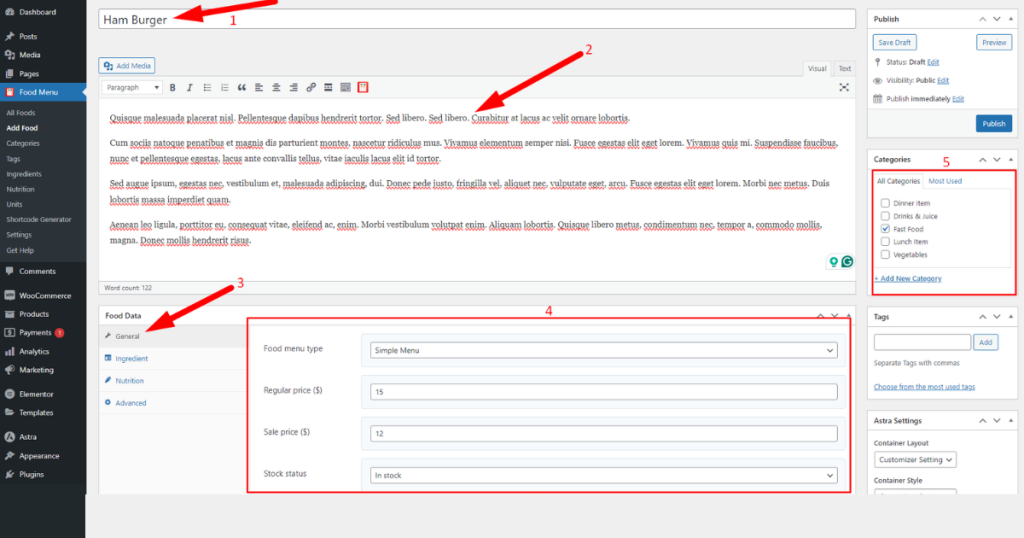
Then, write your food item name, fill in the food item description, include additional information such as food item price, ingredients, nutrition, and more under the Food Data section, and set the food item category.
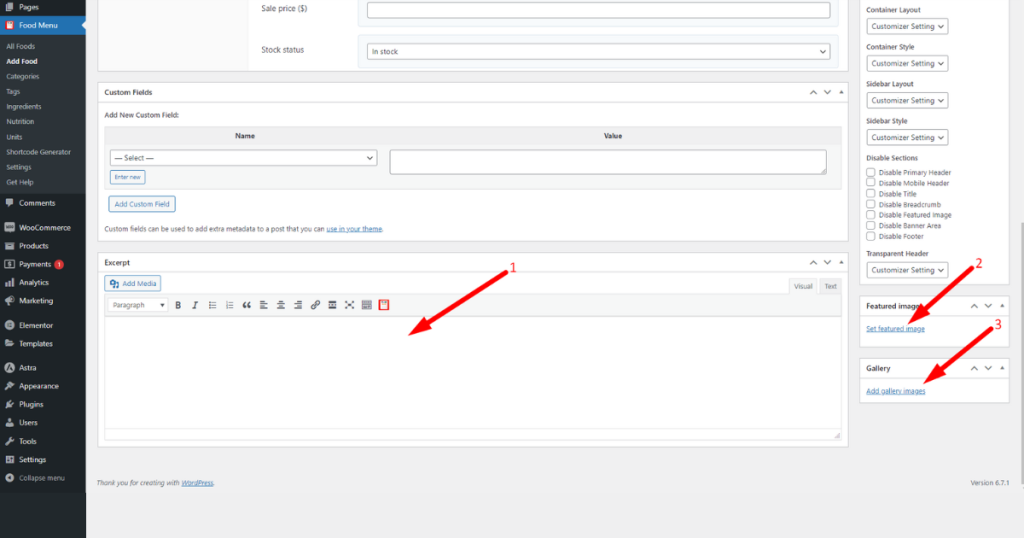
Afterward, scroll down, fill in the Excerpt data (short description of your food item), and add a Featured Image and the Gallery Images of your food item.
Finally, recheck everything and hit the ‘Publish’ button.
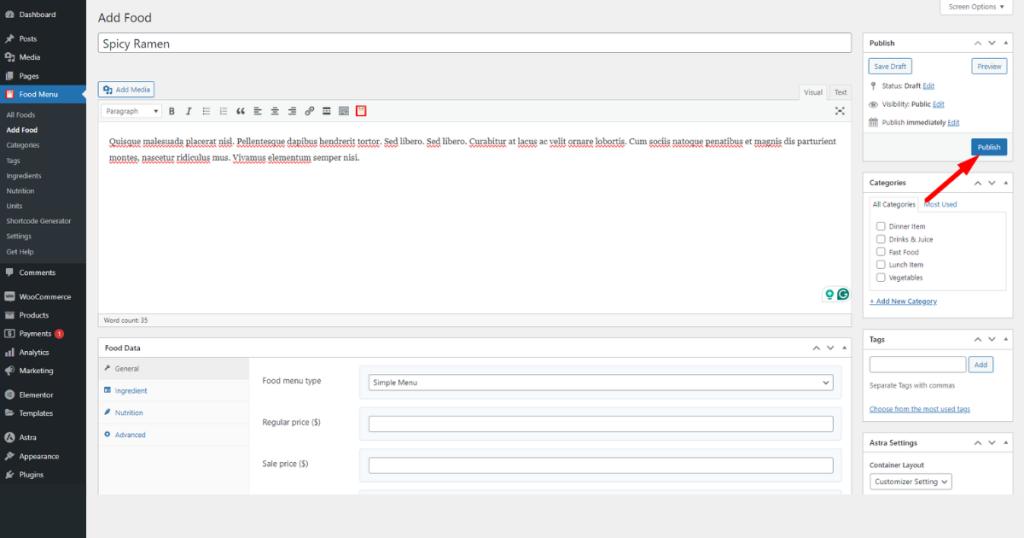
Congrats! You’ve just created a food menu. You now need to display it on your desired page. That’s what we are going to do next.
Step 7: Display Food Menu
Before you exhibit a food menu, you need to set the display layout and generate a shortcode. You may wonder why you need to do this.
The layout helps you professionally display the food menu, and a shortcode is required to showcase your desired menu on your preferred page. That said, let’s first generate a food menu shortcode.
Generate Food Menu Shortcode
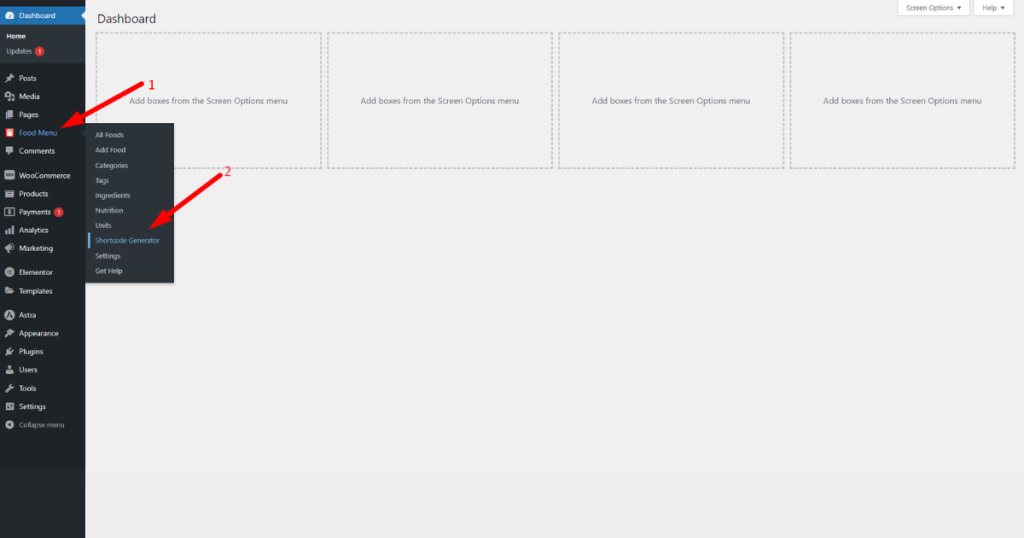
Navigate to the WordPress Admin Panel > Food Menu > Shortcode Generator.
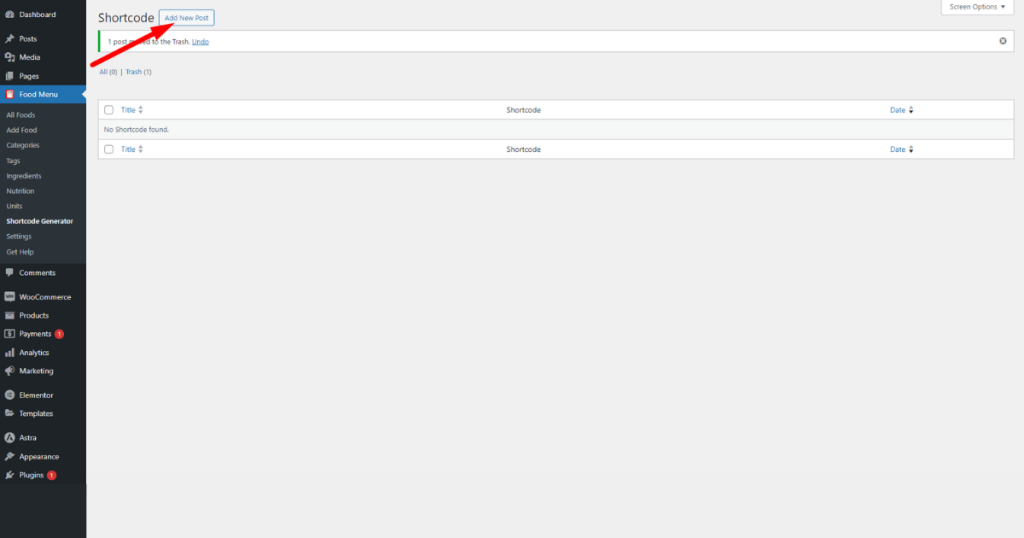
After that, click the “Add New Post” button.
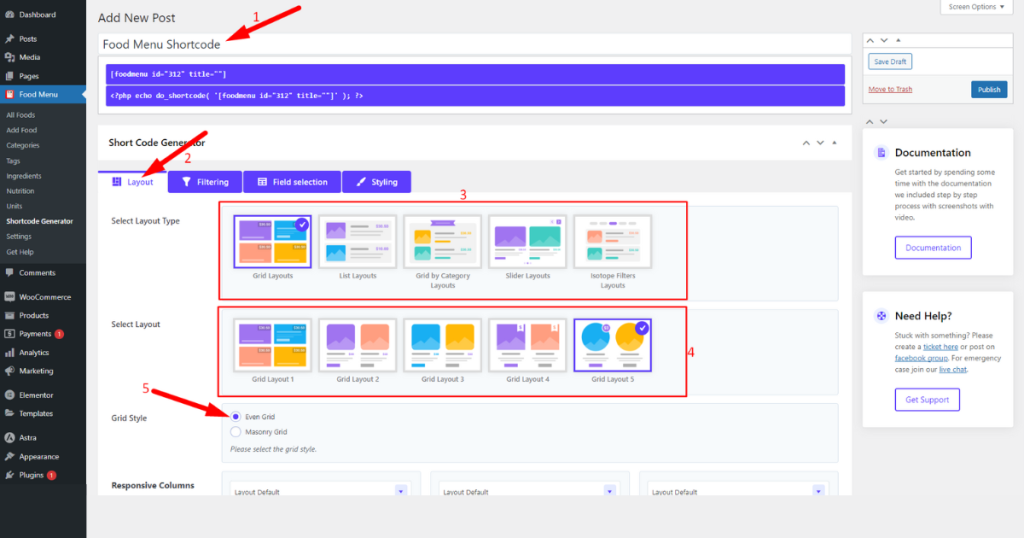
Now, give a title to your shortcode, head to the ‘Layout’ tab, select a layout type (Grid, List, Slider, and Isotope Filters), and choose a layout you like. Then, select a “Grid Style (Even and Masonry Grid).”
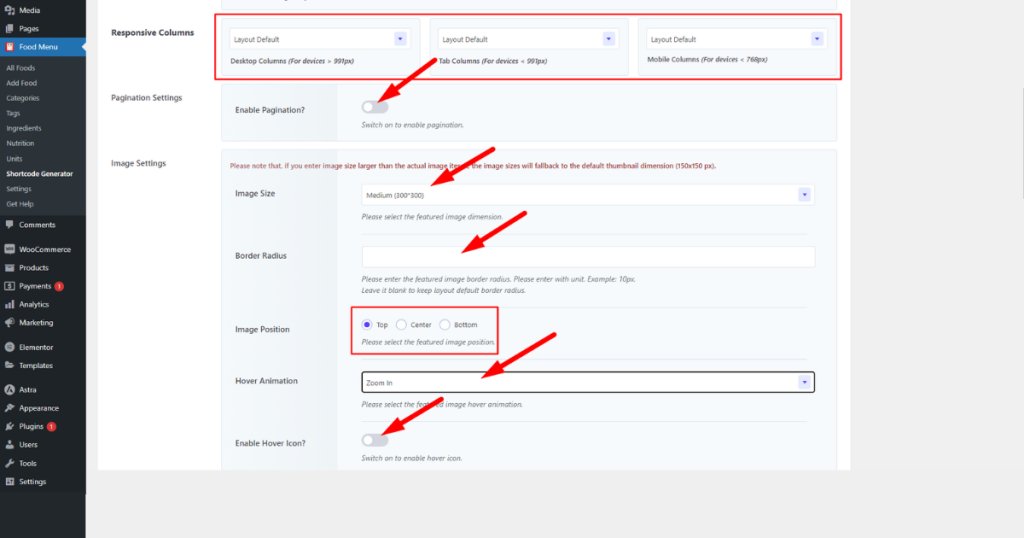
Scroll down and explore other functions under the ‘Layout’ tab. Here, you can work on the responsiveness of columns, enable pagination, tweak image settings, and more.
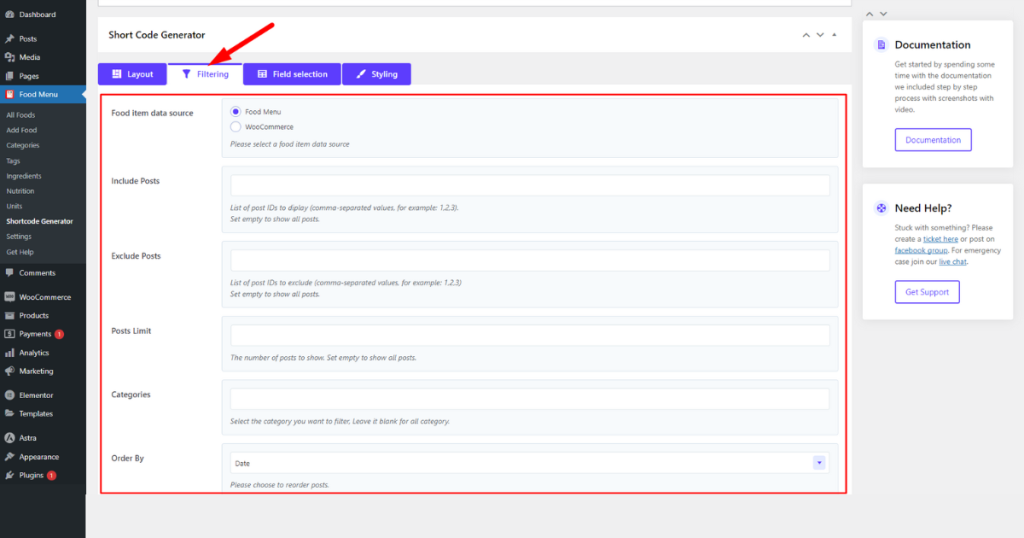
Once you have configured the ‘Layout’ tab, head to the ‘Filtering’ tab and explore each feature, such as “Food item data source,” “Include Posts,” “Exclude Posts,” etc.
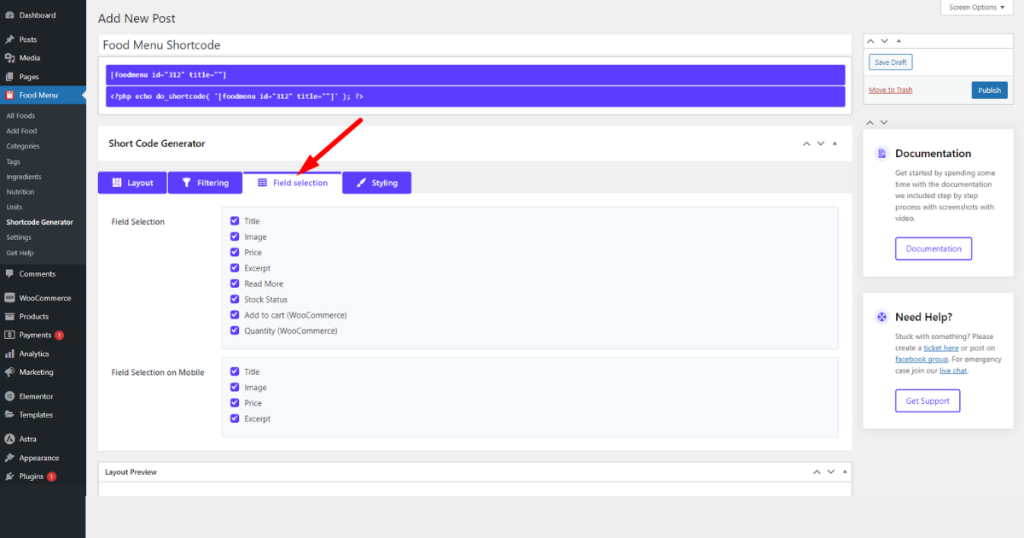
After working on the ‘Filtering’ tab, you can work on the “Field selection” tab to determine which menu fields you want to display across diverse devices.
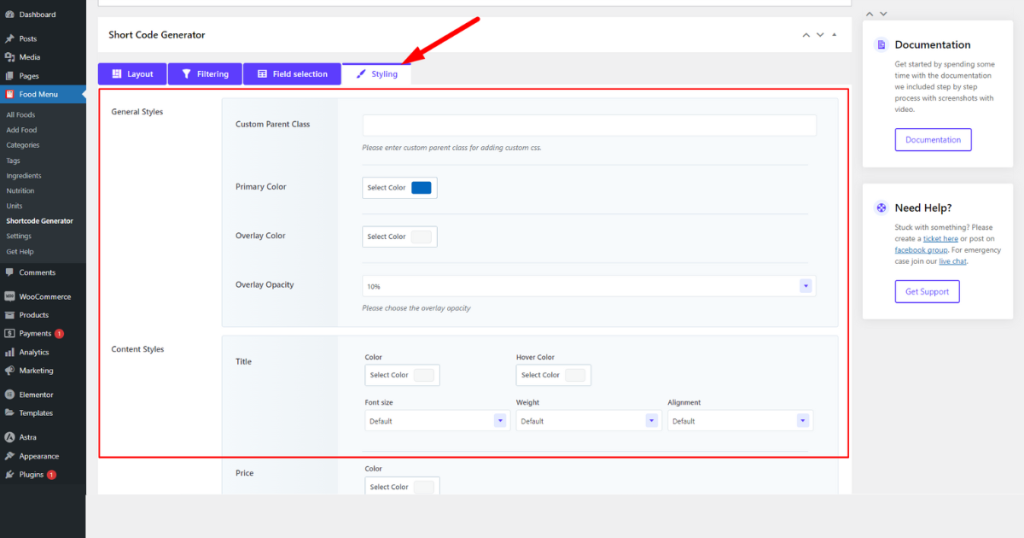
Afterward, head to the ‘Styling’ tab to stylize your food menu. This tab will let you change the primary color, font size, text color, style alignment, and accomplish many more tasks.
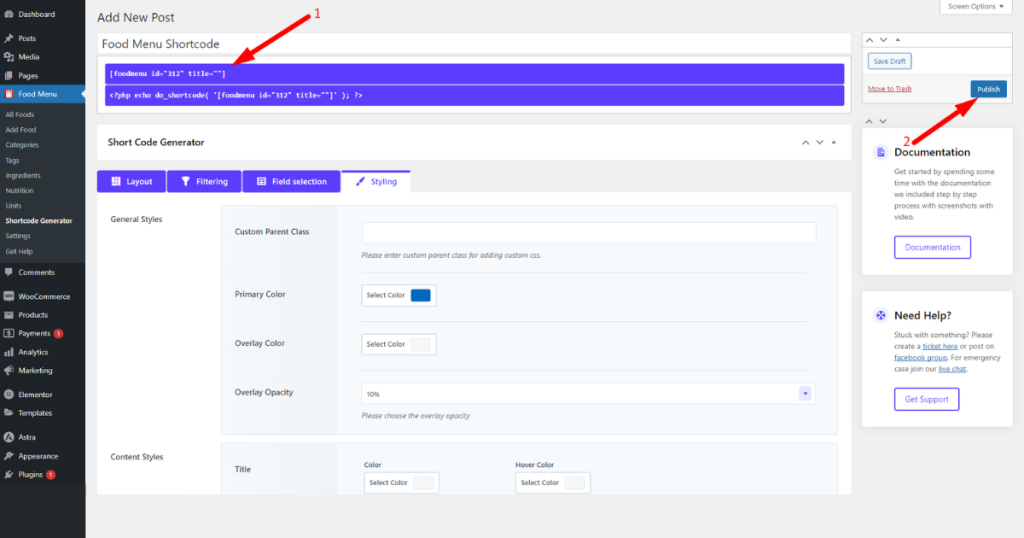
After working on all these tabs (it’s optional), copy the shortcode shown in the screenshot below, save it somewhere (Notepad) for later use, and hit the ‘Publish’ button.
Embed the Shortcode Into a Page
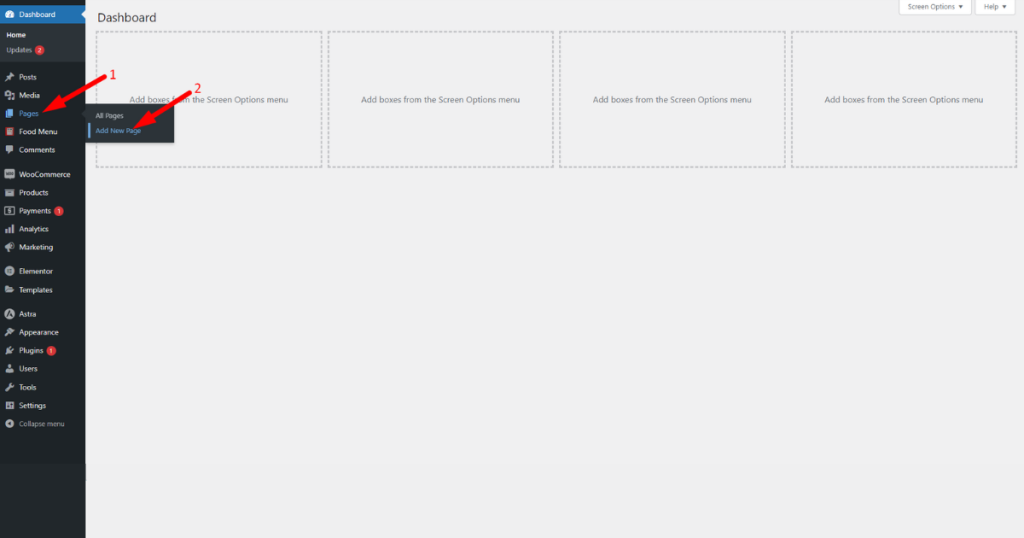
You now need to embed this shortcode into your preferred page. You can either select an existing page or create a new one. We’ll build a new page.
Hence, we go to the WordPress Admin Panel > Pages > Add New Page.
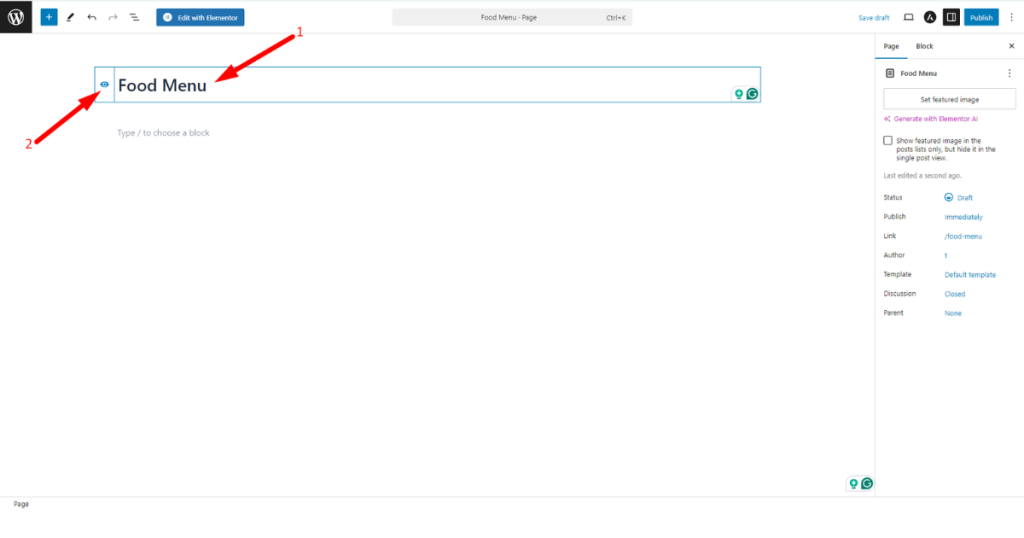
You’ll then see the Gutenberg block editor. Give your page a name and click the eye icon to control the visibility of the page title. You can turn it on to display the page title and turn the eye icon off to hide the page title.
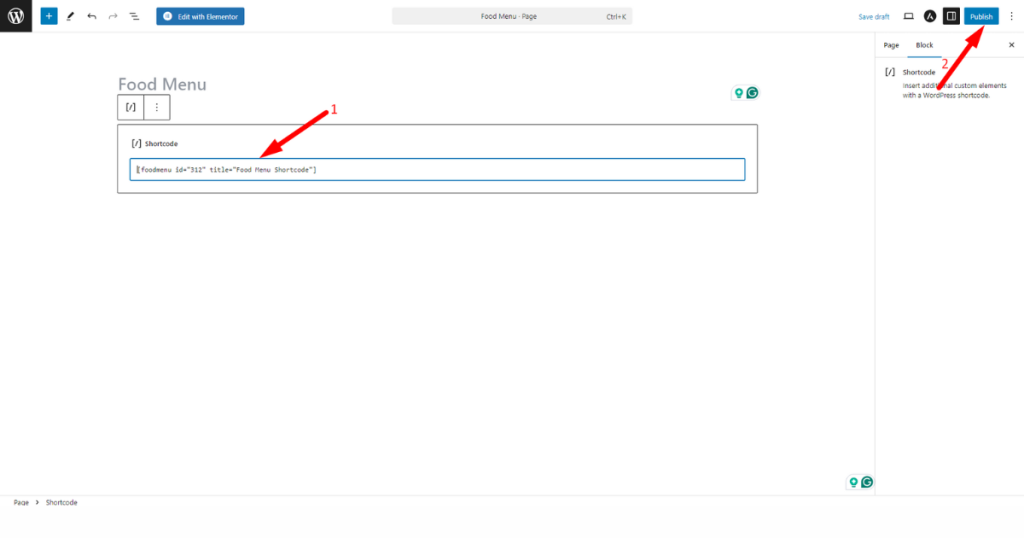
Paste the food menu shortcode we copied a while ago into a block of this page and click the ‘Publish’ button.
Voila! You’ve just created a food menu in WordPress and professionally displayed it on a page.
Now, visit the page and see how your food menu appears. Our one looks like the screenshot below.
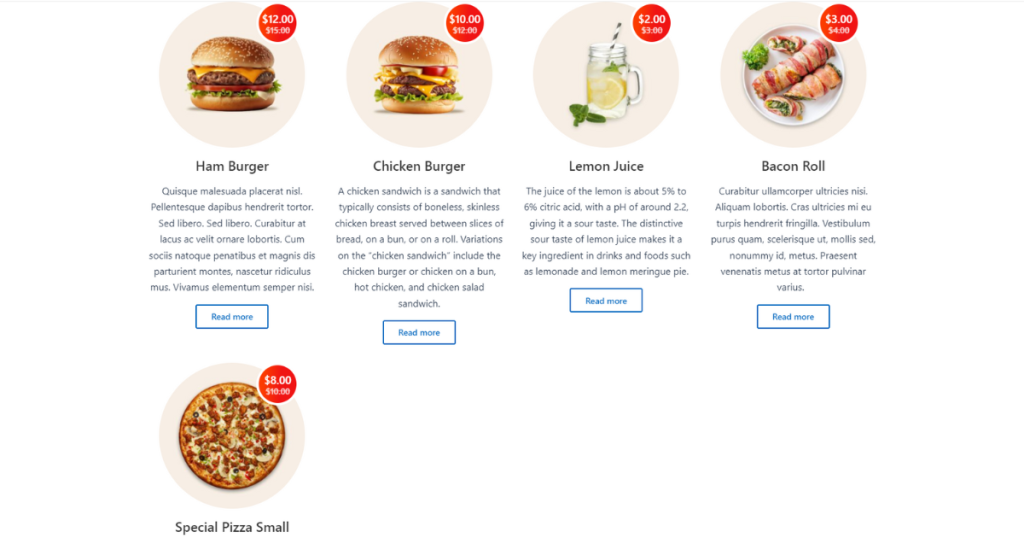
However, if you aren’t happy with the outlook of your food menu, we recommend using the best food delivery WordPress theme.
Bonus: Enable the Online Ordering System
Okay, you’ve successfully created a food menu in WordPress and exhibited it on a page. Now, enable the online ordering functionality on your restaurant website so that customers can place orders.
You can easily integrate this system with your site using one of the best restaurant menu WordPress plugins – Food Menu by RadiusTheme.
But make sure you have the pro version to enable the online ordering system on your restaurant website.
Now, let’s integrate the online ordering system with your site. Follow these steps.
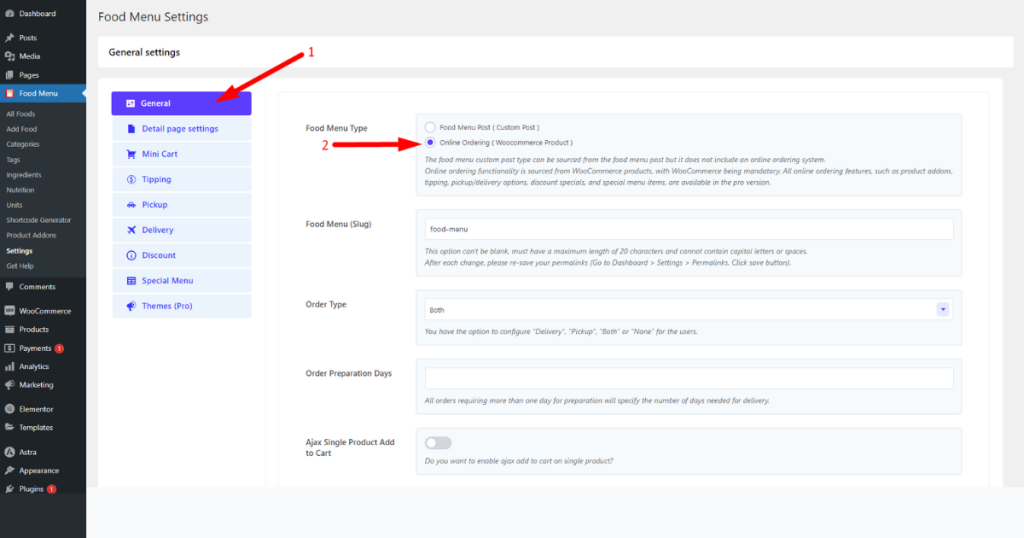
- Head to the WordPress Admin Dashboard > Food Menu > Settings.
- Ensure you are under the ‘General’ tab and select the “Food Menu Type” as “Online Ordering ( Woocommerce Product ).”
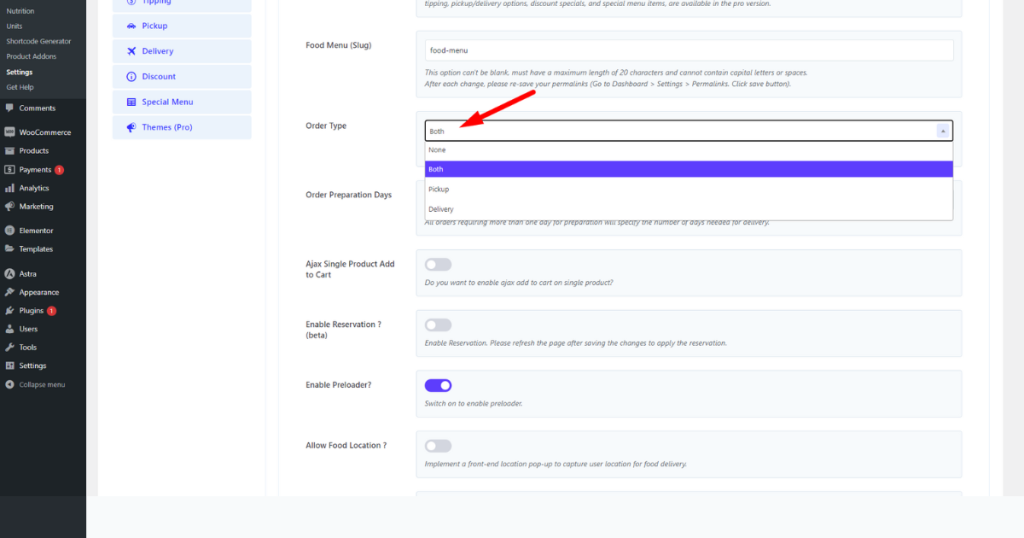
- Now, choose the “Order Type” according to your preferences.
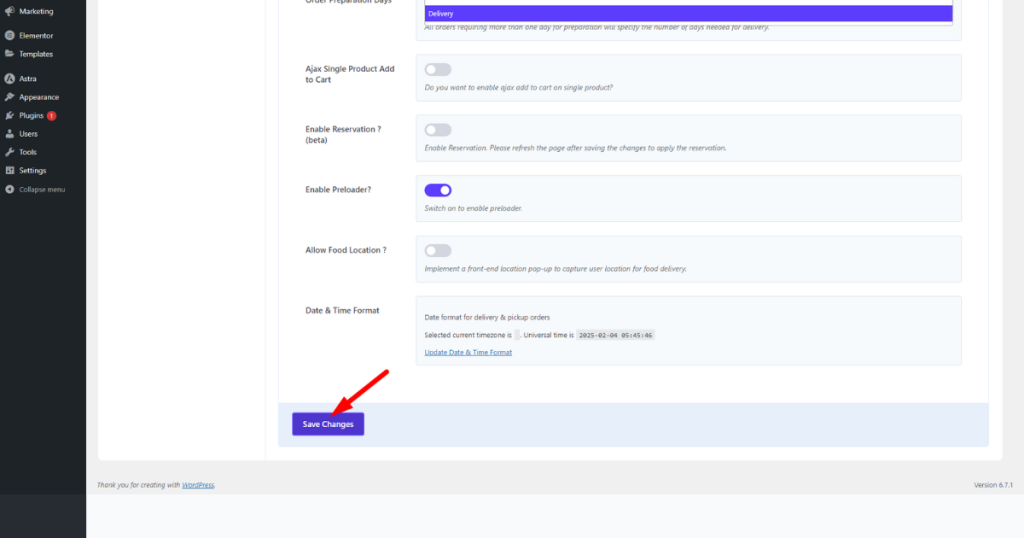
- After that, explore other options and hit the “Save Changes” button.
- You now need to read the Tipping documentation, Pickup documentation, and Delivery documentation and work accordingly.
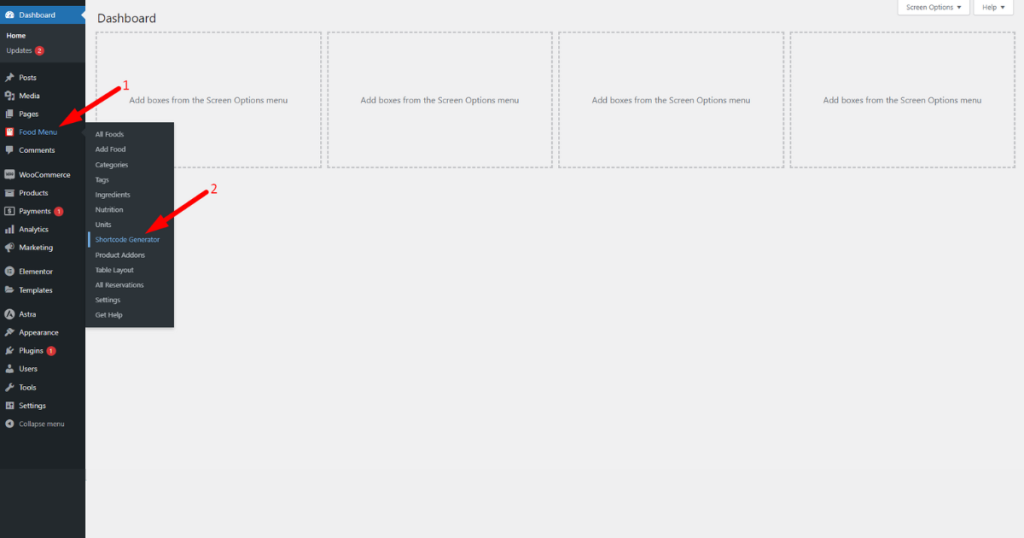
- Then, head to the WordPress Admin Dashboard > Food Menu > Shortcode Generator.
- Click the food menu shortcode you created earlier, navigate to the “Filtering” tab, choose ‘Woocommerce’ as the “Food item data source,” and hit the ‘Update’ button.
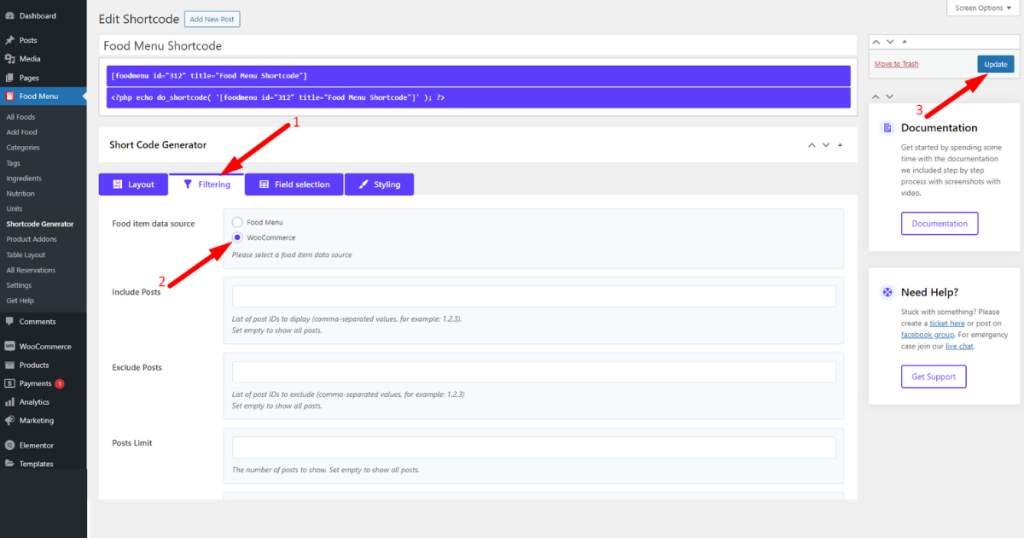
That’s it. You’ve successfully enabled online ordering on your restaurant website.
Remember, after integrating this functionality with the Food Menu Pro plugin, you need to add food items as WooCommerce products again.
If you’ve already added food items (without enabling the online ordering system) just for display purposes, those food items won’t have the online ordering functionality. That’s why you need to re-upload those food items as WooCommerce products.
Go to the WordPress Admin Panel > Products > Add new product to do so.

Then, add a food item by filling in all the necessary information. This is how you enable an online ordering system on your business website.
Wrapping Up
Running a food-related business online, including creating a food menu, can be challenging.
However, from now on, it will be easy if you read this article on “How to create a food menu in WordPress” and correctly follow all the steps outlined here.
Hence, that’s all with this article. We wish you the best of luck with your online food-related business.