
On This Page
What if you could build a billion-dollar marketplace without charging sellers a single cent?
That is exactly what Vinted has done. In just over a decade, this Lithuanian startup has grown from a simple clothing swap website into Europe’s largest secondhand fashion marketplace, with over 120 million registered users across 26 countries.
Vinted crossed the €1.1 billion revenue mark in 2025, generated a gross merchandise value (GMV) of €10.8 billion, and now carries a reported valuation of around €8 billion. All of this, while letting sellers list and sell for free.
So how does Vinted make money? In this guide, we will break down the Vinted business model, explore each of its revenue streams, look at what makes it different from competitors, and share practical lessons you can apply if you want to build your own buying-and-selling marketplace.
What Is Vinted?
Vinted is a peer-to-peer (C2C) online marketplace where individuals can buy, sell, and swap secondhand clothing, shoes, accessories, and home goods. The platform was co-founded in 2008 in Vilnius, Lithuania, by Milda Mitkutė and Justas Janauskas.
The idea was born out of a simple, relatable problem. Mitkutė was moving apartments and realized she had far too many clothes to take with her. Her friend Janauskas, a software developer, built a small website where she could offer her extra clothing to friends. That basic concept eventually evolved into one of the most successful C2C marketplaces in the world.
The company’s mission is to make secondhand the first choice worldwide. Its tagline, “Don’t wear it? Sell it!” captures the platform’s core philosophy of extending the life of clothing and reducing textile waste.
Today, Vinted operates as an ecosystem of businesses that includes:
- Vinted Marketplace – The core peer-to-peer resale platform
- Vinted Go – Logistics and shipping services with 500,000+ pick-up/drop-off points across Europe
- Vinted Pay – In-app payment solutions reducing reliance on third-party processors
- Vinted Ventures – An investment arm supporting the circular economy
The platform is headquartered in Vilnius, with offices in Berlin and Amsterdam, and employs around 2,500 people.
How Does Vinted Work?
Understanding the Vinted business model starts with understanding how the platform works for both sides of the transaction.
For Sellers
- Create a free account and set up your profile.
- Upload photos of items you want to sell, add descriptions, and set your price.
- Wait for a buyer. Your listings appear in search results and buyers’ personalized feeds.
- Ship the item. Once sold, Vinted generates a prepaid shipping label. Pack the item and drop it off.
- Get paid. After the buyer confirms the item arrived as described, the full sale amount is deposited into your Vinted wallet.
The crucial detail: sellers pay zero listing fees, zero commissions, and zero subscription fees. They keep 100% of the sale price.
For Buyers
- Browse or search by category, brand, size, price, and condition.
- Purchase an item. At checkout, you pay the item price + a buyer protection fee + shipping.
- Receive and review. Vinted holds payment in escrow until you confirm the item matches the description.
This escrow system is what makes the buyer protection fee feel worthwhile to shoppers. If something goes wrong—a damaged item, a missing package, or a product that does not match the listing—Vinted steps in with a refund.
How Does Vinted Make Money? (6 Revenue Streams)
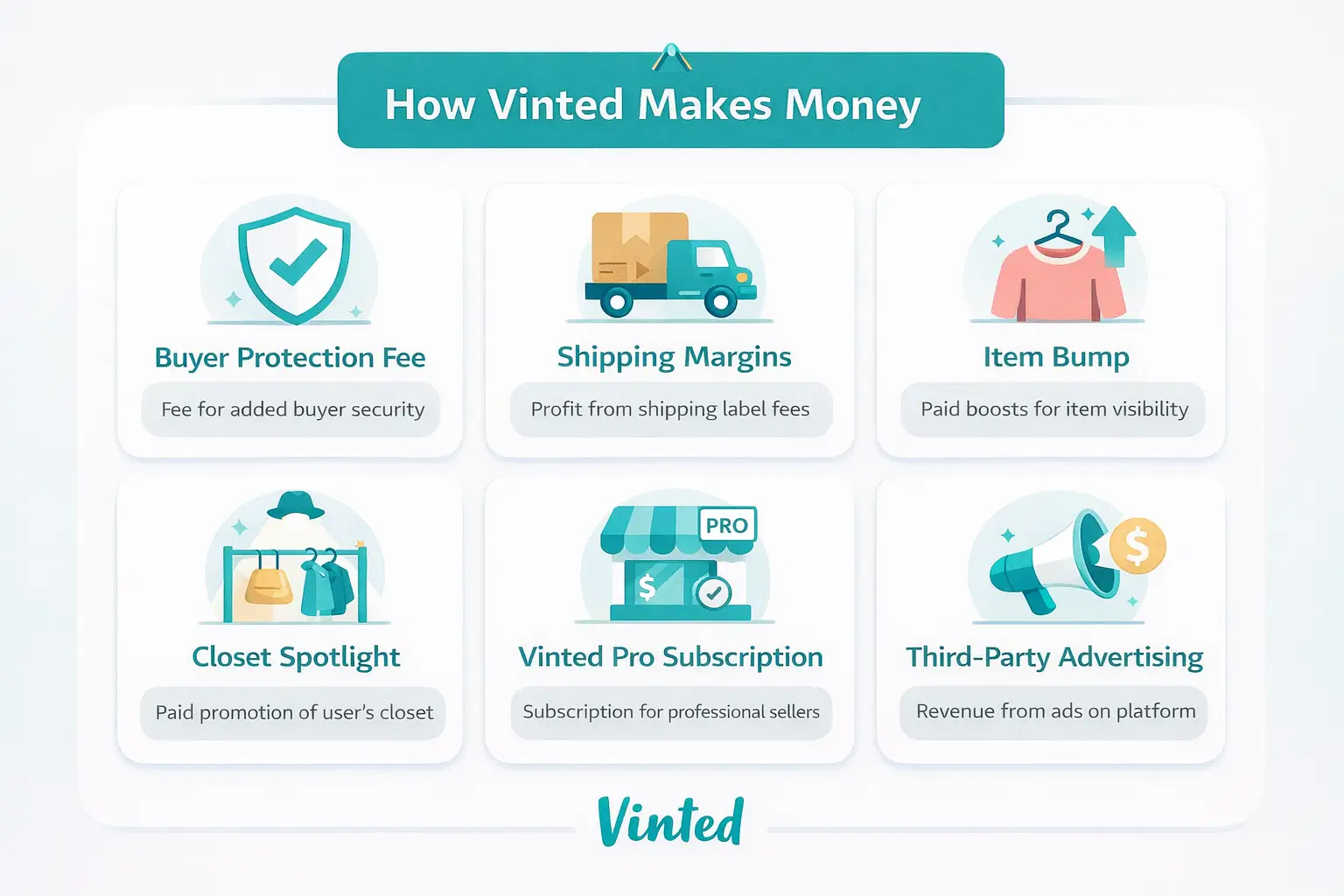
Since sellers pay nothing, all of Vinted’s revenue comes from fees charged to buyers, optional promotional tools for sellers, and advertising. Here is a detailed breakdown of each revenue stream.
1. Buyer Protection Fee
This is Vinted’s core revenue stream. Every purchase on the platform includes a mandatory buyer protection fee charged to the buyer. The fee structure is:
- Orders under €500: €0.70 fixed fee + 5% of the item price
- Orders €500 and above: 2% of the item price
For example, if a buyer purchases a jacket listed at €50, they would pay €0.70 + €2.50 = €3.20 in buyer protection fees, on top of the item price and shipping.
This fee covers secure payment processing, fraud prevention, dispute resolution, refunds for damaged or lost items, and dedicated customer support. From Vinted’s perspective, it acts similarly to a commission—but because it is framed as a protection service for the buyer, it does not discourage sellers from joining the platform.
2. Shipping Margins
Buyers pay all shipping costs on Vinted purchases. Behind the scenes, Vinted negotiates bulk shipping rates with carriers across its markets. The platform then charges buyers a standard shipping rate and retains the difference as margin.
Additionally, Vinted has built its own logistics network, Vinted Go, which provides access to over 500,000 pick-up and drop-off points across Europe. By 2025, Vinted Go was active in five markets (Belgium, France, the Netherlands, Spain, and Portugal) and opened a new sortation centre in France. This vertical integration further improves margins.
3. Item Bump
Sellers who want more visibility for a specific listing can pay for an Item Bump. This feature pushes a listing higher in search results and category feeds for a chosen period.
- Duration: 3 or 7 days
- Cost: Typically $0.75 to $3.00, depending on category and demand
When an item sells during the bump period, the promotion ends automatically. This is entirely optional and does not affect a seller’s ability to list or sell.
4. Closet Spotlight
While Item Bump promotes a single listing, Closet Spotlight promotes a seller’s entire wardrobe. For $6.95, five items from a seller’s catalog are automatically selected and displayed in special spots on buyers’ news feeds for seven days.
This feature is particularly useful for sellers with large inventories who want to drive attention to their overall collection rather than individual pieces.
5. Vinted Pro Subscription
For high-volume sellers, Vinted offers a subscription plan at $9.95 per month. This includes bulk listing tools, advanced analytics, and a permanent Closet Spotlight. It is designed for users who treat reselling as a side business or income stream rather than just clearing out their closets.
6. Third-Party Advertising
Vinted allows external advertisers to display ads on news feeds and listing pages through a self-service advertising platform. Advertisers can register, create campaigns, and set budgets. Vinted likely charges based on impressions and clicks, though exact pricing is not publicly disclosed.
Revenue Streams at a Glance
| Revenue Stream | How It Works | Who Pays |
| Buyer Protection Fee | €0.70 fixed + 5% of item price per transaction (under €500). 2% for orders €500+. | Buyer (mandatory on every purchase) |
| Shipping Margins | Vinted negotiates bulk rates with carriers and retains a small margin on prepaid shipping labels. | Buyer pays shipping; Vinted keeps the margin |
| Item Bump | Sellers pay $0.75–$3.00 to push a single listing higher in search results for 3 or 7 days. | Seller (optional) |
| Closet Spotlight | For $6.95, five items from a seller’s wardrobe appear in special feed spots for 7 days. | Seller (optional) |
| Vinted Pro Subscription | $9.95/month subscription for high-volume sellers. Includes bulk listing tools, analytics, and permanent spotlight. | Seller (optional) |
| Third-Party Advertising | Advertisers serve ads on news feeds and listing pages via a self-service campaign platform. | Advertisers |
Vinted by the Numbers: Key Financial Milestones
| Year | Milestone |
| 2008 | Founded in Vilnius, Lithuania by Milda Mitkutė and Justas Janauskas. |
| 2012 | Launched mobile app; expanded into Germany. |
| 2013 | Series A funding: €5.2M raised for early expansion. |
| 2016 | Thomas Plantenga joined as CEO; major business model overhaul began. |
| 2019 | Raised €128M at €1B valuation; became Lithuania’s first tech unicorn. |
| 2021 | Series F: €250M raised at €3.5B valuation. Launched in Canada. |
| 2023 | First annual profit (€17.8M net income). Revenue: €596M. 100M+ users. |
| 2024 | Revenue reached €813M. Quadrupled net profit. Valued at €5B. |
| 2025 | Revenue crossed €1.1B. GMV hit €10.8B (+47% YoY). 120M+ users across 26 markets. |
In 2025, Vinted’s revenue grew 38% year-over-year to cross the €1.1 billion mark, while net profit came in at €62 million. Net profit declined 19% from 2024 levels because the company invested heavily in expanding into Germany, rolling out Vinted Pay’s wallet, and entering new markets like Latvia, Estonia, and Slovenia.
The total funding raised by Vinted across seven rounds stands at approximately $949 million, with key investors including Lightspeed Venture Partners, EQT Growth, Accel, and Insight Partners.
What Makes Vinted’s Business Model Different?
The secondhand fashion marketplace is competitive. Depop, Poshmark, eBay, ThredUp, and dozens of regional players all operate in this space. So what sets Vinted apart?
Zero Seller Fees Creates a Flywheel Effect
By removing every possible cost for sellers—no listing fees, no commissions, no mandatory subscriptions—Vinted lowers the barrier to entry dramatically. This attracts a large volume of sellers, which in turn creates a massive, diverse inventory. More inventory means more buyers. More buyers mean more transactions. More transactions mean more buyer protection fees for Vinted.
This zero-fee-for-sellers approach is the engine behind Vinted’s growth flywheel. It is also what forced competitors like eBay to reconsider their own seller fee structures in certain markets.
Shifting the Cost to the Buyer
Most marketplaces charge sellers because sellers are the ones making money. Vinted flips this by charging buyers. The key insight is that buyers are generally more accustomed to paying extra fees in e-commerce, especially when those fees are framed as a value-add service (buyer protection, secure payments, dispute resolution).
For sellers, the psychology is powerful: “I keep 100% of my sale price.” That message drives sign-ups and listings.
Vertical Integration with Shipping and Payments
Rather than relying entirely on third-party providers, Vinted has invested in building its own logistics network (Vinted Go) and payment infrastructure (Vinted Pay). This gives the company more control over the user experience, higher margins, and better data on how transactions flow through the platform.
Vinted vs. Competitors: How Do They Compare?
| Feature | Vinted | Depop | Poshmark | eBay |
| Seller Listing Fee | Free | Free | Free | Free (limited) |
| Seller Commission | 0% | 10% | 20% | 10–13% |
| Buyer Fee | €0.70 + 5% | None | None | None |
| Buyer Protection | Included in fee | Via PayPal | Included | eBay Guarantee |
| Primary Focus | Secondhand fashion | Fashion / streetwear | Fashion resale | General marketplace |
| Registered Users | 120M+ | 35M+ | 80M+ | 130M+ |
The key takeaway from this comparison is that Vinted is the only major platform that charges buyers instead of sellers. This fundamental difference in fee structure drives its competitive advantage in attracting sellers and building supply.
How Vinted Grows: Marketing and Expansion Strategy
Vinted uses a combination of strategies to acquire users and enter new markets.
TV Advertising with a Simple Message
Vinted runs frequent television commercials across European markets with a straightforward pitch: turn your unused clothes into cash. The simplicity of the message—combined with the promise of zero seller fees—makes it highly effective for user acquisition.
Word of Mouth and Referrals
The free-to-sell model naturally encourages word of mouth. When someone successfully sells an item and keeps every cent, they tend to tell friends and family. This organic growth has been a significant driver in markets like Lithuania, France, and the UK.
Geographic Expansion Through Acquisitions
Vinted has aggressively expanded by acquiring local competitors:
- Chicfy (Spain, 2019)
- United Wardrobe (Netherlands, 2020)
- Kleiderkreisel/Mamikreisel (Germany, 2020 – rebranded to Vinted)
- Rebelle (premium secondhand, 2022)
- Homerr (Dutch delivery company, 2023)
- Trendsales (2024)
This acquisition strategy lets Vinted quickly absorb existing user bases rather than building from scratch in each new market.
Mobile-First Approach
Vinted’s app is designed to feel like a social media feed. Users can follow sellers, like items, leave comments, and receive personalized recommendations. This social, mobile-first experience drives engagement and repeat usage.
5 Lessons from the Vinted Business Model
If you are thinking about building a classified ads or buying-and-selling marketplace, the Vinted business model offers several practical takeaways.
1. Remove Barriers for the Supply Side
Vinted’s zero-fee policy for sellers is the single most important decision in its business model. When you eliminate costs for the supply side (sellers), you encourage more people to list items. More listings create more choice for buyers. More buyers generate more transactions. And transactions are where your revenue comes from.
If you are building a classified listing website, consider offering free listings to sellers as a starting strategy. Tools like the Classified Listing plugin for WordPress let you set up a fully functional marketplace where you control which fees to charge and which to waive.
2. Charge Mandatory Fees That Deliver Clear Value
Vinted does not hide its buyer protection fee. It is presented openly at checkout and clearly explained: you are paying for secure payments, fraud protection, and refund guarantees. Buyers accept this because they see it as insurance, not a tax.
When monetizing your own marketplace, tie fees to tangible value. If you charge a service fee, make sure users understand exactly what they are getting. You can build a similar classified ads marketplace with WordPress and configure payment gateways and service fees to match your business model.
3. Diversify Your Revenue Streams
Vinted does not depend on a single source of income. It combines transaction fees, shipping margins, optional seller tools, subscriptions, and advertising into a multi-layered revenue model. This diversification makes the business more resilient.
For your own classified website, consider implementing multiple monetization methods. You can offer featured listings, membership plans for professional sellers, ad placements, and transaction-based fees. Learn more about how to earn money from a directory website.
4. Invest in Trust and Safety
Trust is the foundation of any C2C marketplace. Vinted’s escrow system, buyer protection service, and fraud prevention measures give buyers the confidence to purchase secondhand items from strangers online. Without trust, no marketplace can scale.
When you build your own marketplace, prioritize trust features from day one. This includes user verification, review systems, secure payment processing, and dispute resolution. Our guide on how to secure a classified website covers best practices for keeping your marketplace safe.
5. Think Beyond the Marketplace
Vinted has expanded into logistics (Vinted Go), payments (Vinted Pay), and venture investing (Vinted Ventures). These moves increase margins, improve user experience, and create new revenue opportunities. As your marketplace grows, look for adjacent areas where you can add value and capture more of the transaction.
Ready to Build Your Own Buying-and-Selling Marketplace?
The Vinted business model proves that you do not need to charge sellers to build a profitable marketplace. With the right platform, monetization strategy, and trust mechanisms, you can create a thriving online marketplace for any niche—whether it is secondhand fashion, electronics, vehicles, real estate, or local services.
If you want to build a marketplace similar to Vinted using WordPress, the Classified Listing by RadiusTheme gives you everything you need:
- Free and paid listing options you can customize
- Built-in membership and pricing plan support
- Secure payment gateway integrations
- Advanced search and filtering for buyers
- Seller verification and review systems
- Mobile-responsive design for a seamless user experience
Check out our step-by-step guide on how to create a classified website with WordPress to get started today.
Frequently Asked Questions
Is Vinted really free for sellers?
Yes. Sellers pay no listing fees, commissions, or mandatory subscriptions. They keep 100% of the sale price. Optional paid tools like Item Bump and Closet Spotlight exist but are not required.
How much does the Vinted buyer protection fee cost?
For orders under €500, buyers pay a fixed fee of €0.70 plus 5% of the item price. For orders €500 and above, the fee drops to 2% of the item price.
Is Vinted profitable?
Yes. Vinted reported its first annual net profit of €17.8 million in 2023. The company quadrupled that profit in 2024 and generated €62 million in net profit in 2025 on revenue of €1.1 billion.
How many users does Vinted have?
As of 2025, Vinted has over 120 million registered users across 26 markets, primarily in Europe with a growing presence in North America.
What countries does Vinted operate in?
Vinted operates across much of Europe, including Germany, France, the UK, Spain, Italy, the Netherlands, Poland, Belgium, and the Baltic states, and has expanded into Canada and the United States.