
On This Page
A marketplace business model is a way to run a platform where buyers and sellers meet. The platform earns money from fees, commissions, or ads. You do not need to own the products or handle the shipping.
This guide covers every marketplace model that works in 2026. You will learn how each one makes money, when to use it, and real examples you can copy.
What Is a Marketplace Business Model?
A marketplace business model is a plan for making money by connecting buyers with sellers. The platform owner is the middleman. You do not sell your own stock. You run the place where others sell.
Think of it like a mall. You do not own the shops. You own the building and charge rent or take a small cut of each sale.
Every marketplace needs three things:
- Buyers who want to purchase
- Sellers who want to list items or services
- A trust system that keeps both sides safe
How Do Marketplaces Make Money?
Most marketplaces use one or more of these six income streams:
- Commission – A percent of each sale
- Listing fee – A charge for posting items
- Subscription – A monthly or yearly access fee
- Featured ads – Extra payment to boost a listing
- Lead fees – A fee for each buyer contact
- Freemium – Free basic use, paid upgrades
Each one fits a different kind of marketplace. The right pick depends on your niche, your users, and your budget.
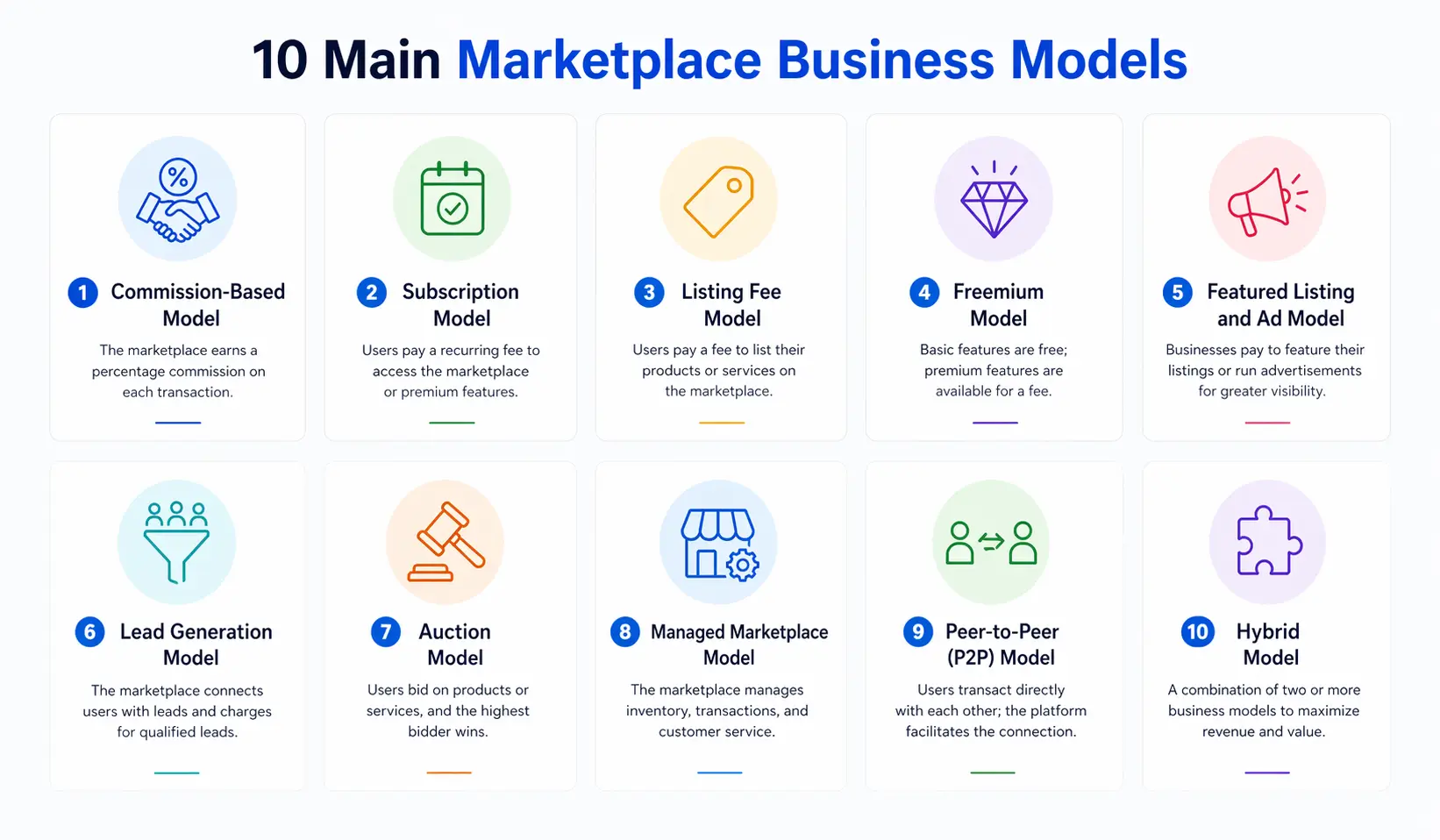
The 10 Main Marketplace Business Models
1. Commission-Based Model
The platform takes a cut from every sale. The cut is usually 5% to 20%.
How it works: A seller lists an item for $100. A buyer pays $100. The platform keeps $10 (10%) and sends $90 to the seller. No sale means no fee.
Commission rates by niche:
- Real estate and high-ticket goods: 1% to 3%
- Physical goods: 5% to 15%
- Services and freelance work: 10% to 30%
- Digital goods: 15% to 30%
- Rare or luxury items: 10% to 20%
What you need to run it: A secure payment system, clear seller payouts, and a strong refund policy.
- Best for: Platforms with high sales volume
- Examples: eBay, Etsy, Airbnb, Uber, Fiverr
- Pros: Income grows with every sale. Sellers only pay when they earn.
- Cons: You need many active users before it pays well. Slow to reach real income.
- Tip: Start at 5% to 10%. Raise it later once sellers see clear value.
2. Subscription Model
Users pay a set fee each month or year. They get access to buyers, sellers, or tools.
How it works: A seller signs up for $29 per month. They get unlimited listings, buyer data, and extra tools. They pay even if they do not make a sale that month.
Common price tiers:
- Basic: $9 to $19 per month
- Pro: $29 to $79 per month
- Enterprise: $199 and up per month
What to include in paid tiers:
- Lower commission rates
- More listings each month
- Analytics and sales reports
- Verified seller badges
- Early access to buyers or leads
What you need to run it: Billing tools like Stripe, clear tier features, and a strong reason for sellers to stay.
- Best for: Niche or high-value markets where sellers earn enough to cover the fee
- Examples: LinkedIn Premium, ZipRecruiter, Houzz Pro, Amazon Seller Pro
- Pros: Steady and easy to predict. Builds strong user loyalty.
- Cons: Hard to get users to pay before they see value. Churn can hurt badly.
- Tip: Offer a 7 to 14 day free trial. Watch your cancel rate every month.
Good Read: Best Membership Plugins for WordPress
3. Listing Fee Model
Sellers pay a small fee to post each item. This is common on classified sites.
How it works: A seller pays $0.20 to list one item. The listing stays live for 30, 60, or 90 days. The seller pays again to renew.
Common fee types:
- Flat fee per listing: $0.20 to $5
- Category fees: Higher for cars, real estate, or jobs
- Duration fees: Pay more for longer live time
- Re-listing fees: Charge again after the listing expires
What you need to run it: A simple pay wall before the listing goes live, and clear rules on refunds for unsold items.
- Best for: Classifieds and local marketplaces with high listing volume
- Examples: eBay (insertion fee), AutoTrader, many job boards
- Pros: Simple pricing. Sellers know the cost upfront.
- Cons: Sellers may post fewer items to save money. Income depends on volume.
- Tip: Give the first 3 to 5 listings free each month. This keeps casual sellers active and brings in more buyers.
4. Freemium Model
Basic use is free. Extra features cost money.
How it works: Anyone can sign up, browse, and make basic listings free. Premium tools cost a monthly fee or a one-time charge.
What to lock behind the paywall:
- Unlimited listings (free gets 5 per month)
- Featured placement in search
- Buyer contact details
- Analytics and sales reports
- Lower commission rates
- Verified seller badges
Typical paid conversion rate: 2% to 5% of free users turn into paying users.
What you need to run it: A strong free tier, clear value on the paid tier, and upgrade prompts at the right moments.
- Best for: Growing a big user base fast before charging
- Examples: Fiverr, Upwork, Canva Marketplace, Patreon
- Pros: Low barrier to sign up. Network effects kick in fast.
- Cons: Most users never pay. You need millions of users to earn well from 2% to 5%.
- Tip: Keep the free tier useful, not broken. Paid features should feel like a natural next step.
5. Featured Listing and Ad Model
Sellers pay to push their items to the top of search results or the homepage.
How it works: A seller pays $5 to show their item at the top of a category for 7 days. Or they pay each time a buyer taps their ad.
Common ad types:
- Top placement for a set time (flat fee)
- Homepage feature (flat fee)
- Category boost (flat fee)
- Pay-per-click ads (CPC)
- Cost-per-thousand views ads (CPM)
Pricing examples:
- Small platforms: $1 to $10 per boost
- Large platforms: $0.20 to $2 per click
What you need to run it: Good site traffic, clear ad slots, and a simple buying flow for sellers.
- Best for: Sites with strong, steady traffic
- Examples: OLX, Zillow Premier Agent, Etsy Ads, Amazon Sponsored Products
- Pros: Sellers pay for visibility, not outcomes. Easy to price.
- Cons: Needs heavy traffic first. Too many ads annoy buyers.
- Tip: Limit the number of ad slots. Scarcity keeps prices high and ads useful.
6. Lead Generation Model
The platform connects buyers with sellers. The seller pays per lead, not per sale.
How it works: A buyer posts a job request, like home painting. The platform sends the lead to 3 to 5 sellers. Each seller pays $5 to $50 for that lead, even if they do not win the job.
Price per lead by niche:
- Home services: $10 to $50
- Legal and financial: $50 to $200
- Insurance: $20 to $100
- B2B services: $50 to $500
Lead types:
- Shared lead: Sent to several sellers (cheaper)
- Exclusive lead: Sent to only one seller (higher price)
What you need to run it: A form for buyers, a lead vetting system, and a refund rule for fake or bad leads.
- Best for: Services that close offline, like home repair, legal, or coaching
- Examples: Thumbtack, HomeAdvisor, Bark, Angi
- Pros: Works well even when the real deal happens off-platform. Easy to track.
- Cons: Leads must be real and ready to buy. Fake leads make sellers quit.
- Tip: Verify leads with phone or SMS checks. Offer refunds for bad leads. This keeps sellers loyal.
7. Auction Model
Buyers place bids. The highest bid wins. The platform takes a cut.
How it works: A seller lists an item with a start price. Buyers bid over a set time (often 3 to 10 days). The highest bid wins, and the platform takes 5% to 15%.
Auction types:
- English auction: Bids go up over time (most common)
- Dutch auction: The price drops until someone buys
- Reserve auction: The seller sets a minimum price
- Buy It Now option: Buyers skip the auction for a set price
What you need to run it: A bidding engine, a clear end-time system, and payment holds so winners pay fast.
- Best for: Rare, one-of-a-kind, or hard-to-price items
- Examples: eBay Auctions, Catawiki, Sotheby’s online, Heritage Auctions
- Pros: Competing buyers push prices up. Good for rare finds.
- Cons: Not a good fit for everyday goods. Buyers may lose interest during long auctions.
- Tip: Keep auctions short (3 to 7 days). Shorter auctions create urgency and higher final bids.
8. Managed Marketplace Model
The platform checks items, stores them, and ships them. It controls the full deal from start to end.
How it works: A seller ships their item to your warehouse. Your team inspects it, takes photos, lists it, and ships it to the buyer. You take a higher cut (15% to 30%) because you do more work.
What you need to run it:
- Warehouse or storage space
- Inspection and authentication team
- Photography setup
- Shipping tools and carrier deals
- Customer support staff
Typical commission: 15% to 30% (much higher than classic marketplaces).
- Best for: Trust-heavy niches where buyers worry about fakes or damage
- Examples: StockX (sneakers), The RealReal (luxury), Carvana (cars), Vestiaire Collective (designer fashion)
- Pros: Buyers trust you more, so they spend more. Higher fees feel fair.
- Cons: Much higher running costs. Harder to scale past thousands of items per month.
- Tip: Start with one tight niche. Add more only after your operations run smooth.
9. Peer-to-Peer (P2P) Model
Regular people sell to other regular people. The platform just connects them.
How it works: A user posts an item. Another user contacts them through in-app chat. They deal in person or through a simple payment tool. The platform earns from optional fees, ads, or small cuts.
Key trust features to include:
- User ratings and reviews
- Verified profiles (phone, ID, or email)
- In-app chat to keep deals on platform
- Escrow payments (money held until the buyer confirms delivery)
- Safe meet-up zones or pickup tips for local deals
What you need to run it: A simple posting tool, messaging, and a dispute system that works fast.
- Best for: Used goods, local services, and niche hobbies
- Examples: Facebook Marketplace, Poshmark, Depop, Vinted, Mercari
- Pros: Low running costs. Easy to grow in a single city or niche.
- Cons: Trust is hard to build. Fraud and scams can damage your brand fast.
- Tip: Add escrow for any deal over $50. It cuts fraud and builds buyer trust quickly.
👉 Good Read: Peer to peer business model
10. Hybrid Model
Mixes two or more of the models above. Most modern marketplaces use this.
How it works: A marketplace may charge a listing fee AND take a commission AND sell featured ads. Each income stream covers a different user type or need.
Popular combinations:
- Listing fee + commission (Etsy)
- Commission + featured ads (Amazon)
- Subscription + commission (Fiverr Pro)
- Auction + Buy It Now + store subscription (eBay)
- Managed model + commission (StockX)
- P2P + escrow fee + ads (Poshmark)
When to add a second model:
- Your first model is working and bringing steady users
- Users are asking for more features or better tools
- You have proof your platform drives real sales
What you need to run it: Clear billing for each stream, simple pricing pages, and careful UX so users are not confused.
- Best for: Scaling and testing new revenue streams
- Examples: Etsy, eBay, Amazon, Airbnb, Fiverr
- Pros: Multiple income streams lower your risk. You serve more user types.
- Cons: Harder to build, run, and explain to new users.
- Tip: Add one new model at a time. Measure the impact for 60 to 90 days before layering on the next.
Marketplace Types by Participants
B2B (Business to Business)
Companies sell to other companies. Orders are often big and repeat.
- Examples: Alibaba, IndiaMART, Faire
B2C (Business to Consumer)
Businesses sell to regular shoppers.
- Examples: Amazon, Walmart Marketplace, Daraz
C2C (Consumer to Consumer)
People sell to other people.
- Examples: eBay, Facebook Marketplace, Mercari
D2C (Direct to Consumer)
Brands sell straight to buyers without retailers in the middle.
- Examples: Warby Parker, Glossier, Allbirds
Marketplace Types by Focus
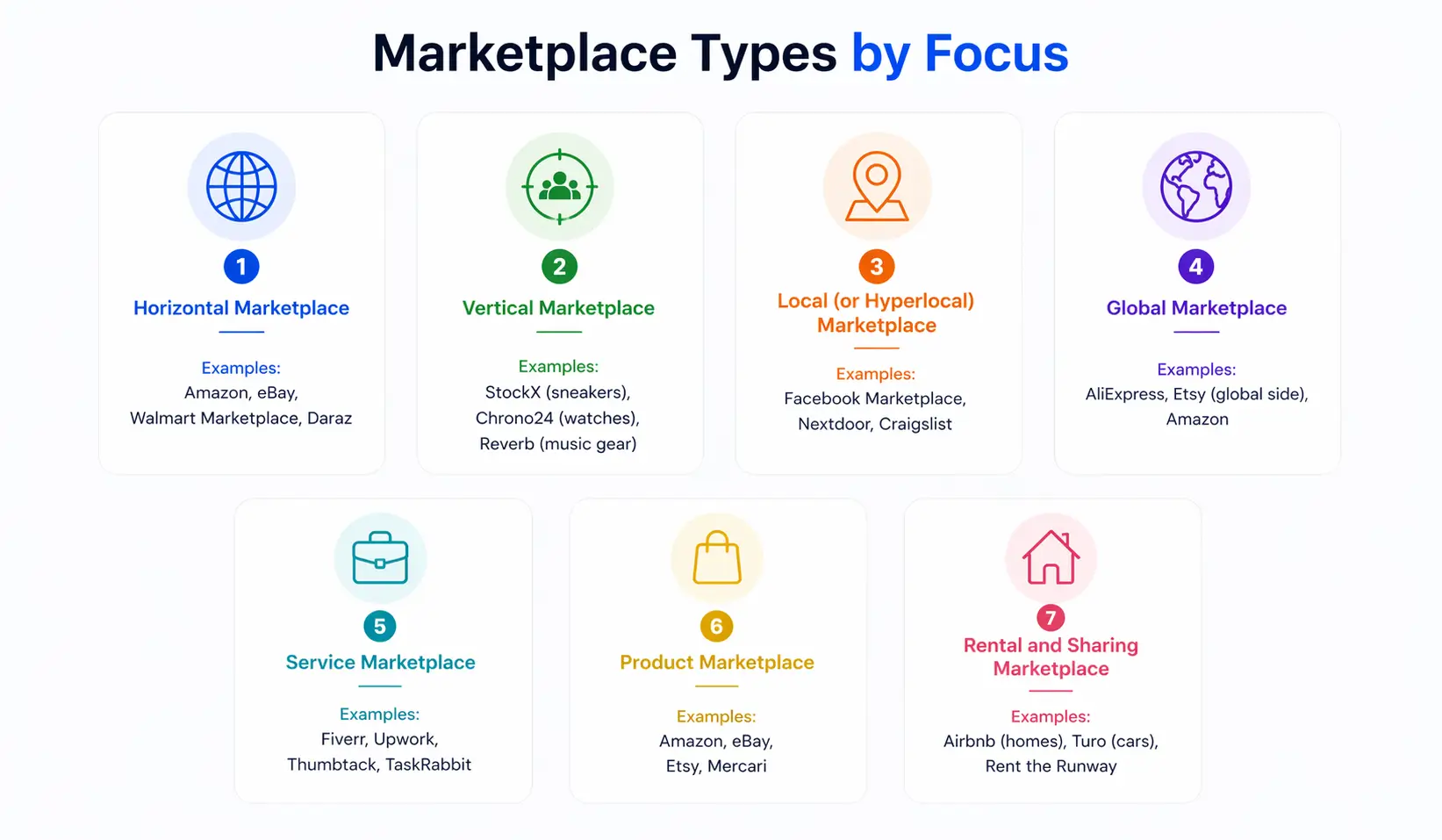
This is about what your marketplace covers. Focus shapes your brand, your SEO, your trust-building, and how fast you can grow. The six main types below will help you pick the right shape for your idea.
1. Horizontal Marketplace
A horizontal marketplace sells many kinds of products in one place. Think of it as a digital shopping mall with every store under one roof.
How it works: Sellers from any category can sign up. Buyers come looking for all kinds of items in one spot.
- Best for: Teams with big budgets, strong logistics, and lots of traffic
- Examples: Amazon, eBay, Walmart Marketplace, Daraz
- Pros: Huge potential reach. Cross-selling works well (buyers come for phones and stay for cases).
- Cons: Very hard to stand out. You compete with giants who spent years and billions on brand building.
- Tip: Avoid starting here as a side hustler. The fight for buyer attention is too tough.
2. Vertical Marketplace
A vertical marketplace focuses on one niche only. It sells one type of product or serves one type of user.
How it works: You pick a tight niche (like vintage watches or used cameras). You build the best site for that niche, with tools and trust signals made for those buyers.
Why vertical wins for side hustlers:
- Easier to rank in search for niche keywords
- Buyers trust you more when you “get” the niche
- Less money needed to market to a smaller crowd
- Higher margins (niche buyers pay for quality)
- Best for: Side hustlers, small business owners, and anyone in a clear niche
- Examples: StockX (sneakers), Chrono24 (watches), Reverb (music gear), Houzz (home design), Poshmark (fashion), Discogs (vinyl records)
- Pros: Deep trust. Strong community. Easier to build a loyal base.
- Cons: Smaller total market. Growth can hit a wall if the niche is too small.
- Tip: Pick a niche you know well or care about. Your taste and language will feel real to users.
3. Local (or Hyperlocal) Marketplace
A local marketplace only serves one city, region, or neighborhood. Buyers and sellers meet nearby, often in person.
How it works: Users post items they want to sell within a small area. Deals happen through local pickup, cash, or easy delivery. Your platform keeps people, money, and trust close to home.
- Best for: Used goods, bulky items (furniture, appliances), food, and local services
- Examples: Facebook Marketplace, Nextdoor, Craigslist, OfferUp, local classifieds
- Pros: Low shipping costs. Strong word-of-mouth growth. Easier to build early traction.
- Cons: Limited user base per city. You must repeat the build in each new area.
- Tip: Grow one city at a time. Get it fully loaded with sellers and buyers before moving to the next.
4. Global Marketplace
A global marketplace serves users from many countries. It handles shipping, payments, and language across borders.
How it works: Sellers list once, and buyers from any country can buy. The platform handles currency, taxes, and cross-border shipping or works with shipping partners.
What you need to run it:
- Multi-currency payment tools
- Language translation
- Cross-border shipping partners
- Tax and customs support
- Fraud protection for high-risk zones
- Best for: Digital goods, rare items, and products with no close local supply
- Examples: AliExpress, Etsy (global side), Amazon Global, Fiverr
- Pros: Huge reach. Big total market. 24/7 buyers in different time zones.
- Cons: Complex operations. Shipping, taxes, and fraud are hard to manage.
- Tip: Start in one or two countries. Add more only when your systems can handle the load.
5. Service Marketplace
A service marketplace sells time and skill, not physical items. Sellers offer work like design, coaching, repair, or cleaning.
How it works: A buyer posts a need or picks a seller. The seller delivers the service online or in person. The platform earns through a commission, lead fee, or subscription.
- Best for: Freelance work, home services, coaching, and consulting
- Examples: Fiverr, Upwork, Thumbtack, TaskRabbit, Toptal, Handy
- Pros: No inventory. No shipping. Sellers can start with zero cost.
- Cons: Hard to measure quality. Buyers often want proof before they pay.
- Tip: Add video intros, portfolios, and strong review systems. Trust sells services more than price.
6. Product Marketplace
A product marketplace sells physical or digital goods. This is what most people think of when they hear the word marketplace.
How it works: Sellers list items with photos, prices, and details. Buyers browse, order, and receive. The platform earns from commissions, ads, or listing fees.
Sub-types of product marketplaces:
- New goods only (like Amazon)
- Used goods only (like ThredUp, Gazelle)
- Mixed new and used (like eBay, Facebook Marketplace)
- Handmade or custom (like Etsy)
- Digital products (like Gumroad, Creative Market)
- Best for: Most classic marketplace ideas, including buying and selling new and used items
- Examples: Amazon, eBay, Etsy, Mercari, ThredUp, Gumroad
- Pros: Clear business model. Easy to explain to sellers and buyers.
- Cons: Shipping and returns add real work. Hard to compete with giants on price.
- Tip: Pick a product focus (new, used, handmade, or digital). Mixing too many types confuses buyers.
7. Rental and Sharing Marketplace
A rental marketplace lets users borrow or share items for a set time instead of buying them.
How it works: Owners list an item or a service slot. Renters pay for short-term use (hours, days, or weeks). The platform takes a cut and often handles insurance or deposits.
- Best for: High-cost items that people do not need to own, like cars, tools, homes, or party gear
- Examples: Airbnb (homes), Turo (cars), Rent the Runway (fashion), Fat Llama (gear)
- Pros: Owners earn passive income. Buyers save money.
- Cons: Damage and theft risk. You need clear rules, deposits, and insurance.
- Tip: Start with one item class (like cameras or tools). Work out deposits and damage claims before adding more.
Good Read: Airbnb Business Model
Horizontal vs Vertical at a Glance
| Focus Type | Reach | Trust | Best For |
|---|---|---|---|
| Horizontal | Very high | Low to medium | Large teams with budget |
| Vertical | Medium | Very high | Side hustlers and niche owners |
| Local | Low per city | Medium | Used goods and local services |
| Global | Very high | Medium | Digital goods and rare items |
| Service | Medium | Depends on reviews | Freelancers and home pros |
| Product | High | Depends on niche | Most marketplace ideas |
| Rental | Medium | Needs insurance | High-cost items used part-time |
Most side hustlers do best with a vertical + local or vertical + global combo. This keeps the niche tight and your trust signals strong. Horizontal is a long game, so save it for after you win one niche first.
Comparison Table: Which Model Fits You?
| Model | Startup Cost | Speed to Revenue | Best Use Case |
|---|---|---|---|
| Commission | Medium | Slow | Long-term scale |
| Subscription | Low | Medium | Niche markets |
| Listing Fee | Low | Fast | Classifieds |
| Freemium | Medium | Slow | Mass user base |
| Featured Ads | Medium | Medium | High-traffic sites |
| Lead Generation | Low | Fast | Service markets |
| Auction | Medium | Medium | Rare items |
| Managed | High | Slow | Trust-heavy niches |
| P2P | Low | Slow | Used goods |
| Hybrid | Medium to High | Medium | Growing platforms |
How to Pick the Right Marketplace Model
Ask yourself these five questions before you build anything:
- Who will use my platform? Businesses, shoppers, or both?
- What are they buying? One-time items, services, or ongoing needs?
- How much does trust matter? Low-cost items need less trust. Cars, watches, and luxury goods need much more.
- Can I handle the work? Managed models need staff, storage, and shipping.
- How fast do I need income? Listing fees pay right away. Commissions grow over time.
A good rule: start simple. Most big platforms began with one model and added more later.
Real Examples of Marketplace Business Models
- Airbnb uses commission (host fees plus guest fees)
- Etsy uses listing fee plus commission plus ads
- Uber uses commission
- LinkedIn uses subscription, ads, and lead generation
- StockX uses a managed model with commission
- Fiverr uses commission plus freemium upgrades
- Thumbtack uses lead generation
- Poshmark uses flat-fee and percentage commission
- Amazon Marketplace uses referral fee plus seller subscription
Most top names use more than one model. This spreads risk and grows income.
Common Mistakes to Avoid
- Doing too much at once. Pick one model first. Prove it works. Then add more.
- Ignoring the chicken-and-egg problem. You need both sides active. Focus on one side first, often sellers.
- Copying giants too closely. Amazon had decades and billions. You do not have that runway.
- Setting commissions too high. Sellers will leave. Start at 5% to 10% and raise it later if the value is clear.
- Skipping trust tools. Reviews, verified profiles, and secure payments must be there from day one.
Quick Start Steps for Side Hustlers and Small Business Owners
- Pick one niche and one model.
- Build a simple site or app. No-code tools work fine at the start.
- Bring in 20 to 50 sellers by hand. Do not wait for them to find you.
- Get your first 10 real transactions.
- Fix what is broken. Ask users what they need next.
- Then scale with ads and new features.
Side hustlers tend to do best with low-cost models like listing fees, featured ads, or P2P.
Small business owners with some budget can try commission-based or managed models in a clear niche.
Final Takeaway
The best marketplace business model is the one that fits your niche, your users, and your budget. There is no single winner. The right pick depends on what you sell, who buys it, and how much you can spend to get started.
Start with one model. Test it with real users. Add more models once the first one is working. That is how every top marketplace grew from a small idea into a global brand.
Freequently Asking Question
What is a marketplace business model?
A marketplace business model is a plan for making money by connecting buyers with sellers. The platform owner acts as the middleman and does not sell their own stock. Instead, they run the place where others sell and earn money through fees, commissions, or ads. Every marketplace needs three things: buyers who want to purchase, sellers who want to list items or services, and a trust system that keeps both sides safe.
How do marketplace platforms make money?
Most marketplaces use one or more of six main income streams: a commission (a percent of each sale, usually 5% to 20%), a listing fee (a charge for posting items), a subscription (a monthly or yearly access fee), featured ads (extra payment to boost a listing), lead fees (a fee for each buyer contact), and a freemium model (free basic use with paid upgrades). The right model depends on the niche, the users, and the platform’s budget.
What is the difference between a horizontal and a vertical marketplace?
A horizontal marketplace sells many kinds of products in one place, like a digital shopping mall. Examples include Amazon, eBay, and Walmart Marketplace. A vertical marketplace focuses on one niche only, such as StockX for sneakers, Reverb for music gear, or Chrono24 for watches. Vertical marketplaces are easier to build trust in, easier to rank in search for niche keywords, and require less marketing spend to reach a targeted audience, making them better suited for side hustlers and small business owners.
Which marketplace business model is best for a new platform or side hustler?
For new platforms and side hustlers, starting with a single model is recommended. A commission-based model works well because sellers only pay when they earn, removing the barrier to sign up. A listing fee model pays right away and suits classifieds or local marketplaces with high listing volume. The key steps are to pick one niche and one model, build a simple site or app using no-code tools, bring in 20 to 50 sellers by hand, achieve the first 10 real transactions, fix issues based on user feedback, and then scale with ads and new features.
What are the most common mistakes to avoid when building a marketplace?
The most common mistakes when building a marketplace include: doing too much at once instead of proving one model first; ignoring the chicken-and-egg problem by not focusing on building one side (often sellers) before the other; copying large platforms like Amazon without having the same budget or runway; setting commissions too high which drives sellers away (start at 5% to 10% and raise it later); and skipping trust tools like reviews, verified profiles, and secure payments, which must be present from day one.