On This Page
Starting and running a successful online grocery business is challenging. You need to cover various business aspects, including market research, financial considerations, and legal compliance.
However, with a bit of help, it can be much easier. Once you break down the process of starting an online grocery store, you can accomplish it with great success.
That said, keep reading this article to learn the process of starting an online grocery business in detail.
Why Start an Online Grocery Business?
There are several advantages to adopting an online grocery business model. An online grocery delivery business has excellent potential, especially since the COVID-19 pandemic. The change in consumer behavior increases the chances of success exponentially.
More reasons for starting an online grocery business include the following:
- The global supply chain makes it possible to offer goods with more variety than local supermarkets.
- Consumers perceive online grocery shopping as safer and more convenient.
- You can easily deliver fresh perishables on the same day with a local online grocery business model.
- With WooCommerce themes like Zilly, creating and running an eCommerce grocery business is incredibly easy.
The flexibility of an online grocery store makes it easy to merge it with a physical grocery store. Other benefits may vary depending on the online grocery business model you choose.
Online Grocery Store Problems and Solutions
Running an online grocery store brings various challenges. Encountering these problems unprepared could spell failure for your business venture. This is why we believe it’s important to delve into online grocery store challenges and solutions before starting one.
- Inventory Management: Managing grocery inventory is a delicate undertaking. Issues like overstocking and stockouts can affect operational budgeting and customer satisfaction.
Solutions include preparing a robust inventory handling system with real-time updates and automated restocking processes.
- Website and App Performance: Slow websites and apps reduce conversion rates since customers will leave for alternative sites.
Solutions for this should start with the creation of the site. Carefully crafted online grocery business themes and apps, like Zilly, are optimized for speed and performance.
- User Interface and User Experience: Poor navigation, lags, and glitches drive customers away.
The solution to this problem is creating a user-friendly interface site. If you use a WordPress theme, use one with good support and regular updates for bug fixes. Zilly is excellent in both regards.
- Delivery Challenges: Delivering correct orders on time is vital for customer satisfaction but challenging to realize.
Solutions include partnering with a reliable delivery service provider. You should also use alternative local shipping carriers in cases of demand increase and unavoidable delays.
- Operational Costs: High operational costs can prevent new grocery businesses from profiting.
The solution is to start with essential services and gradually expand as you become profitable. This will help you balance out the costs and revenue wisely.
The most common solution to most grocery store problems is proper prior preparation. Ensure that you have all the necessary tools to succeed. If you’re ready to get started, here’s a guideline for starting an online business from home.
Start an Online Grocery Business in 10 Steps
Online grocery businesses have many moving parts; therefore, it’s easy to skip important steps. This can lead to incalculable losses in the future.
To help you get everything right, we’ve prepared a comprehensive list of 10 simple steps that you can follow to start an online grocery business from the comfort of your home.
Step 1: Conduct Market Research and Pick Your Niche

The first step in creating an online grocery business is conducting in-depth research on the market you want to enter. This involves painstakingly analyzing your competition, including their marketing and operating behavior.
Starting at their website, social accounts, and physical locations (where possible) will give you a good idea. If you find market gaps that your potential competition doesn’t utilize, find out why they don’t. Create plans on how to service the unfulfilled market demands.
When weighing your odds of success, ensure that you find a unique selling point, such as locally-sourced products. You don’t have to be 100% unique, but strive for it where you can. Modifying ideas borrowed from your competition into something amazing is possible.
As you pick your niche, ensure that you know the ins and outs of the items you choose to deal with. If not, start by familiarizing yourself with them.
Step 2: Identify Your Target Customers

As you conduct market research and identify your favorite niche, you should also consider who your customers will be. Think about your location since that’s who you know and can satisfy best. You can target your local area, state, or entire nation.
Decide the size of your audience, always considering your ability to satisfy everyone within your scope. Evaluate their purchasing behavior. Learn what they prefer and the amounts they’re likely to purchase.
Knowing everything you can about your target audience will help you meet their demands. You can also easily figure out the prices you will offer and plan your finances around concrete numbers.
Step 3: Establish Product Categories
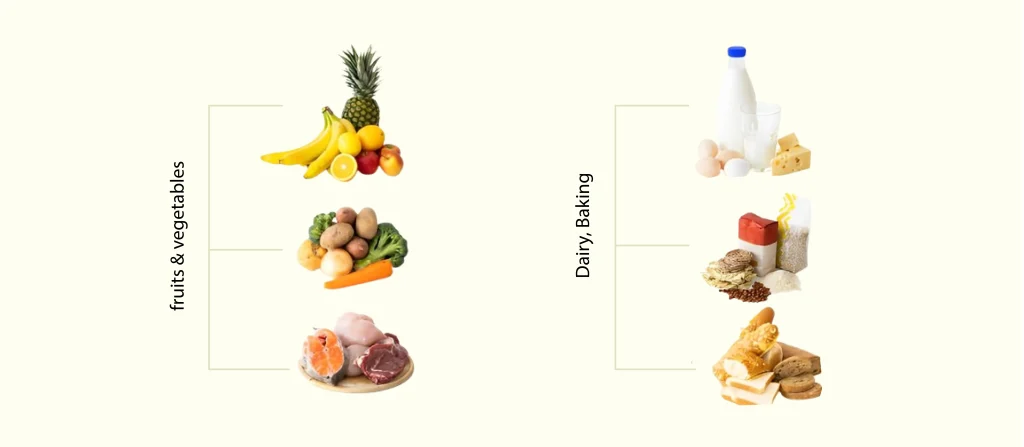
Once you’ve figured out the products you’ll be selling, list their categories. You can be original or just borrow a leaf from various websites within your niche. You’ll find straightforward categories: fruits, canned goods, vegetables, condiments and spices, dairy, baking essentials, oils and fats, and frozen foods.
In the creative path, you can base your thinking on storage and delivery management and other factors. As you create categories, ensure that they enhance the customer experience. They should be easy to navigate.
Once you’ve decided on the items you’ll be dealing with, start thinking about the online grocery business model that suits you best.
Step 4: Online Grocery Business Models to Consider
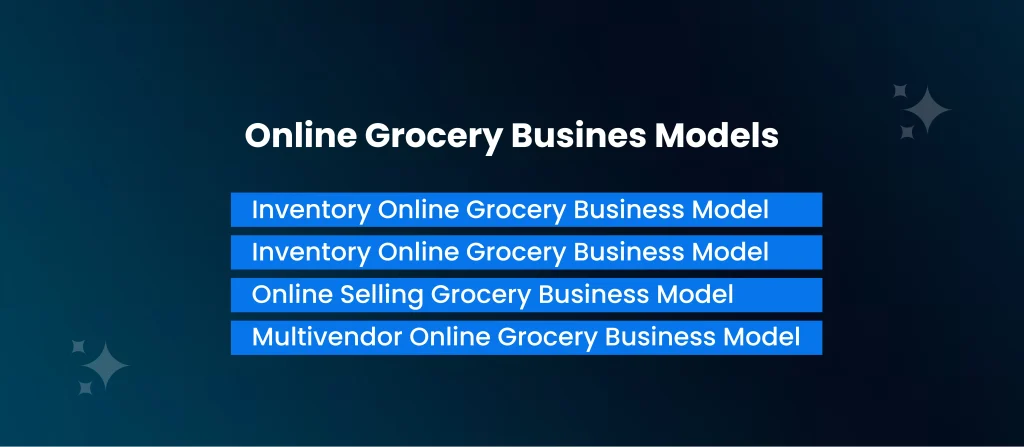
There are different online grocery business models that you can implement. Some involve partnerships with supermarkets where you make deliveries, while others allow you to have a brick-and-mortar store. Here’s an in-depth look at these models.
- Inventory Online Grocery Business Model
In this online grocery business model, the owner manages the goods. After buying from suppliers, you need a storage space to store fresh products.
When customers make orders, you use a supply network to make deliveries. You can use an internal supply network or an external one. This model gives you control over the quality of the product, the revenue you generate, and delivery charges.
Successful Example: FreshDirect
Main Unique Selling Point: Delivery of fresh, high-quality groceries to consumers.
Model Review: This model requires investment in storage, quality control, transportation, logistical planning, and inventory management. It is comparatively expensive. However, it gives you great control over your operations and market, and its earning potential is also astronomical.
- Hyperlocal Online Grocery Business Model
A hyperlocal model focuses on serving a specific region or area. Adopting this model would require collaborating with various vendors or catering to a particular region. Your role would be to handle the order and transport logistics to ensure quick and safe delivery of goods.
In this model, you don’t need storage space. Your website allows vendors to list their products while you deliver customer orders. These vendors can be local retailers and supermarkets.
Successful Example: Instacart
Main Unique Selling Point: Quick delivery to customers.
Model Review: This online grocery business model is great for anyone without storage space. You will need to collaborate with local vendors and establish or hire a reliable delivery network. This is a perfect model for you if you can access reliable deliverymen.
- Online Selling Grocery Business Model
With an online selling model, you mainly focus on online operations. You can earn through various channels. This is by working with established food supply networks and eCommerce multivendor platforms. Here are some of the possible earning channels:
- Commissions: When customers buy goods from your website, you earn commissions from the suppliers or stores.
- Merchandising: You can sell branded grocery products on your site after establishing a reputable brand. This requires branded bags and packaging.
- Subscriptions: Customers who purchase subscriptions pay you in advance. You then deliver the products they need at regular intervals, such as monthly, fortnightly, weekly, or daily.
- Memberships: Customers who subscribe to your membership plans can enjoy early deliveries, zero shipping costs, or reduced wait times. This channel is effective for establishing a loyal customer base.
- Promotions: Grocery shops can pay you to increase their online visibility. You can do this by placing banners of their brands on your site.
- Service Charges: You can charge consumers or retailers a fee for every sale your platform facilitates. You can charge users who aren’t your members or subscribers.
- Sponsored Blog Content: You can start a blog on which you publish helpful content. Vendors can then pay you to post content that promotes their businesses.
Successful Example: Amazon Fresh
Main Unique Selling Points: Limited physical handling of grocery items and many earning channels.
Model Review: This model doesn’t demand storage space. Some of its many revenue generation channels don’t require handling transport logistics. Although you have less control over the quality of goods, the earning potential is incredibly high.
- Multivendor Online Grocery Business Model
In a multivendor model, you are the middleman who connects vendors and customers. You have no control over inventory, but you must handle order delivery. Retailers can pay you a percentage of each sale.
You need a website with multivendor functionality. You can create such a website easily using the Zilly WooCommerce theme, which comes with the Dokan Multivendor add-on, making it easy to create such a website.
Successful Example: Peapod
Main Unique Selling Point:
Model Review: This model has a high chance of success. It maximizes conversions and is easy to run, mainly without inventory management. However, you will still need to figure out the delivery logistics for consistent order fulfillment.
Consider your resources and the type of products you sell when choosing an online grocery business model.
Step 5: Create Your Online Grocery Store Website

A website is the best opportunity to create an excellent first impression. Set up a top-notch website before contacting partners, suppliers, and stores. For your website to set the right tone, in the least, it should be:
- Visually appealing
- Mobile friendly
- User friendly
- Fully responsive
However, this is just the tip of the iceberg. A lot goes into making a website a true business asset. Here are a few steps to creating a great website:
- Register a Domain Name and Connect it with a Hosting Provider: You should choose a name for your website that is precisely the same as the business name you’ll adopt. Then, choose a domain registrar to register the domain name.
Some domain registrars like GoDaddy and HostGator even offer hosting services. What’s more, some also offer WordPress preinstallations, so all you need to do next is choose a WordPress theme.
- Choose WordPress for your CMS: A content management system (CMS) is a platform that facilitates the creation and management of your site. For your information, WordPress fuels 43.6% of websites on the web.
So, undoubtedly, it’s one of the best content management systems to opt for. Consider this CMS while building your online grocery store.
- Choose a Theme: You can choose a multipurpose or niche-centered theme. We recommend that you select a WooCommerce theme made for online grocery businesses. It will have sections and elements for the niche.
Our choice is Zilly, an online grocery business WooCommerce theme with accompanying mobile apps.
This theme has many page templates to choose from, helpful integrations, and an outstanding user interface. Zilly is also compatible with many payment gateways. Incredibly, it costs a meager $29.
- Add Products, Descriptions, and Content: Now that you have a website, it needs content. Start setting up your products and adding content to your pages with relevant keywords. These keywords are the words that your potential customers are likely to search on search engines to get to your site. Check this post: eCommerce product description generator It will help you to generate product descriptions for your grocery products.
- Create Checkout Policies. Checkout policies are like the terms and conditions of your online business. Customers should be aware of them. Keep them brief and clear so that customers can easily understand them.
Creating and running a website with WordPress is incredibly easy. However, you should always provide high-quality images and descriptions that match your products.
Step 6: Create a Business Plan

After deciding on the products and business model you will go with, you need a plan. A proper business plan spells out the resources you’ll need, a plan of your finances, potential risks, and best solutions.
A business plan helps you remain on the right track and evaluate your progress continually. A business plan should have the following:
- A brief summary of your business and its main purpose
- An overview of your niche market and target audience
- A list of the products you’ll be offering
- Financial program (an outline of how you plan to manage your finances)
- Marketing strategy
A marketing strategy is crucial for notifying potential customers of your site’s existence. Start by promoting your business by word of mouth. If possible, your first customers should be your friends and family. Then, you can move on to digital, email, affiliate, and content marketing.
Step 7: Register Your Business

Before operating a business, you must register it as a legal entity. This step is quite complex, requiring you to study the laws and regulations governing businesses in your location, state, and country.
There are many moving parts of an online grocery business. Apart from the transaction, transport, and storage logistics, you will have to sign many partnership agreements. You can choose a Limited Liability Company (LLC) to protect your assets from potential litigations and fines.
The next step is to acquire licenses and permits necessary for operation. Due to the handling of food, some special permits and licenses will come into play for different places. Here are a few of the types needed:
- Business License: Local governments require businesses to have these licenses to prove that they’re legal entities that follow regulations.
- Food Handling Permit: All grocery businesses that handle perishable food need this permit. You may need to take a food safety course and pass a test.
- Alcohol Sales Permit: You’ll need a special sales permit to open an alcohol section in your store.
- Health Department Permit: In addition to the food handling permit, businesses handling groceries are required to meet certain health and safety standards. Inspections might be necessary to issue health permits.
Step 8: Partner with Grocery Stores and Distributors

As your business develops well, you must start planning how to source your products. In the future, you can change the contents of your inventory. However, you still need to establish some main categories.
Ensure that you choose items that you can easily procure. Find distributors, wholesalers, or local farmers to collaborate with. Working with farmers and manufacturers directly is brilliant. It shortens the supply chain, simplifies logistics, and quickens deliveries of the freshest produce.
Be a faithful partner in all your promises and commitments to foster strong, long-term relationships. This is the best way to secure a steady supply of high-quality products, which results in higher conversions and customer loyalty.
Step 9: Organize a Storage Facility and Manage Inventory

Once you’ve established your inventory source, it is time to find the best storage facility you can afford. A warehouse handling foodstuffs must meet certain standards and requirements regarding cleanliness, airflow, and temperature.
Such a storage facility should have various sections. These include a food freezer, refrigerated or chilled area, dry area, and wooden pallets to prevent contact with the floor.
A storage facility needs an inventory management system. Such software helps you monitor your stock in real time. This system can help you analyze the products that are selling well. Evidently, proper inventory management can result in better financial management and great profits.
Step 10: Plan Your Delivery System
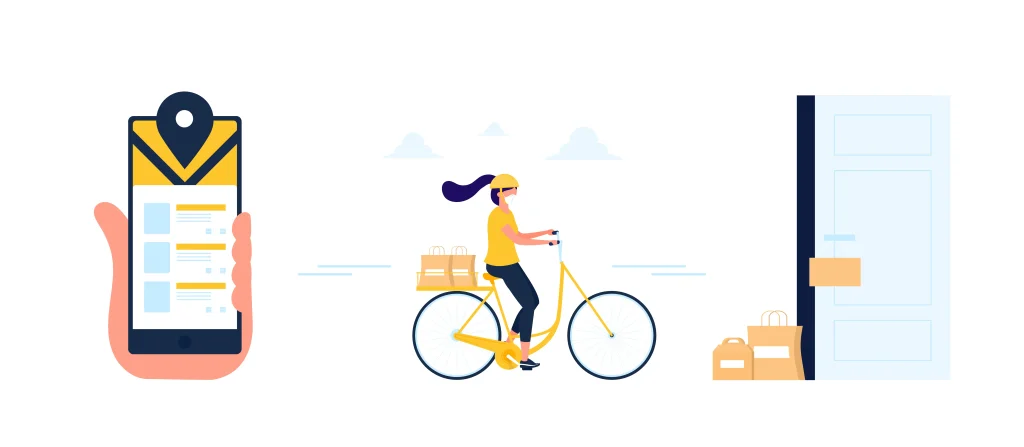
Most groceries have a minimal shelf life. You can’t indefinitely store goods like vegetables, meat, and milk without suffering heavy losses. You can mitigate this by developing a careful and robust delivery plan. This also ensures that customers receive fresh and high-quality products.
The best course of action is to partner with a shipping and logistics company. You can weigh the prices different companies offer and go with the most affordable option. Ensure that your company of choice meets compliance requirements. You can get your own transport staff and equipment when you’re ready to scale up.
You can let your customers choose the delivery schedules they want. You can also allow them to track the progress of their orders. Food delivery services like DoorDash and Uber Eats can help you provide fast and reliable deliveries.
Work to Make Your Online Grocery Brand Popular and Reliable
After all the preparations, you still need to boost your brand image. As you incorporate various marketing strategies, you should also consider all efforts to popularize your brand.
For instance, you should prioritize quality over quantity. You can do this by focusing on providing informative descriptions of the products. Give accurate ingredient information and ensure on-time delivery.
Other efforts include focusing on food safety, collaborating with other retailers, and selling through their channels. Weigh the pros and cons of all such actions—the best of luck in your venture.