
On This Page
Every day, millions of people shop for cars online. They search by make, model, price, and location, compare listings, and contact sellers, all without paying a cent. That raises a fair question: if browsing is free for buyers, how do car classifieds websites actually make money?
The answer is a smart, proven business model that has powered websites like AutoTrader, Cars.com, and CarGurus. Once you understand how it works, you can see why an automotive marketplace can be such a profitable business, and how anyone could build one of their own.
This explainer breaks down the car classifieds business model in plain language: what it is, who the players are, how the money is made, and why the model works so well.
Key info at a glance
| Question | Short answer |
|---|---|
| What is it? | An online marketplace connecting car buyers with sellers and dealers |
| Who pays? | Mostly sellers and dealers — browsing is free for buyers |
| Main revenue streams | Dealer subscriptions, featured listings, lead generation, listing fees, ads |
| Business type | Two-sided marketplace with network effects |
| Why it works | No inventory to hold, low overhead, scalable, recession-resistant |
| Real examples | AutoTrader, Cars.com, CarGurus, TrueCar, OLX Autos |
| How to start one | Use a car listing platform like CL Car Theme (no coding needed) |
What is a car classifieds business?
A car classifieds business is an online platform where people list vehicles for sale and buyers browse and contact sellers. Think of it as the digital version of the car section in an old newspaper, but far more powerful, with photos, search filters, maps, reviews, and instant messaging.
It is a two-sided marketplace. On one side are buyers looking for a car. On the other side are sellers, who fall into two groups: private individuals selling one vehicle, and professional dealers selling many. The website’s job is to bring these two sides together and make buying and selling easy.
Importantly, the platform does not usually own any cars. It is not a dealership. It is the middleman that provides the marketplace, and it earns money for connecting buyers with sellers.
How the business model works
The model rests on a simple exchange of value. Buyers get a huge selection of cars, useful search tools, price insights, and a safe way to contact sellers, all for free. That free experience attracts large numbers of shoppers.
Those shoppers are exactly what sellers want. A dealer with 100 cars on the lot needs buyers, and a marketplace full of ready shoppers is a direct line to them. So sellers and dealers are willing to pay to reach that audience.
This is the heart of the car classifieds business model: keep it free for buyers to build a large audience, then charge the sellers who want access to that audience. Buyers use the platform for free, while dealers fund the operation. The more buyers a site attracts, the more valuable it becomes to sellers, which is why these platforms grow through network effects.
How car classifieds make money
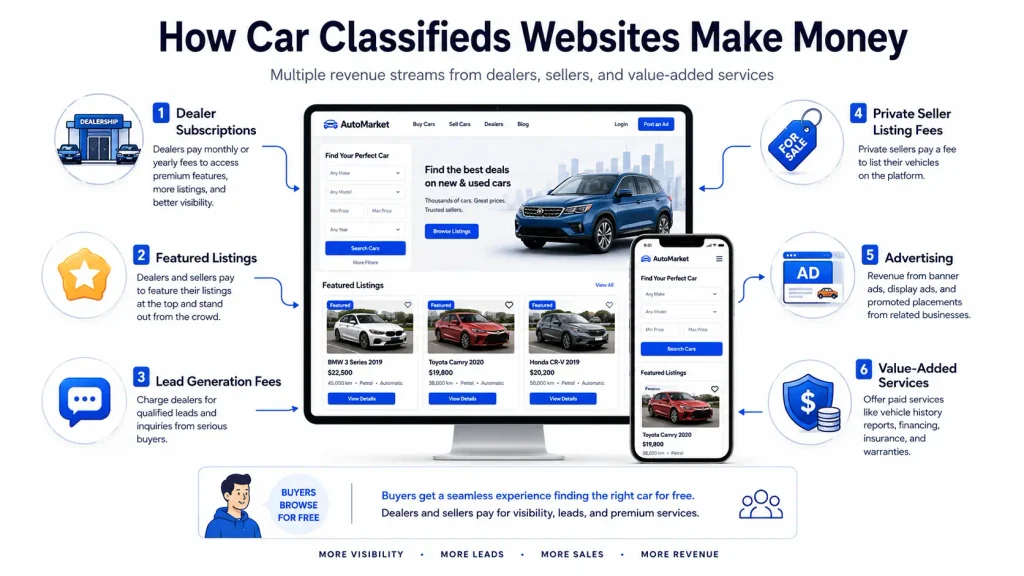
Most successful automotive classifieds do not rely on a single income source. They stack several. Here are the main ones, with real-world examples.
| Revenue stream | How it works |
|---|---|
| Dealer subscriptions | Dealers pay a recurring monthly fee to list inventory |
| Featured / promoted listings | Sellers pay extra for top placement and visibility |
| Lead generation | Dealers pay for each buyer inquiry they receive |
| Private seller fees | A flat fee to list, or a success fee when the car sells |
| Advertising | Brands and lenders pay for ad space on the site |
| Value-added services | Financing, insurance, warranties, and history reports |
1. Dealer subscriptions (the biggest earner)
The largest slice of revenue usually comes from dealers paying a recurring subscription to list their inventory and access marketing tools. Dealers sell many cars, so a steady stream of buyer traffic is worth a monthly fee to them.
This is the backbone of the biggest platforms. For CarGurus, dealer subscriptions are the core of the business; the company generates around 87% of its revenue from dealer subscriptions, with fees based on listing volume and service tier. CarGurus runs a freemium model, where dealers pay for full functionality rather than paying per transaction. AutoTrader works similarly, offering premium and advanced subscription tiers and growing its average revenue per dealer.
2. Featured and promoted listings
On top of a basic listing, sellers can pay to stand out. A featured or “enhanced” listing pushes a car to the top of search results or adds a highlight that draws the eye. Because better visibility means faster sales, sellers happily pay the premium. CarGurus, for example, offers a Featured Listing product that promotes a dealer’s cars at the top of search results. This is a high-margin upsell for the platform.
3. Lead generation fees
Some platforms charge dealers for the buyer inquiries, or “leads,” they receive. When a shopper contacts a dealer through the site, that connection has value. When a customer reaches out to a dealer via CarGurus, the platform earns a small fee per lead. Across the industry, third-party leads typically cost dealers somewhere between $40 and $100 each, depending on the market. It is a pay-for-results model that dealers understand well.
4. Private seller listing fees
Private individuals are usually offered free or low-cost listings to keep the marketplace full, then charged in a light-touch way. A common approach is a success fee. On CarGurus, listing a car as a private seller is free, but there is a $99 fee once the car sells. Other sites charge a small upfront fee or sell optional upgrades like extra photos or a longer listing.
5. Advertising
A busy car marketplace attracts a highly relevant audience, which advertisers will pay to reach. Car manufacturers, lenders, insurers, and parts sellers buy ad space on the site. For CarGurus, advertising — largely from vehicle manufacturers — makes up a meaningful share of revenue alongside dealer subscriptions. The key is to keep ads clearly separate, so they do not undermine trust in the listings.
6. Value-added services
Mature platforms add services around the sale. These include vehicle history reports, financing offers, insurance quotes, extended warranties, and secure payment or escrow. Each is either sold directly or offered through a partner for a referral fee. These services deepen the buyer experience and open new income streams beyond listings.
Types of car classifieds business models
Not every automotive marketplace works the same way. Most fall into a few types.
Horizontal vs vertical. A horizontal marketplace lists everything, including cars (think Craigslist or Facebook Marketplace). A vertical marketplace focuses only on vehicles (AutoTrader, Cars.com), which allows richer, car-specific features and search.
Listing/subscription model. The platform earns mainly from listing fees and dealer subscriptions. This is the most common and predictable model.
Lead-generation model. The platform earns by sending qualified buyer inquiries to dealers. TrueCar, for instance, uses a certificate approach where shoppers get pre-negotiated pricing and are matched to certified dealers.
Transactional/marketplace model. Newer platforms facilitate the actual purchase online and earn from the transaction or related services like financing and delivery.
Many big players blend these. CarGurus, for example, combines marketplace subscriptions, advertising, lead generation, and dealer software into one business.
Why the car classifieds model is so attractive
This business model has several qualities that make it appealing to build.
- No inventory. You never buy or store cars. Your product is the platform, so overhead stays low.
- Scalable. One listing or one million listings run on the same website. Growth does not require proportional cost.
- Network effects. More buyers attract more sellers, and more sellers attract more buyers. Each side strengthens the other.
- Recurring revenue. Dealer subscriptions renew month after month, creating predictable income.
- Recession-resistant. The used-car market stays active even in downturns, which keeps demand steady.
- Multiple income streams. Listings, promotions, leads, ads, and services can all run at once.
The challenges to know about
The model is strong, but it is not effortless. New platforms face a “chicken-and-egg” problem: sellers will not pay to list on a site with no buyers, and buyers will not visit a site with no cars. The fix is to seed the marketplace with listings and build buyer traffic first, then introduce charges once the audience is real.
There is also competition and trust to manage. Established players hold large market shares —AutoTrader, Cars.com, CarGurus, and TrueCar together control most third-party lead flow in the US. That means new sites usually win by focusing on a niche or a local market, and by keeping listings accurate and the experience trustworthy.
How to start your own car classifieds website
The encouraging part is that you no longer need a big development team to launch an automotive marketplace. Modern car listing platforms include the core features — dealer and private listings, advanced search, buyer-seller messaging, and built-in ways to earn — right out of the box.
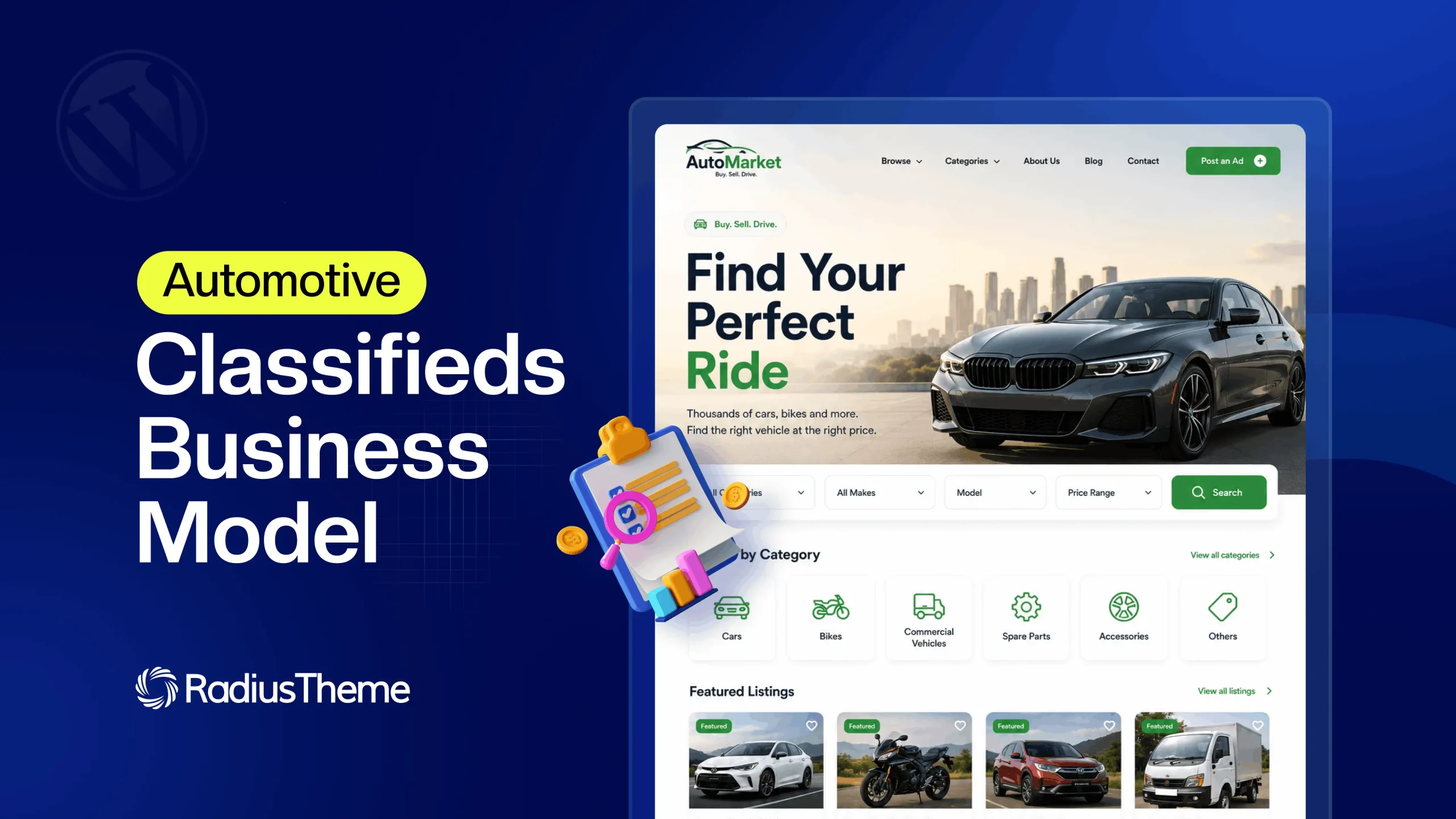
The CL Car listing theme is one such tool. It lets you build a car classifieds website on WordPress without coding, with dealer pages, AI-powered search, and multiple monetization options like paid listings, featured ads, and memberships, the same revenue streams described in this guide. You can choose from modern homepage layouts and launch a professional marketplace quickly and affordably.
See it in action: explore the CL Car Demo to see how a real automotive classifieds site looks and works, and picture your own platform up and running.
Frequently asked questions
How do car classifieds websites make money?
They mainly earn from sellers, not buyers. The biggest income comes from dealer subscriptions to list inventory, plus featured or promoted listings, lead-generation fees, private-seller listing fees, advertising, and value-added services like financing and vehicle history reports. Browsing stays free to attract a large audience.
Do car listing sites charge buyers anything?
Almost never. Buyers browse, search, and contact sellers for free. The free experience is what builds the large audience that sellers and dealers then pay to reach. This is central to how the car classifieds business model works.
What is the most profitable revenue stream for a car marketplace?
Dealer subscriptions are usually the largest and most reliable, because dealers list many cars and pay a recurring fee. For some major platforms, subscriptions make up the majority of total revenue, supported by featured listings, lead fees, and advertising.
Do I need to own cars to run a car classifieds business?
No. A classifieds platform is a marketplace, not a dealership. You do not buy or hold any inventory. You provide the website that connects buyers with sellers and earn from listings, promotions, leads, ads, and services.
Can I build a car classifieds website without coding?
Yes. Using a purpose-built WordPress theme like CL Car, you can launch a car marketplace with listings, search, messaging, and monetization built in — no development skills required. Trying the live demo is a good first step.
Final thoughts
The car classifieds business model is a masterclass in marketplace design: give buyers a free, powerful place to shop, build a large audience, then earn from the sellers and dealers who want to reach it. Layer in featured listings, leads, advertising, and value-added services, and a single platform can generate strong, recurring revenue without ever owning a car.
It is a model that has created industry giants, and thanks to modern tools, it is now within reach for new entrants too. If you are curious how your own automotive marketplace could look, take a moment to explore the CL Car demo and see the model come to life.