
On This Page
The buy and sell marketplace is one of the most resilient online business models in existence. Craigslist still ranks among the most-visited websites in North America. OLX runs in over 30 countries. Facebook Marketplace has more than 1 billion monthly users. Each of these platforms started with a simple idea: connect people who want to sell something with people who want to buy it.
What makes this model so valuable is the math behind it. Marketplaces do not hold inventory. They do not ship products. They do not handle customer service for individual transactions. They simply provide the infrastructure where buyers and sellers can find each other, and they earn revenue from every interaction that happens on the platform.
This guide explains exactly how the buy and sell marketplace business model works, shows real-world examples at different scales, breaks down the long-term market opportunity, and at the end, walks you through how to launch your own classified ads marketplace for free using the CLClassified WordPress theme.
What Is a Buy and Sell Marketplace?
A buy and sell marketplace is an online platform where individuals or businesses can list items for sale and other people can browse, contact the seller, and complete the purchase. The marketplace itself does not own the items being sold. It owns the audience, the trust system, and the infrastructure.
The simplest mental model is this: think of a flea market, but online and open 24 hours a day. Sellers pay for a spot (a listing). Buyers come because they know they will find what they want. The marketplace owner profits from every spot rented out, whether anyone buys anything or not.
There are three common formats:
- Classified ads where sellers post listings and buyers contact them directly to negotiate and complete the sale (Craigslist, OLX, Gumtree)
- Transactional marketplaces where the platform handles the payment, dispute resolution, and sometimes shipping (eBay, Etsy, Mercari)
- Hybrid marketplaces that combine both formats with optional payment processing on top of free listings (Facebook Marketplace, Locanto)
This article focuses primarily on the classified ads format, which is the most accessible business model for a new founder because it does not require building payment processing or shipping logistics from day one.
How the Buy and Sell Marketplace Business Model Actually Works
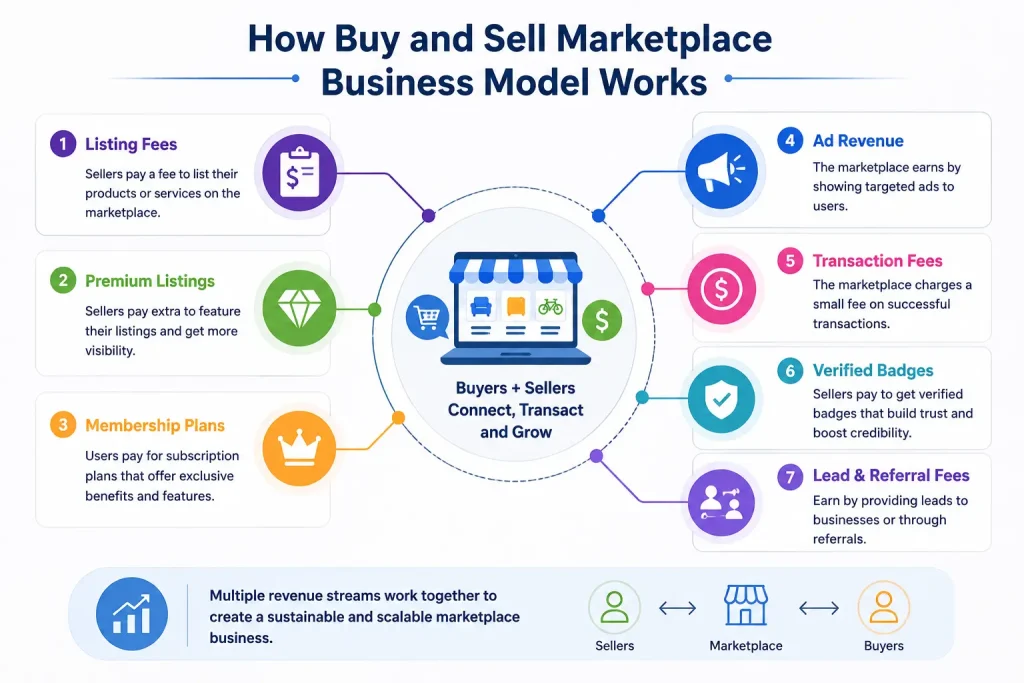
To understand the earning potential, you need to understand how marketplaces generate revenue. There are seven primary revenue streams. Most successful marketplaces use three or four of them in combination.
1. Listing Fees
Sellers pay a flat fee to publish a listing on the platform. The fee may vary by category (selling a car costs more than selling a coffee table) or by listing duration. Example: eBay charges insertion fees beyond a free monthly allowance. Many regional auto-trading sites charge $5 to $30 per car listing.
2. Featured and Premium Listings
Free listings get standard placement. Paid listings get top-of-page positioning, bold text, highlighted backgrounds, longer durations, or category homepage promotion. This is the highest-margin revenue stream for most classifieds platforms. Example: AutoTrader charges premium fees for “Featured Listing” placement. OLX and Gumtree sell “Bump-Up” packs that re-promote an aging ad to the top.
3. Subscription or Membership Plans
Power sellers (real estate agents, used car dealers, recurring sellers) pay a monthly or annual subscription to get unlimited listings, bulk upload tools, branded storefronts, and analytics. Example: Most real estate marketplace platforms run subscription-tier monetization for agents.
4. Advertising Revenue
Once your marketplace has steady traffic, you can sell display ads to local businesses, run Google AdSense, or feature sponsored content. Classified sites convert ad traffic well because users are already in a buying mindset. Example: Craigslist famously stayed simple but ran display ads in select categories.
5. Transaction Fees (Optional)
If you add payment processing later, you can charge a percentage of every transaction. Etsy and eBay both run percentage-based commission models. This is the highest-revenue model but the hardest to start with because it requires payment infrastructure, dispute resolution, and seller verification.
6. Verified Seller Badges
Power sellers pay to display a “Verified” or “Trusted” badge. This builds buyer confidence and increases the seller’s conversion rate, which they happily pay for.
7. Lead Generation and Referral Fees
For high-value categories like real estate, automotive, and home services, the marketplace can earn referral fees by passing qualified leads to professional sellers. Example: Several auto-marketplaces send qualified buyer leads to dealerships for a flat fee per lead.
👉 Good Read: Classifieds Business Model
The Long-Term Market Size: Why This Opportunity Keeps Growing
Before deciding to build a marketplace, it helps to understand the scale of the opportunity. Industry research from multiple sources gives a clear picture of where the online classifieds and marketplace industry is headed.
Current Market Size
According to Market Research Future, the global online classifieds market was valued at approximately $125 billion, with the industry projected to grow at a compound annual growth rate (CAGR) of around 24.8%. Other research firms estimate the broader online classified ad platform market at $43 billion to $90 billion depending on how the segment is defined.
Projected Market Size in the Next 5 to 10 Years
Multiple independent research firms project rapid growth across this decade:
- The global online classifieds market is projected to reach approximately $381 billion to $741 billion within the next 5 to 8 years
- One forecast estimates a market value of $1.4 trillion within the next 10 to 12 years
- The compound annual growth rate is estimated at approximately 24% to 25% across most research firms
What This Means for a New Marketplace Founder
A market growing at 24% CAGR roughly doubles every 3 years. That has practical implications for anyone building a new marketplace today.
A niche marketplace that captures just 0.001% of a $381 billion category represents over $3.8 million in annual transaction value. Even if your platform only captures 5% of that as marketplace revenue through listing fees, featured placements, and ads, the upside is significant for a single-founder operation.
Asia-Pacific is currently the fastest-growing region, with North America still the largest by revenue and Europe in second place. Mobile-first emerging markets are driving most of the new growth, which is why local and regional marketplaces (especially in RTL-language markets, Latin America, South Asia, and Africa) often have stronger growth runway than mature U.S. and European markets.
The Long View: Why the Trend Continues
The reasons behind this growth are durable, not speculative:
- Resale culture is mainstream. Buying used is no longer a budget compromise. It is a sustainability choice, a style choice, and a value choice for younger generations.
- Mobile devices removed the barrier. Posting a listing now takes 60 seconds from a phone. This expands the seller pool dramatically compared to the desktop-only era.
- Trust systems have matured. Buyer ratings, verified profiles, escrow payment options, and integrated chat have removed much of the historical risk of buying from strangers.
- Niche verticals keep multiplying. Every new category (electric scooters, sustainable fashion, vintage tech, modular furniture) creates a fresh marketplace opportunity that the giants cannot serve well.
In other words: the market keeps growing, the barriers to entry keep falling, and the niches keep multiplying. This is a rare combination in any industry.
Real-World Examples at Different Scales
To understand what’s possible, here are examples at three different scales. The point is to show that there is a viable business model at every level, not just at the multi-billion-dollar scale.
Large Scale: OLX Group
OLX runs in over 30 countries and is one of the largest classified ad platforms in the world. It earns from listing fees in certain categories, premium ad placements, subscriptions for car and real estate dealers, and display advertising. Its valuation has reached several billion dollars, with revenue heavily concentrated in emerging markets.
Good Read: OLX Business Model
Mid Scale: Locanto and Gumtree
Locanto and Gumtree both operate in multiple countries and have built reliable mid-scale classified businesses. Neither tries to compete with eBay’s transaction model. They both stick to the classified ads format and earn from featured listings, top placements, and category-specific verticals like real estate and jobs.
Small Scale: Regional and Niche Marketplaces
This is where most new founders should focus. Examples of profitable smaller marketplaces:
- A regional pet adoption marketplace earning through breeder verification fees, premium pet store listings, and pet service ads
- A used farm equipment classifieds site that monetizes through dealer subscriptions and featured equipment listings
- A local college community marketplace for textbook trades, sublets, and used furniture, monetized through small listing fees and local business ads
- A vintage clothing classifieds site earning through featured listings and a small commission on optional payment processing
These smaller marketplaces typically reach steady monthly recurring revenue once they have 200 to 500 active listings and a focused niche audience.
Good Read: How to Create a Website like Locanto
Why Building a Buy and Sell Marketplace Is Still a Real Opportunity
You might think the marketplace space is saturated. The honest answer is yes and no. The mega-platforms are saturated. Local, vertical, and niche-specific marketplaces are not.
Here is why this opportunity remains genuinely open:
1. Niche Markets Are Underserved
Facebook Marketplace works for general buy/sell but has no category-specific features. Selling a vintage motorcycle on Facebook is the same as selling a couch. A niche marketplace can offer category-specific features (motorcycle VIN checks, year and model filters, parts compatibility data) that the giants will never build.
2. Local Trust Beats Global Anonymity
Buyers prefer to transact with people in their own city. A geographically focused marketplace (a single city or region) can build community trust that Craigslist and Facebook Marketplace cannot replicate at scale.
3. Mobile-First Design Has Lowered the Build Cost
A decade ago, building a functional marketplace required a custom development team. Today, a single founder can launch a fully functional marketplace using a free WordPress theme in under a week. The barrier to entry has collapsed.
4. Recurring Revenue Compounds
Featured listings and subscriptions are recurring revenue. If you build a base of 100 sellers each paying $5 per month for a premium listing, you have $500 in monthly recurring revenue from a single feature. Stack three or four monetization layers and the numbers compound quickly.
5. Marketplaces Have Strong Network Effects
The more sellers you have, the more buyers come. The more buyers you have, the more sellers come. This flywheel is hard to start but extremely durable once it begins to spin. Once a marketplace has critical mass in a category, it is very difficult for a competitor to displace it.
6. The Recession-Proof Reality
In good economies, people buy. In recessions, they buy used. A buy and sell marketplace earns in both environments. This is one reason why platforms like Craigslist have outlasted multiple economic cycles.
What Categories Work Best for a New Marketplace
Not every category is equally easy to start. These are the categories with the best mix of demand and lower competition for new operators:
- Used vehicles (cars, motorcycles, RVs, boats) in a specific city or region
- Real estate rentals focused on a college town or specific city
- Pets and pet supplies including breeder listings and pet adoption
- Used farming, construction, or industrial equipment
- Vintage and collectibles (clothing, watches, records, comics, antique furniture)
- Used sports equipment (bicycles, golf, ski, fishing gear)
- Used baby and kids items (strollers, cribs, toys) in a local community
- Musical instruments (guitars, keyboards, drums, audio equipment)
- Used books and textbooks for a specific city or university
- Local services and jobs for a specific city or region
The pattern across all of these is the same: pick a category that has dedicated buyers who are not well-served by general marketplaces, and pick a geographic or thematic focus that lets you build trust quickly.
Build Your Free Buy and Sell Marketplace with CLClassified
If the business model makes sense to you and you want to launch a marketplace without spending money on a premium theme, CLClassified is the most accessible starting point on WordPress.
CLClassified is a free classified ads WordPress theme available on the official WordPress.org theme directory. It is developed by RadiusTheme, the same team behind several popular WordPress products.
What CLClassified Includes
Based on the verified WordPress.org listing:
- Completely free, available directly from the official WordPress theme repository
- AI-powered listing form builder for creating custom ad submission forms
- Smart AI content generation for listing titles and descriptions, which helps sellers write better ads in less time
- Built for buy/sell, real estate, job boards, car dealerships, restaurants, and local services
- No coding required for setup or customization
- Accessibility ready with WordPress accessibility standards built in
- RTL language support for Arabic, Hebrew, Urdu, Persian, and other right-to-left languages
- Translation ready for any language
- Custom colors, custom logo, and custom menu support
- Grid layout, two columns, three columns, and multiple sidebar options
- Featured images, sticky posts, and full-width templates
Suggested visuals to add
- Screenshot of the CLClassified homepage demo
- Screenshot of the AI-powered listing form builder
- Screenshot of the AI content generation feature in action
- Demo video showing a complete listing creation flow
Step-by-Step: How to Launch Your Marketplace in Under a Day
Step 1: Install WordPress on your hosting account. Almost every shared hosting provider (Bluehost, Hostinger, SiteGround) offers one-click WordPress installation. Budget about $3 to $10 per month for hosting.
Step 2: Install the CLClassified theme. Log into your new WordPress site, go to Appearance > Themes > Add New, and search for “CL Classified”. Click Install, then Activate. You can also download the theme directly from WordPress.org.
Step 3: Set up your homepage and categories. Open the WordPress Customizer (Appearance > Customize) to configure your logo, brand colors, navigation menu, and homepage layout. Create categories that match your chosen niche (for example: Vehicles, Real Estate, Jobs, Services, Pets).
Step 4: Build your listing submission form. Use the AI-powered form builder included in CLClassified to create the ad submission form sellers will use. Add the fields your category needs (price, location, condition, photos, contact information).
Step 5: Add a few sample listings. Before launching, post 10 to 20 realistic sample listings yourself. A new marketplace with empty categories will not attract sellers. Seed the platform so first visitors see active listings.
Step 6: Decide on your monetization model. For a free theme launch, the simplest model is to run free listings now to build traffic and add featured listing fees, Google AdSense, or paid placement once you reach 200+ active listings.
Step 7: Promote your marketplace locally. Local Facebook groups, Reddit communities, neighborhood forums, and printed flyers in coffee shops can all bring your first sellers and buyers. Specifically target sellers first because buyers follow listings.
Related Read: How to Build a Free Classified Website in WordPress
Who CLClassified Works Best For
- First-time marketplace founders with no budget for a premium theme
- Hobbyists or community organizers who want to launch a free local marketplace
- Anyone in an RTL language market (Arabic, Hebrew, Urdu, Persian) where free marketplace themes are scarce
- Validators testing whether a niche marketplace idea has traction before investing in premium tools
- Side-project builders running a marketplace alongside a day job
Honest Limitations to Be Aware Of
CLClassified is a free theme, and the free tier has reasonable limits. Here is what it does not include compared to premium classifieds themes:
- No built-in payment processing at the listing fee level. You will need to add a separate plugin or move to a paid theme when monetization scales.
- Limited advanced features like live chat with file transfer, listing claim systems, advanced map providers, or AI image enhancement that paid themes from RadiusTheme include.
- Some advanced classified features (multiple ad types, drag-and-drop form builder with conditional logic, listing expiry mode) are only available in the paid version (Classima) from the same developer.
Upgrade Path
When your free CLClassified-based marketplace starts generating real traffic, the natural upgrade path is to move to a paid theme like Classima (also by RadiusTheme), which adds multiple homepage demos, the full drag-and-drop form builder, listing claim systems, AI image enhancement, store facilities, live chat with file transfer, and a native iOS + Android mobile app. The migration is straightforward because both themes are from the same developer and share core data structures.
Final Recommendations by User Type
You have zero budget and want to validate an idea: Start with CLClassified. The theme is free, hosting costs under $10 per month, and you can have your marketplace live in a day. If you cannot get 50 listings posted in your first two months, you know the niche has a problem before you invest more.
You have a small budget ($150 or less) and want a polished launch: Use CLClassified to test the idea for the first couple of months, then upgrade to Classima if traction is good. Add the Classima mobile app once you cross 500 monthly active users.
You already know the niche works and want to launch with premium features immediately: Skip CLClassified and start with Classima. The drag-and-drop form builder, live chat, AI image enhancement, and multiple homepage demos will save you weeks of work.
You need a marketplace for an Arabic, Hebrew, Urdu, or other RTL-language market: CLClassified explicitly supports RTL and is one of the few free WordPress marketplace themes that does so. This makes it particularly valuable in markets where free options are limited.
You are running a local community project (school, neighborhood, club): CLClassified is perfect because the free price and easy setup match the non-commercial nature of the project. You can also add basic featured-listing donations later if the platform grows.
FAQ
Is CLClassified completely free?
Yes. CLClassified is available free from the official WordPress.org theme directory at wordpress.org/themes/cl-classified. There are no hidden fees or required upgrades to use the basic theme.
Do I need coding skills to launch a marketplace with CLClassified?
No. The theme is built to be configured entirely through the WordPress Customizer and the included AI-powered form builder. Basic comfort with WordPress (installing themes, creating pages, adding menu items) is all that’s required.
How much can a new buy and sell marketplace realistically earn in its first year?
Honestly, most new marketplaces earn very little or nothing in the first six months. The work in year one is building traffic and listings. Once you have 200+ active listings, monetization through featured ads, listing fees, or display advertising can begin to generate revenue, typically starting in the low hundreds per month and growing as traffic compounds.
What is the easiest niche to start with?
A local geographic niche is easier than a global niche. Focus on a single city or region you know well. Vehicles, rentals, pets, used baby items, and local services are all categories where new marketplaces have launched successfully.
How do I get the first sellers on a brand-new marketplace?
Manually. Reach out to people already posting in local Facebook groups, Craigslist, or Reddit and invite them to also post on your platform for free. Offer the first 50 sellers free featured listings to give them extra visibility. Seed the marketplace with at least 20 listings of your own before launching publicly.
Can I add payment processing later if I want to take a commission?
Yes. CLClassified does not include built-in payment processing, but you can add WooCommerce or a paid classifieds plugin extension later. For most new marketplaces, it’s smarter to start with the free classifieds model (sellers and buyers negotiate directly) and add payment processing only when you have proven demand.
What’s the difference between CLClassified and a premium theme like Classima?
CLClassified is free and covers the basics: AI form builder, AI content generation, custom categories, accessibility support, and RTL languages. Classima adds multiple homepage demos, a more advanced drag-and-drop form builder, listing claim systems, AI image enhancement, store facilities with WhatsApp integration, live chat with file transfer, and an optional native mobile app. Start with CLClassified for validation, upgrade to Classima when revenue justifies it.
Bottom Line
The buy and sell marketplace model still works, especially in local, vertical, and niche-focused categories where the giants like Craigslist and Facebook Marketplace are too generic to serve buyers well. The market itself is projected to grow from around $125 billion today to over a trillion dollars within the next decade. The earning potential is real, the network effects are durable, and the build cost has collapsed to almost nothing.
If you want to test a marketplace idea this week, the path is clear: install WordPress on a $10/month hosting plan, download the free CLClassified theme from WordPress.org, build your listing form with the AI builder, seed 20 sample listings, and start promoting to your chosen niche. You can have a working buy and sell marketplace live in under 24 hours, with $0 invested beyond hosting.
If traction is there, the upgrade path to Classima or a custom build is straightforward when revenue starts to justify it. The risk of starting is small. The upside of finding the right niche is significant.