On This Page
Yelp is a successful company for local business listings and consumer reviews. Its business model is innovative and very successful. A review of the model offers valuable insights into the company, its partners, users, and competition.
In this piece, we’ll examine the impressive Yelp business model, including its strengths, weaknesses, opportunities, and threats. We’ll also analyze how the business makes money. Join us as we evaluate the reasons behind Yelp’s success and the efforts of its competitors.

Main Takeaways
From our analysis, you can create a business similar to Yelp and even improve on it. We aim to reveal to you:
- The ins and outs of how Yelp earns revenue, its ownership structure, and mission statement.
- The Yelp Business Model Canvas with insights on company operations, value statements, and competitive factors.
- The challenges of similar businesses
- The company’s strengths, weaknesses, opportunities, and threats.
What is Yelp, and How Does It Work?

Yelp is an American company that operates the Yelp.com site and Yelp mobile application. It also owns the table reservation service, Yelp Guest Manager. The platform was founded in 2004 by co-founders and former PayPal employees, Russel Simmons and Jeremy Stoppelman.
It helps users to discover, rate, and review businesses near them. Users can access and filter businesses using the Yelp website or mobile app. The platform has various filters, including geographical location, price range, outdoor seating, delivery services, and reservation availability.
The search results provide the most relevant businesses to the user. They vary based on user and business location, search term, consumer ratings, and other factors. Business rankings include the most reviewed, highest rated, and distance.
Businesses can claim pages on Yelp to advertise and respond to reviews. They can interact with users with different features. Although claiming your business page is free, some platform features require payment.
Yelp’s Ownership Structure
Yelp was started by Russel Simmons and Jeremy Stoppelman in 2004. Although both are still significant shareholders, it is now a public company. Its largest shareholders include pension and mutual funds and other investment units holding stock on behalf of individual investors.
BlackRock Fund Advisors and The Vanguard Group Inc. are some of its major stockholders. The company’s ownership depends on the buying and selling activity in the stock market and its share issuance. Its ownership structure and public status pave the way for its exponential growth in the contemporary digital economy.
Mission Statement Analysis
The Yelp mission statement is, ‘To connect people with great local businesses.’ It focuses on connecting people and businesses near them. This includes listing nearby establishments and creating communities where users give recommendations, share experiences, and help others.
Yelp aims to empower local enterprises and help people discover great spots to eat, shop, and procure services. Local businesses can show their offerings through the website and receive customer feedback. In summary, Yelp’s mission is to cultivate mutually beneficial interactions among a community of engaged users and top-notch local businesses.
How Does Yelp Make Money
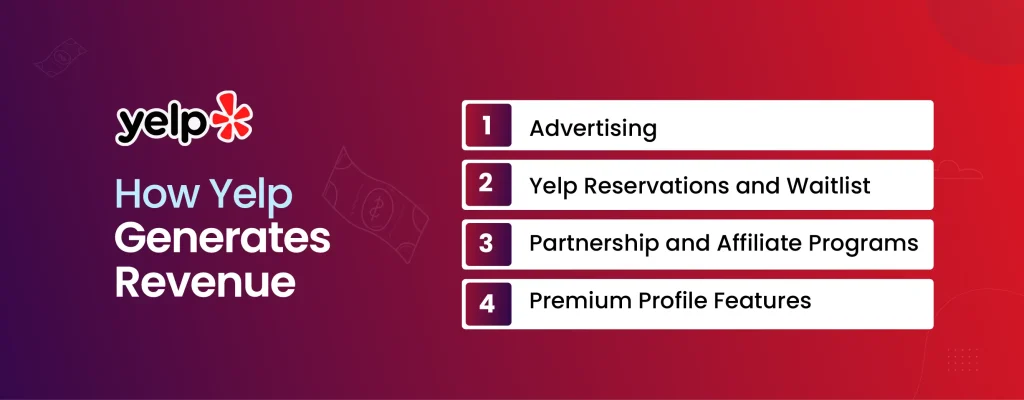
The company uses several revenue streams to keep its operations thriving. Below is an exploration of Yelp’s main revenue generation tactics.
Advertising
Yelp’s main revenue source is local business advertisements. Businesses that need more visibility pay the company for a more dominant listing placement. Sponsored listings appear at the top of search results and on competitor pages.
Businesses can use Yelp Deals and Gift Certificates to attract customers with discounts and special offers. These products connect businesses to customers looking for related services on Yelp.
Much like the Classifieds Business Model, Yelp generates income through advertisements and premium listings.
Yelp Reservations and Waitlist
Yelp Waitlist and Yelp Reservations are booking management tools for reservation-based businesses. They allow restaurants to accept reservations and manage waitlists directly from their Yelp pages. Businesses pay Yelp monthly subscription fees for these services.
Partnership and Affiliate Programs
Yelp earns revenue through various partnerships and affiliate programs. It utilizes its many business listings to earn from directing traffic to various business websites. Businesses, including reservation and food delivery services, pay Yelp commissions from the resulting transactions.
Premium Profile Features
Yelp offers two premium profile packages, namely Branded and Enhanced profiles.
- Branded Profiles: This plan allows businesses to upload videos and display slideshows. They also have more CTA options and an About section.
- Enhanced Profiles: These are branded profiles that also hide rival adverts.
Additionally, businesses can pay to have verified profiles. The blue verification checkmark reinforces their legitimacy. The company charges monthly subscription fees for these three premium profile benefits.
Yelp Business Model Canvas
The Yelp Business Model Canvas is a look into how the company operates and generates value. Here we break down the key business aspects of Yelp.
Customer Segments
Yelp has 3 customer segments: local businesses, content creators, and users.
- Local businesses are categorized into service, location, operating hours, price points, delivery services, etc.
- Users are visitors who come to see reviews
- Content creators are users who actively review businesses on the site.
Key Partners
Yelp’s main partners are local businesses, advertisers, and third-party service providers.
- Advertisers are its source of revenue through paid ads and premium listings
- Local businesses provide the content that users seek
- The third-party service providers, including reservation systems and map services, enhance the user experience
Customer Relationships
Yelp creates positive customer relationships through customer support, social media, and community engagement. It also offers tools for users to personalize various elements. The website provides businesses with tools for tracking engagement, responding to reviews, and updating business information.
Key Activities
Yelp depends on several management activities. One of them is moderating reviews, updating features, and engaging with businesses and users. These activities are crucial to maintaining its relevance and helpfulness.
Value Propositions
Yelp has different value propositions for local businesses and consumers. For consumers, the site offers a reliable and comprehensive platform. It facilitates user discovery and comparison of local companies using community reviews and ratings. Businesses get the chance to engage a large audience and garner positive ratings.
Key Resources
The most important resources in Yelp’s engine include user-generated data and tech infrastructure that runs the website and mobile apps. The user community is another resource that adds credibility and content. Over time, the Yelp brand has grown into an excellent resource for reliability.
Channels
Yelp’s business acquisition and engagement channels include its website and mobile apps. Some of its webpages target developers and business owners who use the Yelp API. It also relies on email marketing, social media, and partnerships with other platforms.
Cost Structure
Most of Yelp’s expenses go to tech maintenance, product development, administrative costs, and marketing efforts to attract and retain businesses. The site also requires constant and responsible review and interaction management. The resulting legal and content moderation costs raise the amount significantly.
Revenue Streams
The company’s primary revenue sources are ad sales and service subscription fees. Ad sales include cost-per-click ads, deal and event promotions, and profile enhancements. On the other hand, subscription services include enhanced visibility and analytical tools. It also earns from transaction charges.
📢Yelp’s approach shares similarities with the Online Directory Business Model by connecting users with local businesses.
Top Competitors of Yelp
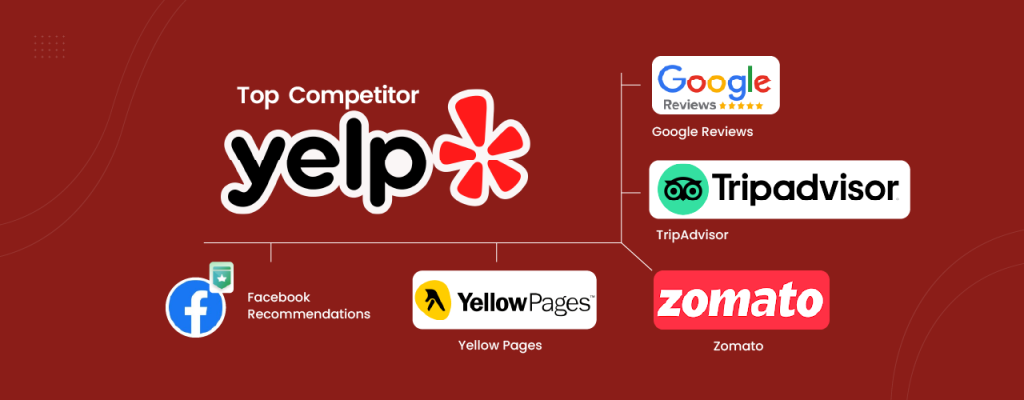
Although Yelp is a household name for reviews and recommendations for various businesses, it faces some formidable competitors. Here, we look at Yelp’s main competitors and what sets them apart.
Google Reviews
Google Reviews is Yelp’s most ardent competitor. It integrates smoothly with various contemporary search engines and map services. These features allow users to leave and view experiences with all businesses. Google ratings are a common metric for gauging the visibility of businesses on search results.
Google Reviews is Yelp’s formidable competitor. Android has 71.9% of the mobile device operating system market share, most of which use Google services. This gives Google Reviews a clear advantage over Yelp.
TripAdvisor
TripAdvisor is popularly known as a travel and accommodation version of Yelp. However, it now accommodates various local businesses. Prior to this expansion, TripAdvisor had established an international reach with a wealth of user-generated content.
TripAdvisor has an advantage of international user reviews. It is also quite comprehensive with hotel, restaurant, airline, cruise, and tourist attraction site reviews. On the contrary, Yelp’s advantage lies in its recognition as a reliable reference for local business ratings and recommendations.
Facebook Recommendations
Facebook boasts more than 3.07 billion active monthly users. It has taken advantage of these numbers in the local business review arena with Facebook Recommendations. It provides suggestions of local spots from friends and the wider community.
Most businesses have active Facebook presences on which they post events and other updates. Many recommendations are personalized since they come from friends. The platform also replaces Yelp’s 5-star rating prompt with a yes/no question: Do you recommend this company?
Zomato
Zomato is Yelp’s competitor, focusing on the food and restaurant industry. It covers millions of restaurants worldwide with table reservations and food delivery services. Users can interact with menus, images, and user reviews of different restaurants.
Yellow Pages
The Yellow Pages provided the first resource for local business listings before the internet. The company now has customer reviews and ratings after its switch from paper to a website. Its worldwide user base contrasts with Yelp’s more local focus.
Yelp SWOT Analysis
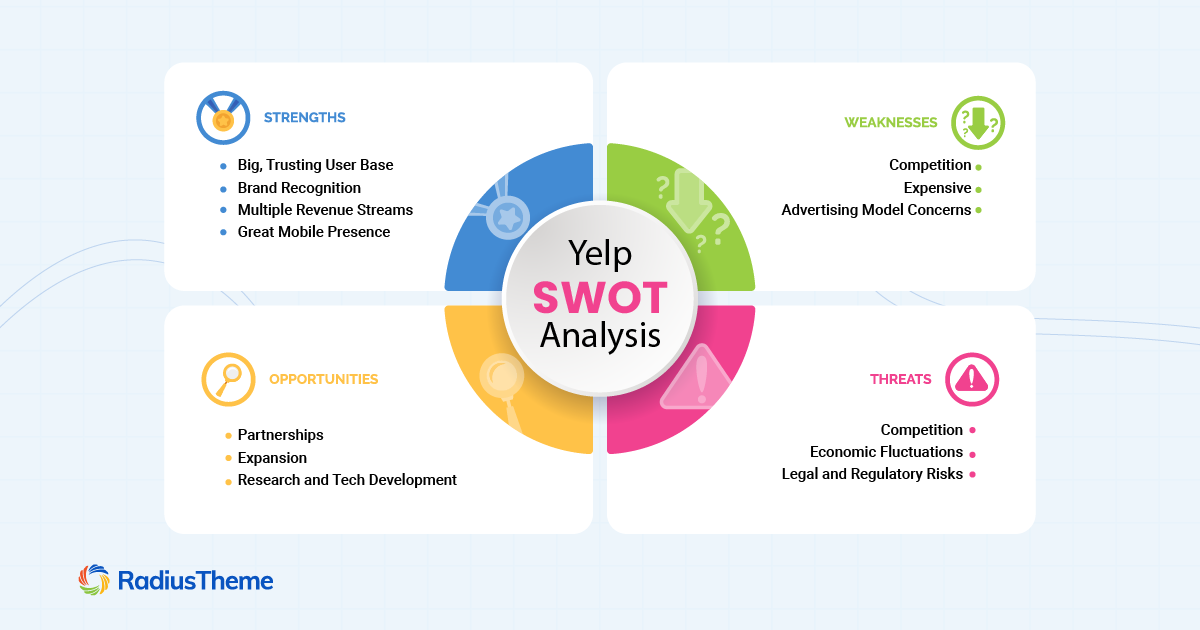
Yelp is in a competitive, flexible, yet lucrative space. This SWOT analysis investigates its strengths, weaknesses, opportunities, and threats to offer insights into its positioning.
Strengths
Big and Loyal User Base: Yelp has gained a vast community of users over the years. They contribute to its wealth of reviews and draw in new users searching for authentic feedback. The site averages hundreds of millions of monthly visitors.
Brand Recognition: Yelp’s singular focus on local communities and reliable reviews has helped it gain consumer trust. Its stable reputation makes it a go-to resource for finding the best local spots.
Multiple Revenue Streams: Yelp’s diversified revenue model includes earnings from business ads, premium subscriptions, and partnerships. It allies with merchants, dealers, and businesses for mutual benefits. The multifaceted income plan is stable and reduces financial risks.
Great Mobile Presence: Yelp has adjusted to the digital era well with a robust mobile application. It offers a better user experience and convenience for sharing and finding reviews.
Weaknesses
Competition: Yelp sees formidable competition from companies like Facebook and Google. Their larger user bases and diverse services give them a clear edge over Yelp.
Expensive: Most businesses may find Yelp’s pay-per-click ad prices expensive. Some niches and locations see costs of up to $40 per click.
Advertising Model Concerns: Small businesses see Yelp’s ad model as financially challenging. What’s more, the visibility of negative ad reviews often has detrimental effects on them.
Opportunities
Partnerships: Strategic partnerships and complementary businesses are an incredible opportunity for Yelp. They could help the company acquire helpful tech, new revenue opportunities, and new user bases.
Expansion: Exploring new locations and markets presents many opportunities for Yelp. Many new, less saturated markets and regions hold excellent revenue potential.
Research and Tech Development: Yelp can improve its bottom line significantly by exploring new revenue-generation methods. This can be accomplished by experimenting with new or improved features and products. Using AI and other new tech may smoothen review processes and improve user experience.
Threats
Competition: Yelp faces stiff new and established competition. New companies mean reduced revenue for Yelp. On the other hand, established competitors like Facebook and Google Maps win in user reach and preference.
Economic Fluctuations: Businesses may reduce ad expenditure when hit with financial challenges. The result would be reduced revenue for Yelp.
Legal and Regulatory Risks: Its operation in multiple jurisdictions exposes Yelp to legal and regulatory risks. Changes in privacy, content, and consumer laws could have a negative effect on Yelp’s operations and revenue.
Frequently Asked Questions (FAQs)
Is Yelp Still Profitable?
Yes. Yelp posted its first ever quarterly profit in 2014, a decade after its establishment. Despite its late blooming, the platform has continued to soar to greater profitability consistently. In 2024, saw a record net revenue, $357 million, and excellent profitability.
Do You Get Paid to Post on Yelp?
Although posting reviews on Yelp doesn’t result in payment, the platform has a reviewer reward system. The Elite program grants select reviewers some perks, such as free products and events. Other users with a dominant online presence can negotiate sponsored posts and similar deals.
Businesses pay Yelp for the promotion of their profiles and better user reach. These paid advertising solutions give businesses an edge over their competition. The only other way to earn with Yelp is by hiring you.
What Are the Disadvantages of Yelp?
Yelp presents its users and businesses with a few disadvantages.
Yelp’s Cons for Users
i. Misleading Reviews: Fake and biased reviews can mislead users.
ii.Overwhelming Choices: Too many options can make it difficult for users to make the best choices.
iii. More Negative Reviews: Users are more likely to leave reviews after negative experiences. The positives of a business are less likely to appear and dominate.
iv.Ad Dominance: The most visible businesses may not necessarily be the best. This is because any business can pay for prominent placement.
Yelp’s Cons for Businesses:
i. Review Issues: The Yelp review issue comes up when customers on a business website click on the Yelp link and leave reviews. These reviews may result in invalid tags and disappear. Clients may have to go to the Yelp site or app to register their reviews.
ii. Negative Reviews: Negative reviews often impact business reputations. Responding and managing them effectively is also challenging.
iii.Costly: The advertisement costs necessary to compete on Yelp can be costly for most small businesses.
iv. Fake Reviews: Competitors and malicious people can post fake reviews, harming their reputation.
Conclusion
Yelp is one of the first companies to monetize user-generated content on a large scale. It leverages data and reviews to attract all businesses and users. Its revenue generation methods provide an excellent case study for anyone interested in local business review sites.
The platform has many strengths that make it the household name it is. Simultaneously, it still faces various threats and weaknesses. However, Yelp’s future is promising with its formidable strengths and opportunities.