
On This Page
Want to build the next TaskRabbit, Fiverr, or Upwork? A service marketplace connects people who need help with people who offer it. And with the right plan, you can build one too.
This guide walks you through every step. From picking a niche to launching your first version. No fluff. Just a clear path you can follow.
What Is a Service Marketplace?
A service marketplace is an online platform where buyers find and hire service providers. The platform itself does not perform the services. Instead, it acts as a bridge between two groups:
- Buyers who need a service done (like logo design, house cleaning, or tutoring).
- Providers who have the skills or tools to do the work.
The marketplace handles the important stuff in between. That includes listings, search, bookings, payments, reviews, and communication.
Think of it this way: A service marketplace is like a shopping mall, but for services instead of products. You do not own the stores. You own the mall.
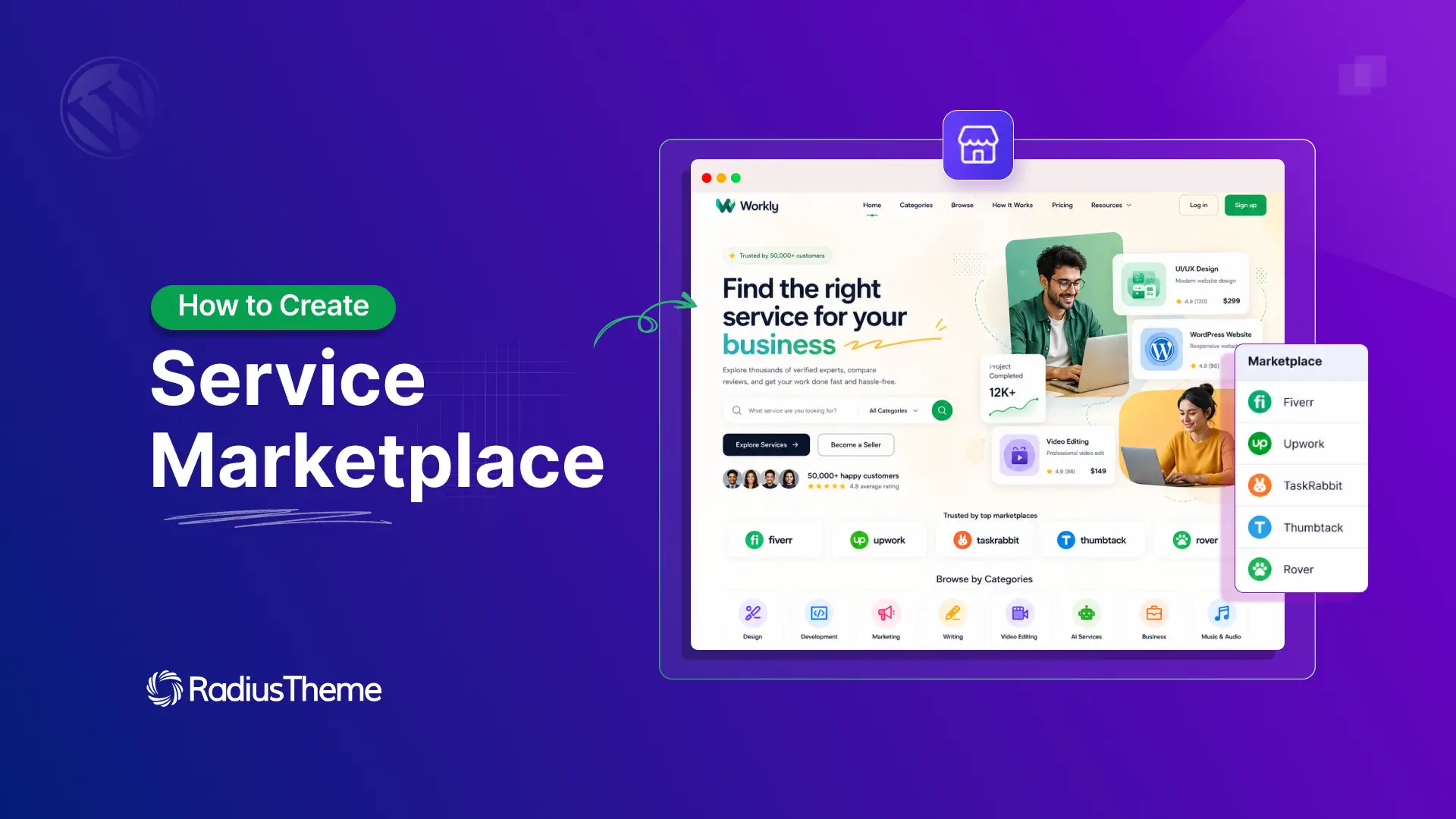
Popular examples include:
| Marketplace | Service Type |
|---|---|
| Fiverr | Freelance creative and tech services |
| Upwork | Remote freelance work |
| TaskRabbit | Local home and handyman tasks |
| Thumbtack | Local professional services |
| Rover | Pet sitting and dog walking |
👉 Good Read: Marketplace Business Model
Types of Service Marketplaces
Not all service marketplaces work the same way. Before you build one, you need to know the main types.
By Service Delivery
On-demand marketplaces connect buyers with providers for immediate or same-day services. Think Uber for rides or Handy for home cleaning. Speed is the main selling point.
Scheduled marketplaces let buyers book services for a future date. Thumbtack and Rover fall into this group. Users browse profiles, compare options, and book when ready.
Project-based marketplaces focus on bigger tasks that take days or weeks. Upwork and Toptal are good examples. Buyers post a project. Providers apply. Work happens over time.
By Audience
B2C (Business to Consumer) marketplaces connect businesses with individual customers. A cleaning company listing on a home services platform is B2C.
C2C (Consumer to Consumer) marketplaces let individuals offer services to other individuals. Fiverr is a strong example. Anyone can sign up and start selling.
B2B (Business to Business) marketplaces connect companies with other companies. Toptal connects businesses with elite freelance developers and designers.
By Focus
Vertical marketplaces focus on one specific industry or service type. Rover only handles pet care. This tight focus makes it easier to build trust and authority.
Horizontal marketplaces cover many types of services. Fiverr lists everything from logo design to voiceover work. These take longer to build but have a bigger addressable market.
Why Build a Service Marketplace?
The service economy is growing fast. People want convenience. They want to find, compare, and book services online. That creates real opportunity.
Here is why a service marketplace can be a strong business:
Recurring revenue with low overhead. You do not deliver the services. Providers do the work. You earn a cut on every transaction without managing inventory or hiring staff.
Scalable by design. Once your platform is live, adding more providers and more buyers does not require a proportional increase in costs. Growth compounds.
Strong network effects. More providers attract more buyers. More buyers attract more providers. Over time, this creates a defensible business that gets harder for competitors to replicate.
Multiple revenue streams. You can earn through commissions, listing fees, featured placements, subscriptions, and premium tools for providers.
High demand across industries. Home services, freelancing, tutoring, health and wellness, legal, pet care, and event planning are just a few sectors where service marketplaces are thriving.
Step 1: Choose a Profitable Niche
Going broad from day one is a common mistake. Most successful marketplaces started with a tight focus.
Airbnb began with air mattresses in San Francisco. Uber launched with black cars in one city. Starting narrow helps you learn faster, build trust, and stand out.
How to Pick Your Niche
Look for pain points. Find a service category where booking or finding providers is still frustrating. The harder it is to find good providers today, the bigger your opportunity.
Check the demand. Use Google Trends, keyword research tools, and forums like Reddit to see if people are actively searching for solutions in your chosen space.
Evaluate the competition. Some competition is healthy. It proves demand exists. But if one dominant player already owns the market, look for a gap they are not serving well.
Consider transaction value. A marketplace where the average booking is $500 needs far fewer transactions to be profitable than one where bookings average $10.
Niche Ideas Worth Exploring
- Home maintenance and repair in specific regions
- Freelance services for a specific industry (like legal or healthcare)
- Tutoring for specific subjects or exam prep
- Pet services in underserved cities
- Event services (photographers, DJs, caterers) in one metro area
- Wellness services (yoga instructors, therapists, nutritionists)
Pick a niche where you understand the audience. Personal experience or industry knowledge gives you a real edge.
👉 Good Read: 30+ Profitable Directory Niche
Step 2: Validate Your Marketplace Idea
A good idea on paper can flop in the real world. Validation helps you test before you invest months of work and money.
Talk to Both Sides
Interview potential providers and buyers. Ask providers what frustrates them about finding clients. Ask buyers what frustrates them about finding good service providers.
If both sides describe problems your marketplace could solve, you are on the right track.
Build a Simple Landing Page
Create a one-page website that explains your marketplace concept. Include an email signup form. Drive traffic through social media or small ad campaigns. If people sign up, that is a strong signal of interest.
Test With a Manual Process
Before building any technology, try running your marketplace manually. Match buyers and providers yourself. Use spreadsheets, forms, and email. This teaches you what features actually matter.
Solve the Chicken-and-Egg Problem Early
Every marketplace faces this challenge. Buyers will not come without providers. Providers will not come without buyers.
Start by focusing on supply. Recruit a small group of quality providers first. Offer them free listings, reduced fees, or guaranteed visibility. Once you have a solid supply, attracting buyers becomes much easier.
Step 3: Define Your Business Model
Your business model determines how you make money. Choose the wrong one and you will struggle to grow. Here are the most common options.
Commission-Based
You take a percentage of every transaction. This is the most popular model. Fiverr charges providers a 20% fee. Airbnb charges both hosts and guests.
Best for: Marketplaces with high transaction volumes. Low barrier for providers to join.
Subscription-Based
Providers pay a monthly or yearly fee to list their services. This model gives you predictable revenue. But it can slow down provider signups.
Best for: Professional service marketplaces where providers earn enough to justify the fee.
Listing Fees
Providers pay to post each listing. This works well when providers already see value in reaching your audience.
Best for: Job boards and niche professional directories.
Freemium
Basic features are free. Providers pay for extras like featured listings, analytics, or priority placement.
Best for: Marketplaces where you need to build a large provider base quickly.
Hybrid
You combine two or more models. For example, a small commission plus optional premium features. Many successful marketplaces use a hybrid approach.
Start with a commission model if you are not sure. It aligns your revenue with the success of your providers. You only earn when they earn.
Step 4: Identify Core Marketplace Features
Your marketplace needs to serve two user groups well: buyers and providers. Here are the essential features each group needs.
For Buyers
Search and filters. Buyers need to find the right provider fast. Let them filter by location, price, availability, ratings, and service type.
Provider profiles. Each provider needs a detailed profile with their services, pricing, photos, portfolio, and reviews.
Booking and scheduling. A simple way to request a service, pick a date and time, and confirm the booking.
Secure payments. Buyers want to pay safely through the platform. Support credit cards, debit cards, and popular payment methods.
Reviews and ratings. Social proof helps buyers make confident decisions. Let them leave reviews after each completed service.
Messaging. Allow buyers to message providers before booking to ask questions or discuss details.
For Providers
Easy onboarding. Make it simple to sign up, create a profile, and list services. A complicated process will drive providers away.
Booking management. Providers need a dashboard to view, accept, decline, and manage their bookings.
Earnings and payouts. A clear view of earnings with reliable payout options (bank transfer, PayPal, etc.).
Reviews and reputation. Let providers build their reputation over time through ratings and completed jobs.
Availability calendar. Allow providers to set their working hours and block off unavailable dates.
For Platform Admins
Admin dashboard. You need a central place to manage users, listings, transactions, disputes, and platform settings.
Analytics and reporting. Track key metrics like total bookings, revenue, active users, and provider performance.
Content moderation. Tools to review and approve listings, manage flagged content, and handle disputes.
Commission management. Set and adjust commission rates, process payouts, and track platform earnings.
Step 5: Choose the Right Technology Approach
This decision shapes your budget, timeline, and flexibility. You have three main options.
Option 1: Custom Development
Build everything from scratch using frameworks like React, Node.js, Django, or Laravel.
Pros: Full control over features and design. Best for unique or complex requirements.
Cons: Expensive. Slow. A custom marketplace can cost $50,000 to $200,000+ and take 6 to 12 months to build.
Best for: Well-funded startups with very specific needs.
Option 2: No-Code and Low-Code Platforms
Use tools like Sharetribe, Bubble, or CS-Cart to build a marketplace without heavy coding.
Pros: Faster launch. Lower upfront cost. Good for testing an idea.
Cons: Limited customization. You may outgrow the platform as you scale.
Best for: Early-stage founders testing a concept.
Option 3: WordPress-Based Service Marketplace
WordPress powers over 40% of the web. It is flexible, well-supported, and cost-effective. And with the right plugins, you can turn a WordPress site into a full service marketplace.
Why WordPress works well for service marketplaces:
- Low startup cost compared to custom development
- Thousands of themes and plugins to extend functionality
- Full ownership of your platform and data
- Large community for support and development resources
- SEO-friendly out of the box
- Easy to manage without deep technical knowledge
Option 3: WordPress-Based Service Marketplace
WordPress powers over 40% of the web. It is flexible, well-supported, and cost-effective. And with the right plugins, you can turn a WordPress site into a full service marketplace.
Why WordPress works well for service marketplaces:
- Low startup cost compared to custom development
- Thousands of themes and plugins to extend functionality
- Full ownership of your platform and data
- Large community for support and development resources
- SEO-friendly out of the box
- Easy to manage without deep technical knowledge
Key WordPress plugins and themes for service marketplaces:
You can combine the right plugin or theme with WordPress to build a fully working service marketplace. Here are some of the best options:
Classified Listing by RadiusTheme is one of the best solutions for building a service marketplace like TaskRabbit. It gives you everything you need to create a classified or service listing platform. Providers can create detailed listings. Buyers can search, filter, and contact providers directly. The plugin supports multiple monetization options including listing fees, membership plans, and featured listings. It is well-maintained, regularly updated, and works with most WordPress themes.
ServListing is a Service Finder WordPress theme built specifically for creating a service marketplace with booking features. It is a no-code, affordable solution for building a service listing website with all the monetization options you need. You get provider profiles, search and filters, booking management, payment processing, and review systems right out of the box. If you want a ready-to-go solution without touching code, ServListing is one of the easiest paths from idea to live marketplace.
Other helpful tools to pair with these solutions:
- WooCommerce for additional payment and transaction handling
- BuddyPress for community features and messaging between users
- RadiusBooking for advanced appointment scheduling if your marketplace needs it
A WordPress service marketplace can go from concept to launch in a few weeks instead of months. It is an excellent starting point for founders who want to move fast without spending a fortune.
Which Approach Should You Choose?
| Factor | Custom | No-Code | WordPress |
|---|---|---|---|
| Cost | High ($50K+) | Low to Medium | Low to Medium |
| Time to Launch | 6-12 months | 2-6 weeks | 3-8 weeks |
| Customization | Unlimited | Limited | High |
| Scalability | Excellent | Moderate | Good |
| Technical Skill Needed | High | Low | Low to Medium |
| Ownership | Full | Platform-dependent | Full |
For most first-time marketplace founders, WordPress or a no-code platform is the smartest starting point. You can always migrate to a custom solution once your marketplace gains traction and revenue.
Step 6: Build an MVP First
An MVP (Minimum Viable Product) is the simplest version of your marketplace that still delivers value. It is not about building everything. It is about building enough to learn what works.
What to Include in Your MVP
Focus only on features that are essential for a buyer to find a provider, book a service, and pay.
Your MVP should include:
- Provider registration and profiles so providers can sign up and list their services
- Search and browse so buyers can find providers
- A booking or contact system so buyers can request a service
- A payment system so transactions happen on your platform
- Basic reviews so buyers can share their experience
What to Leave Out of Your MVP
Skip anything that is nice to have but not critical. That includes advanced filters, mobile apps, AI-powered matching, loyalty programs, and complex analytics dashboards. You can add all of these later.
Launch, Learn, and Improve
Get your MVP in front of real users as quickly as possible. Watch how they use it. Listen to their feedback. Then improve.
The first version of your marketplace will not be perfect. That is the point. Every week you spend building in isolation is a week you could be learning from real users.
Step 7: Market and Grow Your Marketplace
Building the platform is only half the job. Now you need to bring in users on both sides.
Attract Providers First
Direct outreach. Find service providers on LinkedIn, Facebook groups, or existing directories. Reach out personally. Explain the benefits of joining your platform.
Offer early incentives. Waive fees for the first few months. Give early providers “founding member” badges. Feature them prominently on the platform.
Make onboarding effortless. The faster a provider can go from signup to live listing, the more likely they are to stick around.
Attract Buyers
SEO and content marketing. Create helpful content around the services on your platform. If you run a home services marketplace, publish guides like “How to Choose a Reliable Plumber” or “What to Expect When Hiring a House Cleaner.” This brings in organic traffic from people actively looking for services.
Local SEO. If your marketplace serves a specific area, optimize for local search. Create location pages. Get listed in local directories. Encourage reviews on Google.
Social media marketing. Share success stories, provider spotlights, and tips on the platforms where your audience spends time.
Referral programs. Give both buyers and providers a reason to spread the word. Offer credits, discounts, or cash rewards for referrals.
Paid advertising. Start small with Google Ads or Facebook Ads targeting your niche. Measure results carefully before scaling.
Track the Right Metrics
As your marketplace grows, focus on these key numbers:
Liquidity measures the percentage of listings that lead to a transaction. A marketplace with high liquidity means buyers are finding what they need.
GMV (Gross Merchandise Value) is the total dollar value of transactions on your platform. This shows how much economic activity your marketplace is generating.
Take rate is the percentage of GMV you keep as revenue. Higher is better, but not at the expense of driving away users.
Repeat usage shows how often buyers and providers return. A healthy marketplace has strong repeat usage on both sides.
Provider retention tracks how many providers stay active over time. Losing providers means losing supply, which hurts the entire marketplace.
Common Mistakes to Avoid
Building a marketplace is hard enough without making preventable errors. Watch out for these:
Launching too broad. Trying to serve every service category from day one spreads you too thin. Start narrow. Dominate one niche before expanding.
Ignoring one side of the marketplace. Both buyers and providers matter equally. If providers have a bad experience, they leave. If buyers cannot find good providers, they leave. Balance your attention.
Over-building before launch. Spending months perfecting features nobody asked for is a trap. Ship your MVP. Let users tell you what to build next.
Not solving the trust problem. Trust is the currency of a marketplace. Invest early in verification, reviews, secure payments, and dispute resolution.
Competing on price alone. Racing to the lowest commission rate is not a winning strategy. Compete on value: better providers, better tools, better experience.
Wrapping Up
Creating a service marketplace takes planning, patience, and a willingness to learn as you go. But the formula is straightforward.
- Pick a focused niche where people struggle to find good service providers.
- Validate demand by talking to real people on both sides.
- Choose a business model that aligns your success with your users’ success.
- Build an MVP with only the features that matter most.
- Choose a technology approach that matches your budget and timeline.
- Launch, listen, and improve.
- Grow by attracting providers first, then buyers.
You do not need to build the next Upwork overnight. Start small. Learn fast. And let your users guide you toward a marketplace that people actually want to use.
Freequently Asking Question
What is a service marketplace?
A service marketplace is an online platform where buyers find and hire service providers. The platform itself does not perform the services. Instead, it acts as a bridge between buyers who need a service done and providers who have the skills or tools to do the work. The marketplace handles listings, search, bookings, payments, reviews, and communication. Popular examples include Fiverr, Upwork, TaskRabbit, Thumbtack, and Rover.
What are the different types of service marketplaces?
Service marketplaces can be categorized by service delivery (on-demand, scheduled, or project-based), by audience (B2C, C2C, or B2B), and by focus (vertical or horizontal). On-demand marketplaces connect buyers with providers for immediate services. Scheduled marketplaces allow future bookings. Project-based marketplaces handle larger, longer-term tasks. Vertical marketplaces focus on one industry, while horizontal marketplaces cover many service types.
How do you choose the right niche for a service marketplace?
To pick the right niche, look for pain points where finding or booking providers is still frustrating. Check demand using Google Trends and keyword research tools. Evaluate competition to find gaps that dominant players are not serving well. Consider the average transaction value, since higher-value bookings require fewer transactions to be profitable. Niche ideas include home maintenance, industry-specific freelance services, tutoring, pet services, event services, and wellness services.
How do you validate a service marketplace idea before building it?
Validate your idea by talking to potential providers and buyers to understand their frustrations. Build a simple landing page with an email signup form to gauge interest. Test your concept manually by matching buyers and providers yourself using spreadsheets and email before investing in technology. Solve the chicken-and-egg problem early by recruiting a small group of quality providers first, then attracting buyers once supply is in place.
What are the best business models for a service marketplace?
The most common service marketplace business models are: Commission-based (taking a percentage of every transaction, used by Fiverr and Airbnb), Subscription-based (providers pay a monthly or yearly fee), Listing fees (providers pay per listing posted), Freemium (basic features are free, premium features are paid), and Hybrid (combining two or more of these models). For new marketplaces, starting with a commission model is recommended because it aligns your revenue with provider success.
What technology options are available for building a service marketplace?
There are three main technology approaches: Custom development using frameworks like React, Node.js, Django, or Laravel — which can cost $50,000 to $200,000+ and take 6 to 12 months. No-code and low-code platforms like Sharetribe, Bubble, or CS-Cart, which are faster and cheaper but have limited customization. WordPress-based solutions, which are cost-effective, flexible, and can launch in 3 to 8 weeks. WordPress plugins like Classified Listing by RadiusTheme and themes like ServListing are strong options for building a full-featured service marketplace quickly.
What should be included in a service marketplace MVP?
A service marketplace MVP should include provider registration and profiles so providers can sign up and list their services, search and browse so buyers can find providers, a booking or contact system so buyers can request a service, a payment system so transactions happen on the platform, and basic reviews so buyers can share their experience. Advanced filters, mobile apps, AI-powered matching, loyalty programs, and complex analytics dashboards should be left out of the MVP and added later based on user feedback.