
On This Page
Most people spend 15 minutes choosing a domain name and 15 months regretting it.
For a standard business website, a mediocre domain name is a minor inconvenience. But for a directory website where your URL is essentially your product, a bad domain name can quietly sabotage your SEO rankings, erode user trust, and cost you thousands in rebranding costs further down the road.
Your directory site’s domain name is the first thing a potential user sees in search results. It is the first impression you make on a business owner, considering whether to list their company with you. It is the anchor of every backlink, every social media post, and every word-of-mouth referral you’ll ever earn.
This guide compiles strategic frameworks, tested naming formulas, TLD comparisons, and real-world examples to help you make the right call the first time.
🎯 What You’ll Learn: How to pick a directory domain name that strengthens your SEO from day one, builds instant trust with users and listing businesses, scales with your growth, and works as a brand not just a URL.
Why Your Domain Name Matters More for Directories
Before we get into formulas and tactics, let’s address a foundational question: why does this matter so much more for a directory website than for, say, a blog or an e-commerce store?
1. Your Domain Is Your Brand Promise
When someone searches for ‘plumbers in Chicago’ and sees ‘ChicagoPlumbers.com’ in the results, a signal fires instantly in their brain: this site is exactly what I’m looking for. That psychological shortcut called immediate category recognition is worth more than any amount of advertising spend.
Unlike a SaaS product or an e-commerce brand where users become loyal to a product experience, directory users are loyal to utility. They come because the name tells them you have what they need. Lose that signal and you lose the click.
2. It Directly Influences Your SEO Starting Point
Exact match domains (EMDs) and partial match domains (PMDs) still carry measurable SEO weight in 2025, particularly for local and niche search queries. A domain like VeganRestaurantFinder.com or DenverRealEstateListings.com enters the SEO race with an inherent advantage for its target keywords.
This doesn’t mean Google ranks bad content on good domains, quality still wins. But when two sites publish equally strong content, the domain with keyword relevance will consistently outperform a generic or abstract name for those specific terms.
3. Backlink Anchor Text Gets a Free Boost
When other websites link to your directory, they often use your brand name or domain as the anchor text. A keyword-rich domain name means that every brand-name backlink you earn also serves as a partial keyword anchor link, giving you a double SEO benefit from a single link.
4. Trust Is the Currency of Directory Websites
Businesses pay to be listed on your platform. Users trust your listings to be accurate and curated. Both transactions require trust and trust starts before they even click. A clear, professional, memorable domain name is the first handshake in that trust relationship.
The 3 Core Naming Strategies for Directory
There is no single “correct” approach to naming a directory. There are three distinct strategic paths, and the right one depends entirely on your budget, your market, and your growth horizon.
The Literal Approach (SEO-First)
This strategy combines your niche or location directly with your function. The result is a domain name that leaves zero doubt about what the site does.
Core Formula: [Niche/City] + [Function] → Clear, Searchable Domain
Example formulas and outputs:
| Formula Pattern | Example Domains |
|---|---|
| [City] + [Service] | AustinPlumbers.com / MiamiLawyers.com |
| [Niche] + [Finder/Directory] | VeganFinder.com / FreelanceDirectory.com |
| [Action] + [Niche] | HireDesigners.com / FindDoctors.com |
| [Niche] + [Location] | DentistsLondon.com / ChicagoRestaurants.com |
| [Best/Top] + [Niche] | TopTradespeople.com / BestNannies.com |
Best For: Bootstrapped founders, local directories, niche verticals, anyone prioritizing organic SEO traffic from day one.
Key Risk: Literal names can limit your perceived scope if you expand. A domain called ChicagoPlumbers.com looks odd if you expand to Dallas. Plan your geographic scope before committing.
💡 SEO Insight: Partial match domains consistently outperform generic names for long-tail local queries. If your directory targets a specific city or niche, a literal domain name is a compounding SEO asset it gets more valuable, not less, over time.
The Authority Approach (Trust-First)
This strategy uses words that imply curation, vetting, and quality. Rather than simply describing what your directory lists, the name signals that your listings are filtered and trustworthy.
This is particularly powerful for directories that charge businesses for premium listings; it makes the premium feel justified. A business would rather be listed on EliteLawyers.com than AllLawyers.com because the former implies prestige.
High-trust authority keywords to incorporate:
- Verified implies vetting and quality assurance
- Top / Best communicates curated excellence
- Pro / Elite signals professionalism and premium status
- Select / Certified implies a standard was applied
- Guide / Hub positions you as the definitive resource
- Trusted / Approved direct trust signal
Real examples by niche:
| Niche | Domain Example | Why It Works |
|---|---|---|
| Legal | VerifiedLawyers.com | Implies each lawyer has been vetted builds user confidence |
| Healthcare | TrustedDoctorsHub.com | Patients search for trusted practitioners this domain converts |
| Trades | ProTradespeople.com | “Pro” signals quality to homeowners hiring contractors |
| Hospitality | EliteHotels.co | Sounds premium encourages high-end hotel listings |
| Local | TheBestOfLondon.com | City pride + authority strong for local business directories |
Best For: Directories targeting premium listings, professional services (legal, medical, financial), B2B directories, or any market where users are making high-stakes decisions.
The Abstract Brand Approach (Growth-First)
Think Yelp. Think Zillow. Think Trivago. These are completely invented words that carry no literal meaning and they became globally dominant platforms.
The abstract brand approach creates a unique, trademarkable name that can expand into any category, any geography, and any market without semantic constraints.
The Catch: This approach requires significant marketing investment to educate your audience. When someone hears “Yelp” for the first time, they have no idea what it is. Yelp spent millions teaching the market what that word means.
⚠️ Honest Recommendation: Unless you have venture capital funding or a substantial marketing budget (think $50,000+), avoid the abstract brand approach entirely. For a bootstrapped or small-budget launch, you need your domain name to do marketing work for free. Abstract names cannot do that.
When abstract names DO make sense:
- You are building a national or global platform from day one
- You have funding to invest in brand awareness campaigns
- You’ve already validated the market and are in growth mode
- The name itself is highly memorable and phonetically strong (e.g., “Houzz,” “Thumbtack”)
The Non-Negotiable Usability Rules
No matter which naming strategy you choose, every directory domain must pass these fundamental usability tests. These rules exist because directories grow through word-of-mouth referrals and return traffic, both of which require a name that is easy to remember, spell, and share.
Rule 1: The Radio Test
Imagine your domain name is being read aloud on a podcast, a radio advertisement, or a conference presentation. Will listeners know exactly how to find you without asking for the spelling?
| Domain Name | Radio Test Analysis |
|---|---|
| ❌ XpressFindr.com | Is it Express or Express? Is it Finder or Findr? Two spelling ambiguities in one name. |
| ❌ QuikServ.com | “Quick” or “Quik”? “Serve” or “Serv”? You’ll lose half your referral traffic. |
| ❌ EazyClaim4U.com | Numbers and letter substitutions look clever in writing but are catastrophic verbally. |
| ✅ FastFind.com | Instantly clear. Both words are spelled exactly as they sound. Zero ambiguity. |
| ✅ LocalHire.com | Simple, two real words, naturally memorable. Passes the radio test easily. |
| ✅ HomePro.com | Short, professional, zero spelling confusion. Works in every medium. |
Rule 2: Never Use Hyphens
Hyphens in domain names are a trust-killer. Legitimate brands established in the last decade do not use hyphens. Hyphens are strongly associated with low-quality, spammy websites from the early 2000s and that association has never gone away.
The Double Problem with Hyphens: When you tell someone verbally to visit Miami-Business-List.com, they will type MiamiBusinessList.com, sending your traffic directly to a competitor or a parked domain.
Rule: If the hyphenated version of your name is available but the unhyphenated version is taken, do not buy the hyphenated version. Instead, choose a different name entirely.
Rule 3: Keep It Under 15 Characters
Every additional character in your domain name is an additional opportunity for a typo, an additional cognitive load for the user to remember, and an additional character that gets truncated in search result titles and social media previews.
Character count analysis:
| Length | Verdict | Examples |
|---|---|---|
| Under 10 characters | Ideal | Yelp.com (4), Zillow.com (6), HireHQ.com (6) |
| 10 to 15 characters | Good | LocalHire.com (9), ProPlumbers.com (11) |
| 15 to 20 characters | Acceptable | WeddingVendors.com (14) borderline |
| Over 20 characters | Avoid | MiamiBusinessDirectory.com too long, too risky |
Rule 4: The Trademark Check
Before falling in love with a domain name, verify it doesn’t infringe on an existing trademark. A domain that gets a cease-and-desist letter six months after launch can cost you everything you’ve built.
Quick trademark verification steps:
- Search the USPTO trademark database at trademark.uspto.gov (US-based directories)
- Search EUIPO at euipo.europa.eu (European directories)
- Run a basic Google search for the name to see if any established brands are using it
- Check that your exact name is not already incorporated as a company in your jurisdiction
- Once cleared, consider registering a trademark yourself as your directory grows
Choosing the Right Domain Extension (TLD)
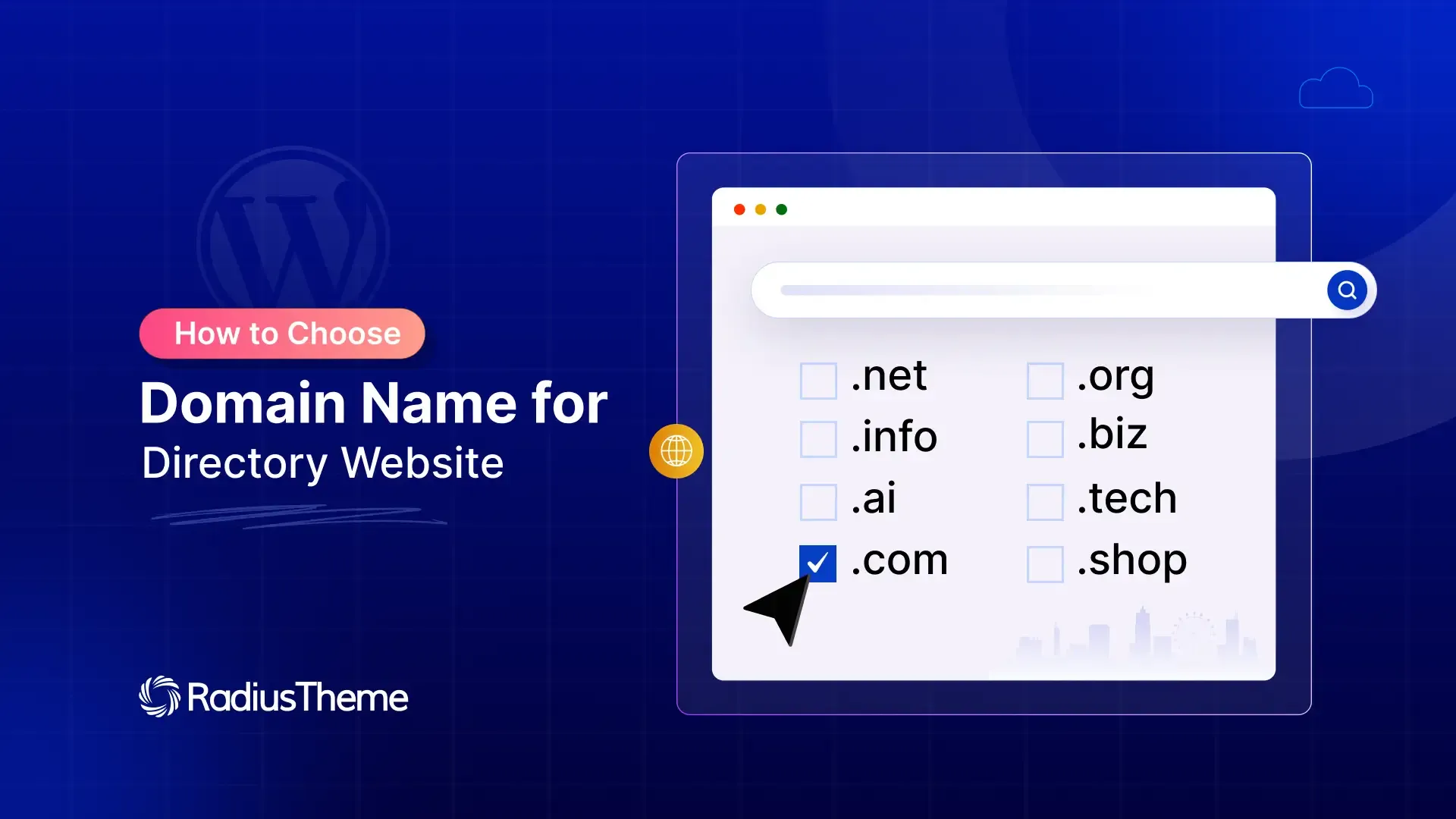
The TLD (Top-Level Domain) the .com, .co, .io at the end of your URL affects SEO perception, trust signals, and memorability. The directory space has more flexibility than most industries, but there is still a clear hierarchy.
| Extension | Verdict | When to Use It |
|---|---|---|
| .com | 👑 First Choice | Maximum trust, best resale value, strongest global recognition. Always your first attempt. |
| .co | 🥈 Strong Runner-Up | Widely understood as a legitimate business extension. Acceptable if .com is taken. |
| .net | ⚠️ Weakening | Once strong, now declining in trust perception. Use only if highly relevant to your niche. |
| .org | ⚠️ Contextual | Appropriate only for non-profit or community directories. Avoid commercial platforms. |
| .io / .ai | 🤖 Tech Signal | Use only if your directory features advanced AI tools otherwise it creates a mismatch expectation. |
| .directory | ❌ Risky | Descriptive but unfamiliar. Users often perceive new TLDs as lower-trust or “spammy.” |
| .nyc / .london | 📍 Geo-TLDs | Excellent for hyper-local directories but only if 100% sure you will never expand beyond that city. |
💡 The .com Strategy: If your preferred .com is taken, try adding a relevant prefix or suffix rather than switching to a weaker TLD. GetLocalPros.com is better than LocalPros.io. Use tools like NameMesh or LeanDomainSearch to find available .com combinations instantly.
Smart prefix/suffix patterns when your ideal .com is taken:
- Get[Name].com → GetElectricians.com
- [Name]HQ.com → PlumbersHQ.com
- Find[Name].com → FindSolicitors.com
- [Name]Now.com → HireNow.com
- The[Name].com → TheContractorList.com
SEO and Marketing Impact of Your Domain Name
Let’s get specific about the measurable ways your domain name affects your search engine performance and marketing ROI. These are not theoretical, they are quantifiable impacts that compound over the lifetime of your website.
Impact 1: Click-Through Rate in Search Results
Google pays close attention to click-through rate (CTR) as a ranking signal. A domain name that matches user search intent for example, showing “DenverPlumbers.com” in a result when the user searched “plumbers in Denver” generates a higher CTR than a generic domain name.
Studies from Moz and Ahrefs have consistently shown that domain name relevance influences CTR by 10–30% for competitive local queries. Over thousands of monthly searches, that difference translates directly into more organic traffic without spending an additional dollar on content or links.
Impact 2: Direct Navigation Traffic
Directory websites earn a disproportionate share of their traffic from direct navigation users who type your URL directly into their browser because they remember it. This traffic has a zero customer acquisition cost and the highest conversion rate of any channel.
A memorable, literal domain name dramatically increases direct navigation traffic. When someone tells a friend ‘I found my electrician on ElectriciansHQ.com,’ that friend can recall and type that URL weeks later. An abstract or complex name breaks this chain entirely.
Impact 3: Link Earning and Brand Anchor Text
When bloggers, journalists, or other directory owners link to your site, the anchor text they naturally use is your brand name or domain. A keyword-rich domain name converts these brand mentions into partial-match keyword links, arguably the safest form of keyword anchor text in a post-Penguin link profile.
For example, if your site is called LocalTradesmen.com and a home improvement blog links to you saying “check out LocalTradesmen.com,” you’ve just earned a keyword-relevant backlink with completely natural anchor text. That combination brand name + keyword relevance is a backlink profile that Google loves.
Impact 4: Conversion Rate for Premium Listings
For business owners deciding whether to pay for a premium listing, your domain name is a credibility signal that happens before they even reach your pricing page. A name like VerifiedTradepeopleUK.com communicates standards and selectivity making businesses more willing to pay for placement.
Conversely, a generic or abstract name forces you to work harder on your sales page to establish the same level of credibility. Your domain name is silent pre-selling and great pre-selling makes everything downstream easier.
Future-Proofing: Naming for the AI Era
The way people discover directory websites is changing. In 2020, a user typed a query into Google. In 2025, a growing percentage of those same users are asking AI assistants ChatGPT, Perplexity, Google Gemini to recommend the best directory for their needs.
This shift has a subtle but important implication for directory naming. AI systems are trained on language that describes actions and outcomes, not passive lists. The old vocabulary of directories was about storage: pages, listings, yellow pages. The new vocabulary is about action and intelligence.
From Passive to Active Naming
| Old Directory Naming Pattern | Modern Active Alternative |
|---|---|
| Old Passive Language | New Active Language |
| YellowPages, Directory, Listing | Scout, Finder, Guide, Advisor, Hub |
| BusinessList.com | BusinessScout.com |
| HotelListings.com | HotelFinder.com or AskHotels.com |
| LocalDirectory.com | LocalGuide.com or NearbyPros.com |
| ProfessionalDatabase.com | FindPros.com or HireCertified.com |
AI-Friendly Naming Prefixes
These prefixes position your directory as an intelligent, active tool rather than a static database which aligns better with how AI assistants describe and recommend services:
- Smart → SmartContractors.com implies intelligent matching
- Ask → AskLocal.com conversational, AI-native phrasing
- Go → GoHire.com action-oriented, momentum-forward
- Snap → SnapPlumbers.com implies speed and efficiency
- Find → FindNannies.com direct, functional, user-intent aligned
- Rapid → RapidListings.com communicates speed of results
💡 Future-Proof Test: Ask yourself: if someone told an AI assistant to ‘find me the best directory for wedding photographers,’ would your domain name make sense in the AI’s response? Names that sound active and purposeful get recommended more naturally than names that sound like databases.
Step-by-Step Domain Selection Process
Here is a practical, repeatable process to go from blank page to registered domain in under three hours.
Step 1: Define Your Scope
Answer these three questions before touching a domain search tool:
- What is your niche? (Be specific: not ‘home services’ but ‘electricians in Texas’)
- What is your geographic scope? (Local city, national, or global?)
- What is your business model? (Free listings, paid packages, subscription?)
Your answers determine which naming strategy fits best. A local, bootstrapped directory → Strategy A. A premium national directory → Strategy B. A funded startup → possibly Strategy C.
Step 2: Generate 20–30 Name Candidates
Use these free tools to generate combinations from your target keywords:
- LeanDomainSearch.com enter one keyword, get hundreds of .com combinations
- NameMesh.com enter multiple keywords, get categorized suggestions
- Wordoid.com generate brandable made-up words if pursuing Strategy C
- Bust a Name lets you combine prefixes, keywords, and suffixes flexibly
Generate at least 20 candidates before evaluating any of them. Avoid falling in love with the first name you like. It narrows your judgment.
Step 3: Apply the Elimination Filters
Run each candidate through this elimination checklist. Eliminate any name that fails even one test:
| Filter Test | Pass Criteria |
|---|---|
| Radio Test | Say it aloud. Is the spelling 100% clear? No ambiguity? |
| Hyphen-Free | Does it contain any hyphens? If yes, eliminate. |
| Length Check | Is it under 15 characters? Under 10 is ideal. |
| Spelling Check | Does it use creative misspellings? (Findr, Xpress) eliminate. |
| Trademark Check | Does a search on USPTO or EUIPO show any conflicts? |
| Google Check | Search the name. Does any established brand rank for it? |
| .com Available | Is the .com extension available? If not, is the .co available? |
| Future Scope | Will this name make sense in 5 years if you expand? |
Step 4: Shortlist to 3 Finalists
From your filtered list, pick the 3 strongest candidates. For each finalist, ask:
- Would I be comfortable saying this on a conference stage?
- Would a business owner feel proud to say ‘We’re listed on [Name].com’?
- Does it communicate what we do without explanation?
- Can I build a brand identity (logo, colors, tone) around this name?
Step 5: Register and Lock In Your Domain
Once you’ve chosen your domain:
- Register it immediately domain availability changes by the hour
- Buy the .com first; also buy the .co if budget allows
- Register common misspellings if they are short words (set them to redirect to your main domain)
- Enable domain privacy protection to keep your personal contact info off WHOIS records
- Set auto-renewal so you never accidentally let your domain expire
💡 Recommended Registrars: Namecheap (best value + free privacy protection), Google Domains (cleanest UI), or Cloudflare Registrar (cost price, no markup). Avoid registering through your hosting provider if it locks you in unnecessarily.
Next Steps After Choosing a Domain
Choosing the right domain is the foundation but it’s just the beginning. Here are the next strategic milestones for your directory website, each with a detailed guide to take you forward.
Choose Your Niche
If you haven’t yet validated which directory niche you’ll target, this is where to start. Different niches have dramatically different revenue potential, competition levels, and audience behaviors.
📌 Read Next: Best Online Business Directory Niches
Build Your Directory Website
With your domain registered and your niche validated, it’s time to build. This comprehensive guide walks you through the complete WordPress directory setup from theme selection to your first published listing.
📌 Read Next: How to Create a Directory Website in WordPress
Monetize Your Directory
A directory without a monetization strategy is a hobby. A directory with the right pricing model is a scalable business. Learn every revenue stream available to you from paid listings to advertising to lead generation fees.
📌 Read Next: How to Earn Money from a Business Directory Website
Drive Traffic to Your Directory
Getting your directory indexed is one thing. Getting hundreds of targeted visitors every day is another. This guide covers both SEO and non-SEO traffic strategies specifically designed for directory websites.
📌 Read Next: Best Ways to Increase Directory Site Traffic
Frequently Asked Questions
Yes, but indirectly and partially. Exact match and partial match domains carry SEO relevance signals, particularly for local and niche queries. However, domain relevance is one factor among many. Strong content, quality backlinks, and user experience signals outweigh domain name alone. The domain name’s biggest SEO impact is on click-through rate in search results where a relevant, clear name consistently outperforms generic alternatives.
Expired domains with existing backlink profiles can give you a head start, but carry significant risks for directory websites. Directories rely heavily on trust and a domain with a spammy history or a penalty can permanently undermine that trust signal. Unless you have the expertise to fully audit a domain’s backlink profile, penalty history, and brand associations, starting fresh with a new domain is almost always the safer choice.
Apply the prefix/suffix strategy first: Get[Name].com, [Name]HQ.com, Find[Name].com, [Name]Now.com. If the name is owned by an active business, choose a different name entirely. If it’s parked (owned but not actively used), you can consider making an offer to buy it tools like Estibot can help you estimate a fair price. As a last resort, .co is an acceptable alternative for startup directories.
Extremely important if you are building a local directory and potentially limiting if you plan to scale. For a genuinely local-focused directory (a single city or region), a location-specific domain (DenverContractors.com) is a significant SEO and trust asset. If you want the option to expand geographically in future, use a niche name without a geographic qualifier (ContractorHub.com) and create location-specific subfolders or pages within the site.
Technically yes but practically it is one of the most damaging things you can do to a directory website. A domain change requires a full URL migration, 301 redirects from every old URL, updated backlink profile, and a period of ranking volatility that can last 6–18 months. Directories that have accumulated listings, user accounts, and backlinks are especially difficult to migrate. Choose carefully the first time treating your domain name as a permanent, foundational business decision.
Final Thought
Your domain name is the one element of your directory website that is nearly impossible to change once you’ve launched and built authority. Every other element of your design, your categories, your pricing, your content can be updated, optimized, and improved. Your domain name is permanent. Treat it as such. Spend the time to get it right before you spend a single minute building your site.