On This Page
Whether you are a private boat owner looking to sell your vessel, a dealer wanting to expand your reach, a manufacturer ready to go direct-to-consumer, or an entrepreneur exploring the booming marine tech space, understanding what a boat marketplace is and how it works is your starting point.
This guide covers everything: definitions, platform types, key features, earning models, SEO strategies for listings, and the tools you need to build or use a boat marketplace effectively.
What Is a Boat Marketplace?
A boat marketplace is an online platform that connects buyers and sellers of watercraft including private owners, licensed dealers, and manufacturers. Think of it as the Autotrader or Zillow of the marine industry, but purpose-built for everything from 12-foot fishing dinghies to 100-foot luxury superyachts.
These platforms serve two primary models:
- Sales Marketplaces — Where vessels are listed for permanent purchase (new or used).
- Rental Marketplaces — Where boat owners list their vessels for short-term hire, similar to how Airbnb works for accommodation.
Some advanced platforms combine both models, creating hybrid ecosystems where the same vessel can be listed for sale or available for charter when not in use — maximizing asset utilization for the owner.
Who Uses a Boat Marketplace? Understanding the Ecosystem
The marine marketplace ecosystem has four core user groups, each with distinct needs:
1. Private Sellers
Individual boat owners who want to sell without going through a broker. They need easy listing tools, photo/video upload capabilities, and access to a wide buyer pool without high commission fees.
2. Boat Dealers
Licensed dealers often manage inventories of dozens or hundreds of vessels. They need bulk listing capabilities, lead management integrations, and premium placement options. Platforms like Boat Trader and boats.com have been built specifically around dealer needs.
3. Manufacturers
Boat manufacturers use marketplaces to generate direct-to-consumer leads, showcase new model lines, and connect with authorized dealer networks. A manufacturer listing on a major platform gains exponentially more visibility than any standalone website alone.
4. Buyers & Renters
On the demand side, buyers range from first-time fishing boat purchasers to seasoned yacht collectors. Renters are typically experience-seekers — groups booking a catamaran for a weekend, families renting a pontoon for a lake holiday, or corporate clients chartering a yacht for an event.
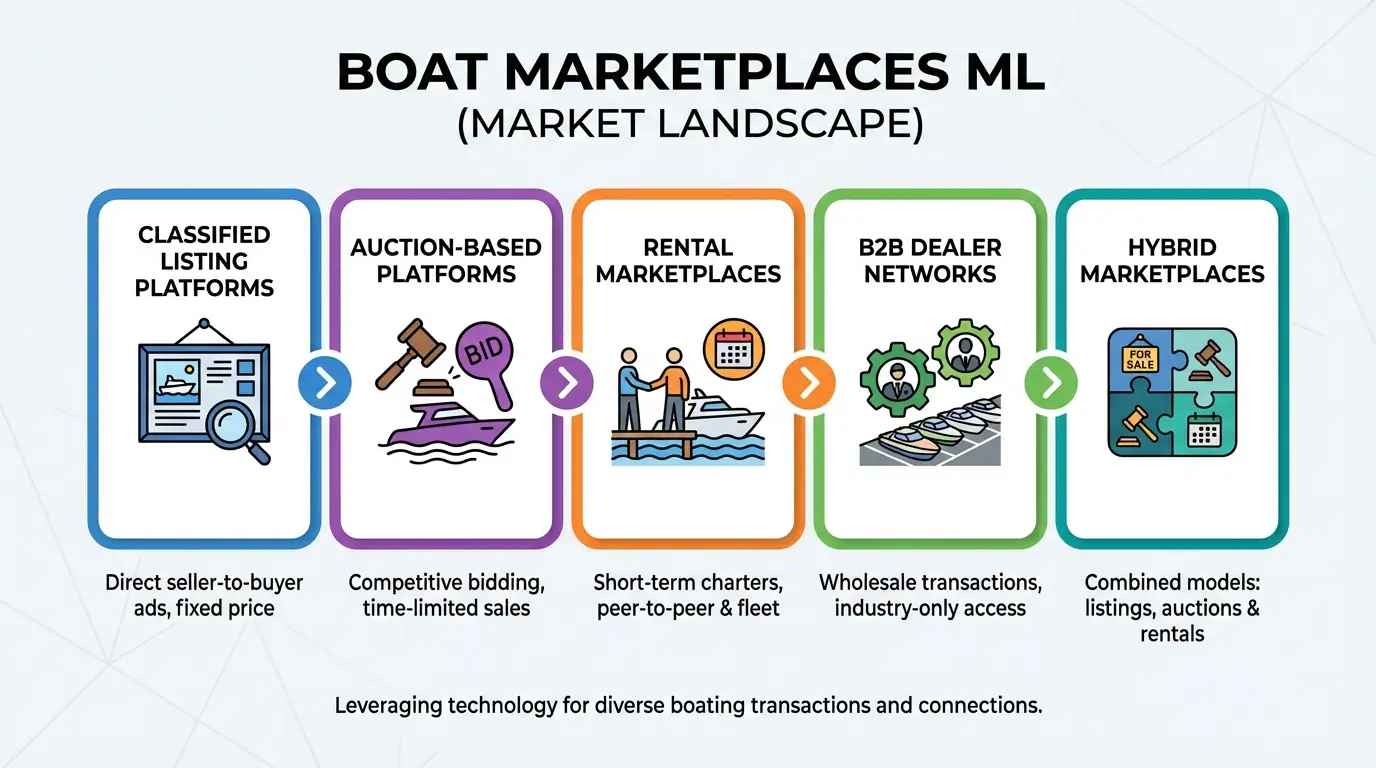
Types of Boat Marketplaces: Which Model Is Right for You?
Classified Listing Platforms
The most common model. Sellers pay to list their boats; buyers browse for free. Revenue comes from listing fees, featured placements, and dealer subscriptions. Examples: Boat Trader, Boat24, YachtWorld.
Auction-Based Platforms
Boats are listed with a starting bid price and sold to the highest bidder within a set timeframe. This model accelerates sales and works particularly well for marine repossessions, estate sales, and fleet liquidations.
Rental/Charter Marketplaces
These operate on a commission model — the platform takes a percentage of each booking. The owner sets availability and price; the platform handles discovery, payments, and often insurance. Think GetMyBoat or Click&Boat.
B2B Dealer Networks
Purpose-built platforms connecting manufacturers with dealer networks. Rather than serving the general public, these marketplaces streamline wholesale inventory distribution and dealer territory management.
Hybrid Marketplaces
The most scalable model for new builders. A hybrid platform allows both sales listings and rental bookings under one roof, giving users maximum flexibility and giving operators multiple revenue streams simultaneously.
Must Have Fetures for Boat Marketplace
Whether you are evaluating an existing platform or planning to build one, these are the non-negotiable features that separate high-performing marine marketplaces from the rest:
- Advanced Search & Filter Engine — Filter by vessel type (sailboat, powerboat, catamaran, yacht, PWC), price range, year, length, location radius, engine hours, and fuel type.
- Rich Media Listings — Support for high-resolution photo galleries, 360-degree walkthroughs, and video embeds. Buyers want to inspect boats visually before traveling.
- Verified Seller Badges — Trust signals are critical in high-value transactions. Dealer verification, seller ratings, and history reports increase conversion rates significantly.
- Geolocation & Map View — Buyers want to see what is available near them or in their target destination. Interactive map listings improve engagement metrics.
- Saved Searches & Alerts — Let buyers save their filter criteria and receive email or push notifications when matching vessels are listed.
- Secure Messaging System — An in-platform communication tool protects both parties and keeps conversations trackable.
- Mobile-First Design — The majority of marketplace traffic comes from mobile devices. Responsive design is not optional.
- Payment & Escrow Integration — For rental platforms, especially, secure payment processing with escrow protection reduces fraud and builds buyer confidence.
- SEO-Optimized Listing Pages — Each boat listing should generate a unique, crawlable URL with structured data markup for Google’s rich results.
How Boat Marketplaces Make Money: Revenue Models Explained
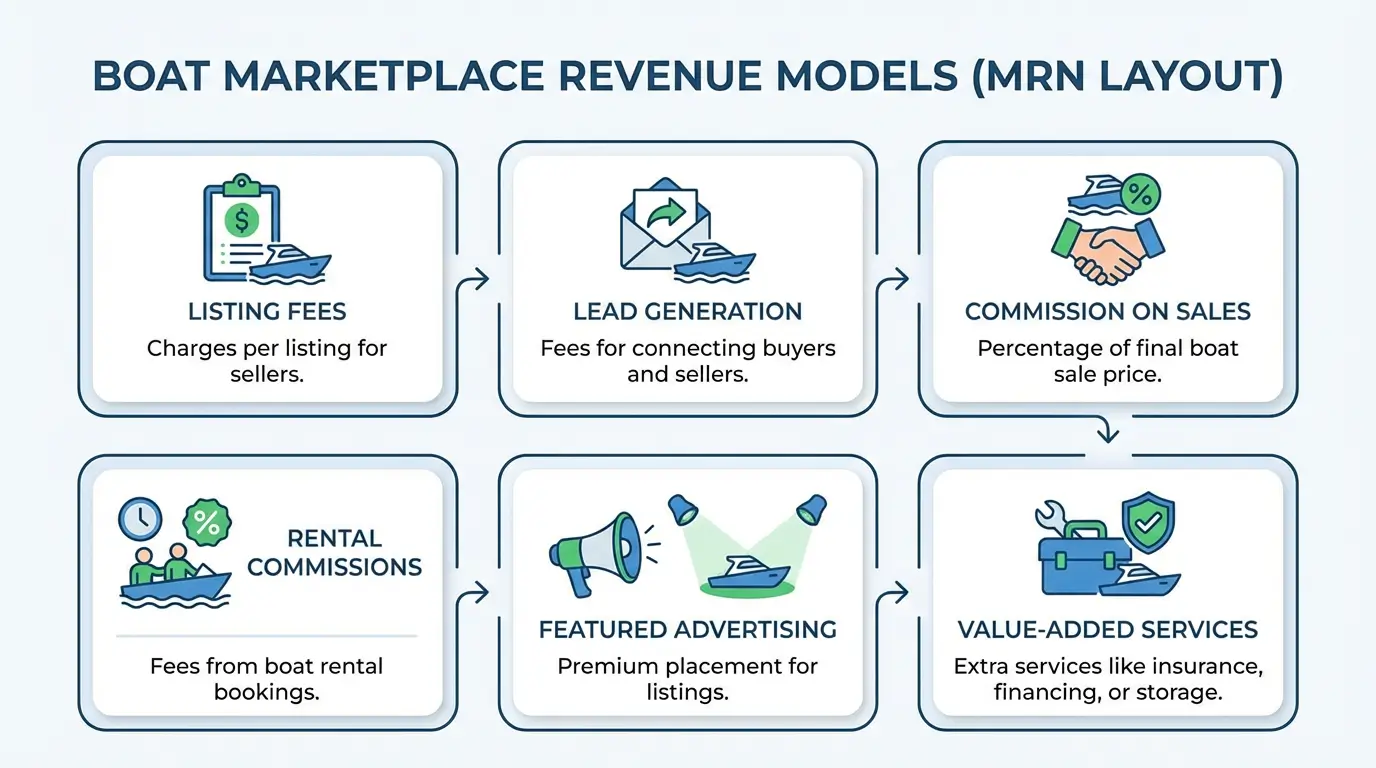
If you are building a boat marketplace, your business model is as important as your technology. Here are the primary monetization strategies used by the world’s leading marine platforms:
Listing Fees
Sellers pay a flat fee or tiered subscription to list their vessels. Free basic listings with paid upgrades (more photos, featured placement, priority search ranking) is the classic freemium approach.
Lead Generation & Dealer Subscriptions
Dealers and manufacturers pay monthly subscriptions for unlimited listings plus lead routing. This is the backbone revenue model for platforms like Boats Group and Boat Trader — reliable, recurring, and scalable.
Commission on Sales
The platform takes a percentage of the final transaction value. This model aligns platform incentives with seller success but requires robust escrow and transaction management infrastructure.
Rental Commissions
For rental marketplaces, a 15–25% commission on each booking (split between owner and renter service fees) mirrors the proven Airbnb model and generates high revenue relative to operational overhead.
Featured Advertising
Boat-adjacent businesses — marine insurers, surveyors, financing companies, yacht clubs — pay for banner placements, sponsored content, and email campaigns targeted to the platform’s qualified buyer audience.
Value-Added Services
History reports, professional photography packages, listing copywriting, boat survey coordination, financing referrals, and shipping logistics represent high-margin add-on revenue opportunities.
👉 Good Read: Monetize Your Directory Website
How to Build a Boat Marketplace: Tools & Technology Stack
Building a boat marketplace from scratch does not require a team of 20 engineers. The right no-code and low-code tools can get a functional, SEO-optimized, monetized platform live within weeks.
WordPress + Classified Listing Plugin
For entrepreneurs who want full control without enterprise-level budgets, WordPress combined with a purpose-built classified listing plugin is the most proven route. The Classified Listing Plugin by RadiusTheme is specifically recommended for boat marketplace builds — it offers category-specific fields, location-based search, map integration, paid listing packages, and WooCommerce compatibility for payment processing.
Why this stack works: WordPress powers over 43% of all websites globally. Its plugin ecosystem means you can add marine-specific features — hull material filters, engine type fields, certification fields — without writing a single line of custom code. The result is a professional, scalable marketplace that ranks well in search engines from day one.
Sharetribe
A dedicated marketplace SaaS platform. Strong for rental models, with built-in booking, payments, and reviews. Less flexible for sales-focused classified models but excellent for charter-first platforms.
Custom Development
Enterprise-level projects with complex B2B dealer network requirements, custom matching algorithms, or advanced analytics dashboards may require a bespoke build. Expect timelines of 6–18 months and budgets starting at $50,000 USD.
How to Get Your Boat Marketplace Found Online
A marketplace with no traffic is a ghost town. Here is how the best marine platforms dominate search:
Search Engine Optimization (SEO) for Boat Listings
- Each listing should have a unique title tag formatted as: [Year] [Make] [Model] for Sale — [Location] | [Site Name]
- Use structured data (Schema.org Product or Vehicle markup) so Google displays price, availability, and key specs directly in search results.
- Build location landing pages: ‘Boats for Sale in Miami’, ‘Used Yachts in Fort Lauderdale’ — these capture high-intent local searches.
- Internal linking between related listings (same brand, similar price range) improves crawl depth and time on site.
Answer Engine Optimization (AEO) for AI Search
As AI-powered search tools like ChatGPT, Perplexity, and Google’s AI Overview become primary discovery channels, boat marketplaces must optimize for featured snippet capture and direct answer formats:
- Create dedicated FAQ pages answering common buyer questions: ‘What is the average cost of a used pontoon boat?’ or ‘How does boat financing work?’
- Use clear H2/H3 heading structures with question-format headings so AI engines can extract and cite your content as authoritative answers.
- Publish comprehensive buyer guides and cost breakdowns — these are highly likely to be surfaced by AI assistants responding to research queries.
Geo-Targeted Optimization (GEO) for Local Discovery
- Register your marketplace on Google Business Profile as a boat dealer/marketplace category.
- Build marina-specific and lake-specific landing pages for the regions you serve.
- Partner with local yacht clubs, marina operators, and boat shows for backlink acquisition — these are high-authority, niche-relevant links that move rankings.
Top Boat Marketplace Platforms to Know
Understanding the competitive landscape helps both buyers and platform builders:
- Boat Trader — The largest US-focused boats-for-sale classified platform. Dealer-oriented with strong SEO authority.
- boats.com — Owned by Boats Group alongside YachtWorld. Broad international inventory with strong filter functionality.
- YachtWorld — Premium-tier yacht listings targeting the $100K+ segment. Broker-centric model.
- Boat24 — Europe’s leading multilingual boat marketplace. Strong in Germany, France, and the UK.
- GetMyBoat — The leading peer-to-peer boat rental platform globally. Commission-based rental model.
- Click&Boat — Europe’s dominant boat charter marketplace, with a particular stronghold in the Mediterranean.
Benefits of a Boat Marketplace
For Buyers
Access to thousands of vessels in one place, transparent pricing, user reviews, and the ability to compare specifications side-by-side eliminates the friction of traditional boat shopping — no more driving between marinas or calling dealers who may not even have the boat listed on their website.
For Sellers
Exposure to a global buyer pool rather than just a local catchment area means faster sales and better prices. Structured listing formats ensure your boat is presented professionally even if you have never sold online before.
For Dealers & Manufacturers
Marketplaces provide a scalable lead generation channel that supplements — or in some cases replaces — traditional advertising. The analytics dashboards on leading platforms give dealers actionable insights on which models attract the most inquiries, helping inventory decisions.
For Platform Builders
The marine industry is a multi-billion dollar global market that has been slower to digitize than automotive or real estate. That gap represents a significant opportunity for marketplace entrepreneurs willing to build niche-specific, deeply functional platforms that serve real buyer and seller needs.
Final Thoughts
The short answer is yes — but with nuance. As a buyer or seller, established platforms like Boat Trader or boats.com offer immediate access to liquidity and qualified buyers. For rentals, GetMyBoat or Click&Boat provide proven infrastructure you can plug into today.
As a marketplace builder, the opportunity is real — particularly for regional niche players (electric boat rentals, specific coastal markets, premium superyacht charters) that the large generalist platforms underserve. The technology barrier has never been lower, with tools like the Classified Listing Plugin by RadiusTheme enabling feature-rich marketplace launches on WordPress without enterprise budgets.
Whether you are dipping a toe into the water or ready to dive in, the marine digital marketplace industry rewards those who show up with the right platform, the right content strategy, and the right tools.