
On This Page
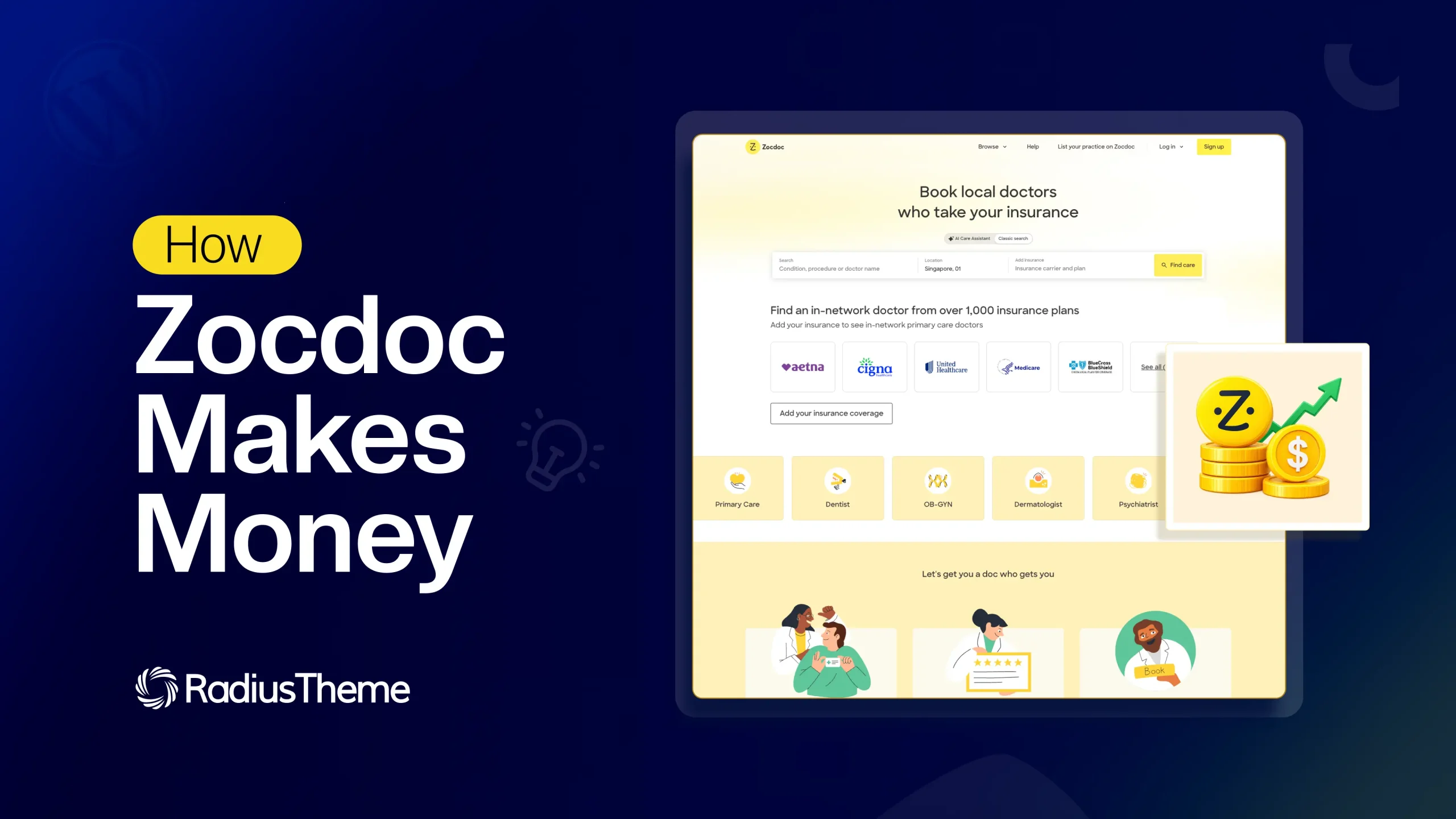
Zocdoc is one of the best-known names in online healthcare. Each month, millions of patients use it to find a nearby doctor, check real-time availability, and book an appointment in seconds. Best of all, patients pay nothing to use it.
That raises an obvious question: if booking is free for patients, how does Zocdoc make money? The short answer is that Zocdoc charges the other side of the marketplace — the doctors and practices — for access to new patients. In this guide, we break down the Zocdoc business model in simple terms, explain each way it earns, and show how you can build a doctor booking marketplace of your own.
Quick answer: how Zocdoc makes money
Zocdoc runs a two-sided marketplace. It is free for patients, and providers pay for the new patients they receive. Its main revenue streams are:
- Pay-per-booking fees — providers pay a fee for each new patient who books through Zocdoc.
- Sponsored Results (ads) — providers pay extra to appear higher in search.
- Practice tools and telehealth — added services and technology for providers.
- Partner distribution — Zocdoc’s booking technology powers other health sites.
Let us look at how the whole model fits together.
What is Zocdoc?
Zocdoc is an online medical appointment marketplace founded in 2007. The idea was simple: if you can book a restaurant table or a flight online, you should be able to book a doctor the same way. Today, patients use Zocdoc to search for doctors, dentists, and specialists by location, specialty, and insurance, read verified reviews, see real-time openings, and book instantly.
For patients, the service is completely free. <cite index=”20-6″>There is no fee to search for a doctor, no fee to book an appointment, and no fee to cancel.</cite> That free experience is the engine that attracts millions of patients — and that patient demand is exactly what Zocdoc sells to providers.
The two-sided marketplace explained
To understand how Zocdoc earns, you first need to understand its shape. Zocdoc is a two-sided marketplace with patients on one side and healthcare providers on the other.
Patients bring demand. Because the platform is free and easy, huge numbers of people use it to find care. Providers bring supply. Doctors and practices list their profiles, specialties, insurance, and open appointment times.
The value Zocdoc sells is access. A new patient can be worth a lot to a practice over time, so providers are willing to pay to be discovered and booked. <cite index=”20-4″>By charging the side that gains commercial value — the providers — Zocdoc can keep the patient experience completely free.</cite> This is the heart of the Zocdoc business model.
How the Zocdoc business model evolved
Zocdoc did not always work this way, and the change is a useful lesson for anyone building a marketplace.
At first, Zocdoc used a simple subscription model. <cite index=”13-1″>Zocdoc’s original subscription model charged doctors a flat annual fee for access to the platform.</cite> Early on, that fee was around $3,000 per year per provider. It was easy to sell and gave predictable revenue.
But a flat fee had a flaw. <cite index=”13-1″>High-demand providers got far more bookings, making the subscription fee a bargain, while low-demand providers found it too expensive and churned.</cite> A busy dermatologist in a big city got great value, while a provider in a quieter area struggled to justify the cost.
So Zocdoc shifted to a performance model. <cite index=”13-1″>In 2018, Zocdoc transitioned to a platform business model — charging providers per new patient booking — and their business took off.</cite> This aligned Zocdoc’s income with the value it delivers: actual booked patients. It also lowered the barrier to entry, since providers no longer paid a large fee upfront.
The main ways Zocdoc makes money
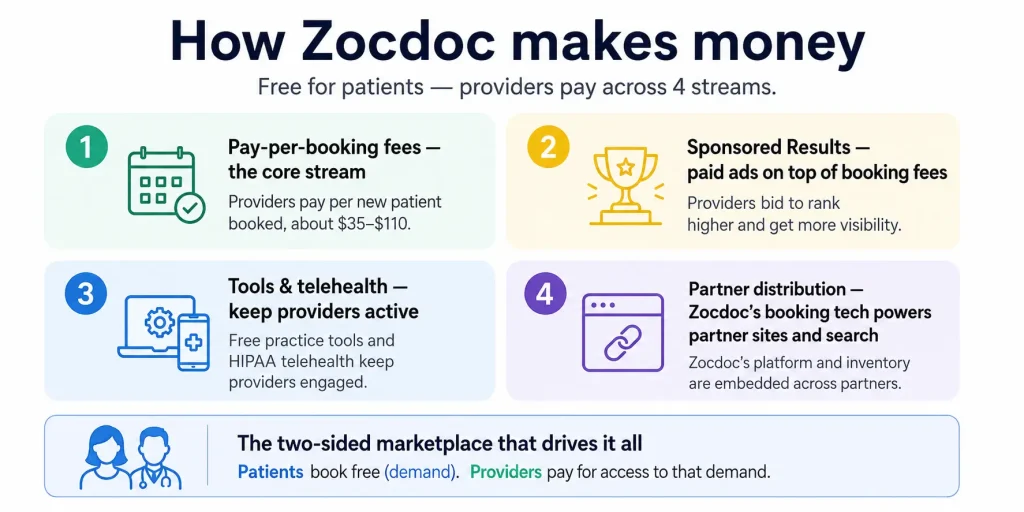
Here is each revenue stream in the current Zocdoc business model, explained simply.
1. Pay-per-booking fees (the core)
This is Zocdoc’s primary source of revenue. Providers pay a fee each time a new patient books an appointment through the marketplace. <cite index=”9-1″>These fees range from $35 to $110 per booking, depending on factors like location and specialty.</cite>
Two details make this model provider-friendly. First, the fee applies to new patients, not existing ones. Second, providers stay in control of spending. <cite index=”18-1″>Set a monthly spend cap to limit how many new-patient Marketplace bookings your practice receives.</cite> They can pause visibility or turn individual providers on and off at any time.
2. Sponsored Results (advertising)
Zocdoc also earns from a performance-based ads tool called Sponsored Results. It works like an auction: a provider sets a bid, and their listing appears higher in search so more patients see and book them. <cite index=”16-1″>The Sponsored Results cost is on top of new patient booking fees.</cite>
Crucially, providers only pay when it works. <cite index=”21-1″>Set your Sponsored Results bid, and only pay when you get bookings — not for clicks or views.</cite> According to Zocdoc, sponsored listings convert far better than average organic results, which is why practices are willing to pay for the visibility.
3. Free practice tools and telehealth
Not everything Zocdoc offers costs money, and that is by design. <cite index=”22-1″>For healthcare providers, there are both free tools (Zocdoc Practice Solutions) that can be used with your entire patient base — as well as a Marketplace where you can choose to list your practice to reach new patients and pay only per new patient bookings.</cite>
The free tools — like a booking button for a provider’s own website, calendar sync, reminders, online forms, and telehealth — keep providers active on the platform. Zocdoc’s HIPAA-compliant telehealth lets patients book virtual visits, and <cite index=”20-1″>Zocdoc does not add a fee for video visits.</cite> These tools deepen the relationship, making providers more likely to also pay for new-patient bookings and ads.
4. Partner distribution
Zocdoc has extended its reach beyond its own site. Its booking technology powers scheduling on other platforms, and providers can be discovered across partner sites and search engines. <cite index=”19-1″>Get discovered and booked on partner sites — Healthgrades, Yelp, AI assistants, and more.</cite> This widens the funnel of patient demand, which in turn increases the bookings that generate Zocdoc’s fees.
Why the model works so well
The Zocdoc business model is powerful because of network effects. More patients attract more providers, and more providers (with more open appointment times) attract more patients. Each side makes the other more valuable.
The pay-per-booking approach also keeps incentives aligned. Zocdoc only earns when a provider gains a new patient, so the company is motivated to keep improving search, matching, and the booking experience. And because patients never pay, there is no friction stopping them from using the platform — which keeps demand high.
Key lessons for building your own doctor booking marketplace
If you want to build a platform like Zocdoc, its model offers clear takeaways:
- Keep it free for patients. Free access removes friction and builds the demand that providers will pay for.
- Charge the side that gains value. Providers pay because new patients are worth far more than the fee.
- Offer more than one revenue stream. Combine booking fees, featured or sponsored placement, memberships, and paid tools.
- Reduce risk for providers. Pay-per-result pricing and spending controls make it easy to say yes.
- Build trust. Verified reviews, real-time availability, and a smooth booking flow are what keep both sides coming back.
The good news is that you do not need Zocdoc’s engineering budget to launch a site with these features.
Build a website like Zocdoc with CL Doctor
You can launch your own doctor booking marketplace without writing code using the CL Doctor theme by RadiusTheme. It is a doctor directory WordPress theme with built-in appointment booking, made specifically for healthcare directories, clinic networks, and physician-finder websites — the exact type of platform this guide describes.
CL Doctor is powered by the Classified Listing Pro plugin, so the marketplace tools are built in. Patients can search for doctors by location, specialty, or insurance, view detailed profiles, read verified reviews, and book appointments directly on your site — the same core experience that makes Zocdoc so useful. With the RadiusBooking integration, visitors book through a smart form or an AI assistant, with 24/7 self-scheduling, per-service pricing, Google Calendar sync, and payment at booking via PayPal or Stripe.
Most importantly for your business, CL Doctor is built to earn. It includes multiple monetization models — such as paid listings, featured placements, and membership subscriptions — plus payment gateways like PayPal, Stripe, Authorize.net, and WooCommerce. That means you can charge doctors to list, offer premium visibility (much like Sponsored Results), and add recurring memberships, all from one dashboard. It also comes with AI tools to generate listings and content, advanced search, Google Maps, and multiple homepage layouts to match your brand.
In short, CL Doctor gives you the patient-friendly booking experience and the provider-paid revenue model that make Zocdoc work — in an affordable, code-free package you fully own. If you want a step-by-step guide, see this video:
Frequently asked questions
How does Zocdoc make money if it is free for patients?
Zocdoc makes money from healthcare providers, not patients. Providers pay a fee for each new patient who books through the marketplace (roughly $35 to $110 depending on specialty and location), and can pay extra for Sponsored Results ads to appear higher in search. Patients pay nothing to search or book.
What is Zocdoc’s main revenue model?
Zocdoc’s core revenue model is pay-per-booking. Since 2018, providers are charged per new patient booking rather than a flat subscription. This aligns Zocdoc’s income with the value it delivers — actual booked appointments — and lowers the upfront cost for providers.
Does Zocdoc charge patients anything?
No. Zocdoc is completely free for patients. There is no charge to search for a doctor, book an appointment, or cancel. Patients only pay their normal cost of care, such as an insurance copay or a self-pay rate, which goes to the provider, not Zocdoc.
How did Zocdoc’s business model change over time?
Zocdoc started with a flat annual subscription (around $3,000 per provider). Because that fee was a bargain for busy providers but too costly for quieter ones, Zocdoc switched to a pay-per-booking model in 2018, which fueled its growth and made the platform accessible to more providers.
Can I build a doctor booking website like Zocdoc?
Yes. Using a doctor directory WordPress theme like CL Doctor, you can launch a marketplace with doctor profiles, specialty search, verified reviews, and appointment booking — plus built-in monetization like paid listings, featured placements, and memberships — without coding.
Final thoughts
The Zocdoc business model is a masterclass in marketplace design: keep the service free for patients to build demand, then charge providers for the new patients they gain. Its shift from flat subscriptions to pay-per-booking, backed by ads, free practice tools, and partner distribution, is what turned it into a healthcare giant.
The same principles are within reach for your own project. With a purpose-built theme like CL Doctor, you can offer patients a smooth, free booking experience while earning from providers through listings, promotions, and memberships — and start building your own doctor booking marketplace today.